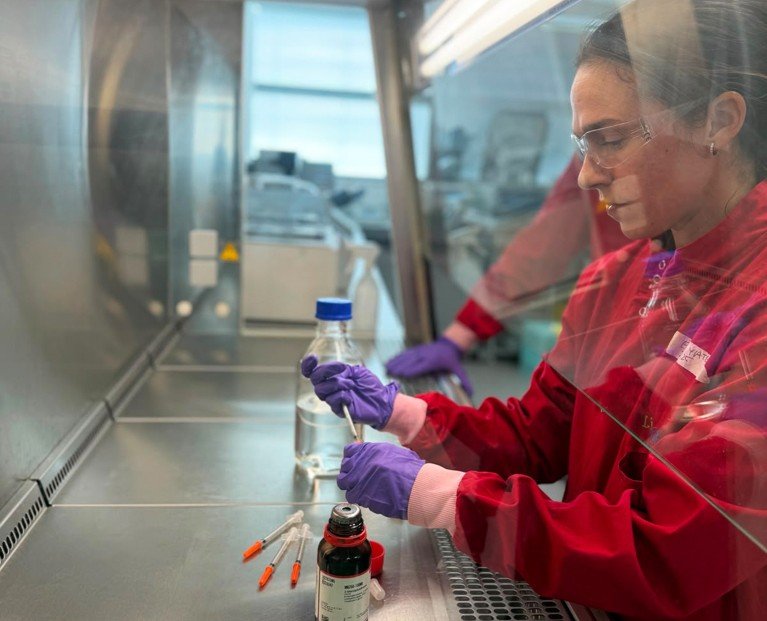
Emma Yates, chief scientific officer at Proteotype Diagnostics, would like to see more funding and support for founders during parental leave. Credit: Wesley Sukdao, Proteotype CEO An estimated 25 million women across the world’s most advanced economies are being denied the opportunity to launch and develop their own businesses, and those who do typically have
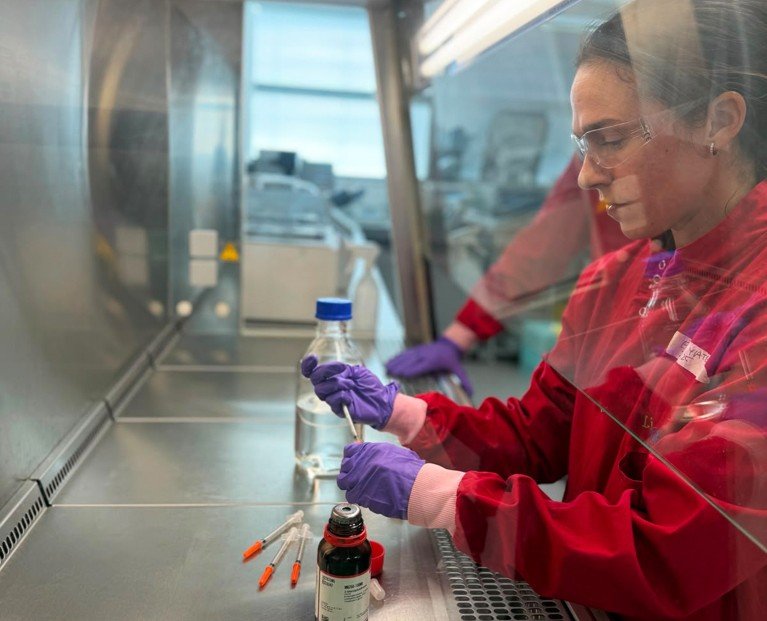
Emma Yates, chief scientific officer at Proteotype Diagnostics, would like to see more funding and support for founders during parental leave. Credit: Wesley Sukdao, Proteotype CEO
An estimated 25 million women across the world’s most advanced economies are being denied the opportunity to launch and develop their own businesses, and those who do typically have more-modest growth ambitions than male founders, finds a report by the Organisation for Economic Co-operation and Development (OECD)1.
According to the Bridging the Finance Gap for Women Entrepreneurs report, published at the end of last year, the gender gap in start-up financing is particularly stark in science, technology, engineering and mathematics (STEM) sectors. The OECD trawled studies from 2013 onwards, with a focus on ones from the past few years, finding that, globally, companies founded by women receive only about 2% of total venture-capital investments.
Female entrepreneurs are about 63% less likely to secure venture-capital funding than are men, and on average get only 70% of the amount that male entrepreneurs receive. This means that they are less likely to seek loans or investment in the first place, the report warns. One estimate in the report speculates that UK gross domestic product could have been 12% larger than it was in 2017 if women had started and scaled up businesses at the same rate as men did.

How I honed my biopharma dealmaking and business-development skills after my PhD
A second report on venture-capital allocation published last year paints a similar picture. It found that of the US$289 billion invested globally in 2024, 2.3% went to female-only founding teams, compared with 83.6% to all-male teams. Mixed-gender teams landed a 14.1% share of the funding pot.
The report, which was published by the London-based entrepreneur-support community the Founders Forum Group, also revealed that during fundraising women are more than twice as likely as male founders to be asked questions focused on risks. They are also interrupted almost five times more frequently than men are during pitch presentations and spend an average of 7.4 months fundraising compared with 5.2 months for their male counterparts.
The findings from these two reports will resonate with many female science entrepreneurs and those who support them. Four women tell Nature about their experiences learning to navigate a funding landscape in an ecosystem that can often seem hostile.
Worst critics
“Most of my investor conversations have been constructive and professional,” says Emma Yates, chief scientific officer at Proteotype Diagnostics in Cambridge, UK. She co-founded the company with her husband, its chief executive and chairperson, in 2019. “There have been isolated moments where I felt assumptions were being made that a male founder might not have faced, and a few investors were also uncomfortable with a husband-and-wife founding team,” Yates adds.
The company’s mission is to create an affordable early-cancer detection method based on the body’s immune response. So far, the firm has raised around $6.89 million in private and grant funding and the test is currently in a clinical trial, the final results of which are due at the end of the year. After that, Yates expects that they will start to seek series A funding — the first substantial round of start-up venture-capital financing — to take the company forwards.
In Yates’s view, female founders are often their own worst critics, which can make them less likely to seek funding for a good idea before they have a huge amount of evidence to back it up. “In science, you are trained to be cautious and to let the evidence speak,” she says. “Fundraising also requires you to communicate the scale of the opportunity before every uncertainty is removed. That was a learning curve for me.”
Ultimately, Yates thinks that “the bigger question now is whether women founders receive the same benefit of the doubt and access to growth capital”.
Careers advice from scientists in industry
Last year she received a £75,000 ( US$101,000) Women and Innovation Award from Innovate UK, the country’s national innovation agency, which Yates used to complete manufacturing validation of Proteotype’s diagnostic kit.
Business-development help came from other programmes. “The most useful support was very specific,” says Yates. It was crucial for “helping us think through clinical-study design, the technical evidence base, investor communication, commercial development and how to build the right plan around the science”.
In 2022, Yates had her first child. “Typically at that point in time, you’re wanting something with lots of job security so you can take a nice one-year maternity leave,” she says of the standard parental-leave practice in the United Kingdom. At the time, Proteotype still depended heavily on the founding team. “I was back on video calls within five weeks,” she says. “For founders, especially in science-based companies, the choice is often not a clean binary between being fully off or fully back at work.”
Yates would like to see innovation grants and founder-support programmes that provide temporary operational cover and childcare during parental leave. “For an early-stage science company, that kind of support could be the difference between maintaining momentum and a founder feeling they have to come back before they are ready,” she says.
Making the jump from a research career to founding her own company has been life changing for Yates. “I’m a different person than I was when I started,” she says. “I know how to lead a team, work with investors and clinical stakeholders, and make decisions under uncertainty. That is what science-based entrepreneurship requires.”
Perfectionism
Henriette Maaß, co-founder and chief executive of NanoStruct in Würzburg, Germany, credits the company’s foundation to a transfer grant from Germany’s Federal Ministry for Economic Affairs and Energy. The company uses gold nanostructures to detect small quantities of contaminants, such as bacteria in the food industry. The grant enabled her to leave a project-management role at a semiconductor firm in 2021 and return to The Julius Maximilians University of Würzburg (where she completed her physics PhD two years earlier). There, she worked with Enno Schatz, a former colleague who would become chief technology officer at NanoStruct, to develop the idea that led to her co-founding the company.
More grants, including a €75,000 ($86,000) award from the European Union’s Women TechEU programme — which supports start-ups founded or co-founded by women who hold a top management position and own at least 25% of company shares — enabled the company to keep going. It now has ten employees and is looking for funding to take its product to market.
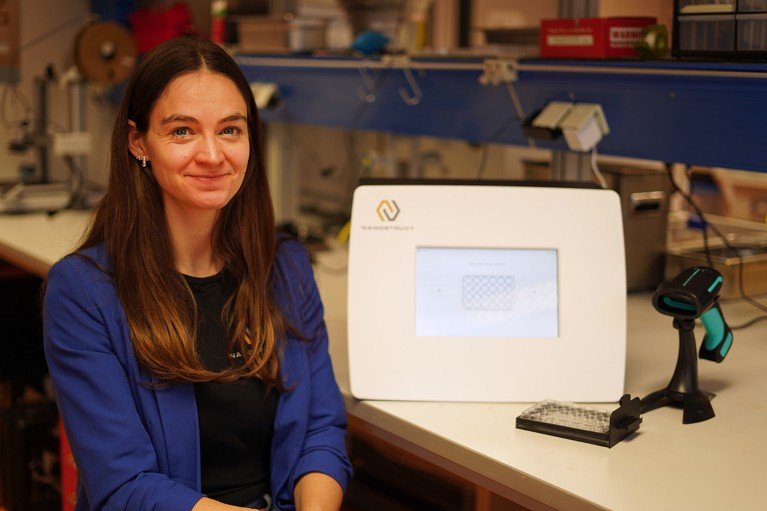
Henriette Maaß, co-founder and chief executive of NanoStruct, used government and European Union funding to launch and sustain her company.Credit: Enno Schatz
Maaß was pregnant when she started seeking early ‘seed’ funding for NanoStruct in 2025, and worried about how both potential funders and colleagues would react. “This was actually something I felt a bit insecure about but I knew I wanted to stay as chief executive of my company,” she says. She began to see the positive side of at least knowing they would attract investors who would be comfortable with a chief executive who is also a new mother.
Now, Maaß often takes her baby to meetings. “There is no one-fits-all advice,” she says. “Find your own way to manage both roles and don’t expect yourself to be perfect.”
Transitions
A key challenge faced by Kitiya Vongkamjan, chief executive at Unique Phage-Based Solutions (UniFAHS), was how to quickly turn herself from an academic into a businesswoman. She co-founded the Bangkok-based biotechnology company — which uses phage technology to target major food-borne pathogens — in 2020 with Chalita Wongpukdee, who is now the company’s chief marketing officer.
“We need to go from researchers to founders, and the ecosystem is so different” between the two sectors, says Vongkamjan. She thinks it takes courage for researchers to make that switch.
Vongkamjan received a Leaders in Innovation Fellowship from the UK Royal Academy of Engineering, which included a two-week entrepreneurship training course. At the end of the course, participants showcased their innovations in front of a panel of judges. Vongkamjan says that this taught her “all the skills for research to commercialization” and provided her with a mentor for the first two years of developing her spin-off. Financial help also came from the “three Fs”, Vongkamjan jokes — friends, family and fools — alongside commercialization support from start-up incubators at the Southern Regional Science Park at the Prince of Songkla University in Hay Yai, Thailand. Vongkamjan held an academic position there from 2012 to 2020. Her current institution, Kasetsart University in Bangkok, has also been supportive.

Meet the biotech-company founders driven by their child’s rare disease
In Asia, venture-capital funding often seems “out of reach” for women, says Vongkamjan, which might explain why her company didn’t progress as quickly as some of the companies that have a male founder, she adds. “People want to know, are you really a business person, or are you really just a research-focused person?”
Vongkamjan says that she has noticed women are also less likely to talk-up their successes. For example, she has been reticent to post about milestones reached by her business but says, “if you go on LinkedIn and you compare female and male founders, you see more posts” from the men. In 2025, a group of women even showed anecdotally, by posting with male aliases, that women’s LinkedIn posts tend to get less traffic than men’s do.
In 2024, UniFAHS completed a funding round of $1.4 million to move into other markets across southeast and South Asia. Funding came partly from ADB Ventures, an investment fund that Vongkamjan says has a reputation for supporting women. The company now employs 20 people but Vongkamjan has chosen to keep her food-microbiology laboratory at Kasetsart University, where she continues research that feeds into the company. She anticipates that will change as the company grows and everything will eventually be conducted in the company’s lab.
Keep following us for the latest insights.