Updated August 24, 2026 — 12:55pm,first published August 20, 2026 — 1:51pm Save You have reached your maximum number of saved items. Remove items from your saved list to add more. AAA Key points OPERA: Verdi’s Il Trovatore dials things up when it comes to absurdity THEATRE: Cleopatra and Antony at fortyfivedownstairs is a smart
Updated ,first published
OPERA
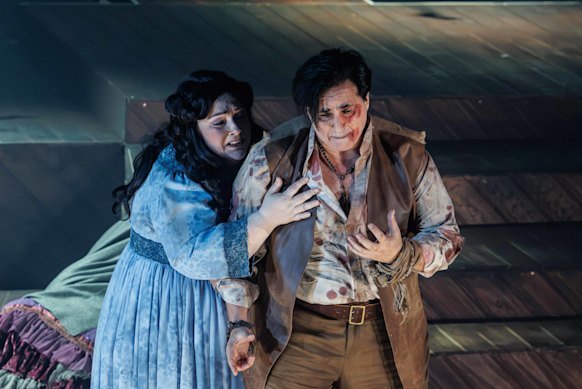
Il Trovatore ★★★★
Melbourne Opera, Athenaeum Theatre, until August 30
Any night at the opera is an exercise in suspending disbelief.
Characters professing undying love having only just met, being duped by the most dubious of disguises, or the classic – mortally wounded but managing to hold on long enough to sing another 30 minutes. None of that holds an operatic candle to Verdi’s Il Trovatore.
Many have bemoaned the infuriating absurdity of the plot – a multitude of offstage convolutions: a gypsy seeking revenge for her mother’s murder accidentally throws her own baby onto a fire instead of the son of her mother’s executioner.
She then raises said baby as her own; then the adult Count Di Luna and Manrico meet, duel and fall in love with the same woman, unaware they are brothers – the audience is required to yield to imagination to have any chance of enjoying the ensuing 2½ hours.
It’s true that only a primitive view would judge an opera on the plot’s (de)merits. But it’s also true that of all Verdi’s operas, Il Trovatore (The Troubadour) is nothing without supremely talented singers. Thankfully, in director Matthew Barclay’s new production, Melbourne Opera has a whole cast full of them.
Tenor Rosario La Spina is, frankly, incredible. The role of Manrico has some punishing exposed solo lines, sections requiring romantic lyricism and intense high notes for good measure. La Spina did it all with barely the hint of a challenge. His spontaneous mid-show standing ovations from some audience members were well-deserved.
Where La Spina had power, soprano Helena Dix (Leonora) gave a masterclass in control, spinning the very softest, most even high notes imaginable. Dix is yet to be tested by any role Melbourne Opera has offered her, her voice as malleable as it is absolute.
Simmering with menace, Melbourne’s resident baritone baddie Christopher Hillier (the Count) turns in another striking performance. As the manic gypsy Azucena, mezzo Sarah Sweeting shows her superlative prowess as a singing actress.
The Melbourne Opera Orchestra and chorus have matured in their professionalism with the rise of conductor Raymond Lawrence.
A mere few years ago, this orchestra could be undone by Wagner brass or horn writing, the chorus slightly slipshod. Not any more. Precision and energy are paramount; Lawrence and the orchestra drive the drama forward, the chorus formidable throughout.
Il Trovatore is an opera lover’s opera. But if you’re willing to park your pragmatism at the door, this Trovatore will impress even the most cynical spectator.
Reviewed by Bridget Davies
THEATRE
Cleopatra and Antony ★★★
Melbourne Shakespeare Company, fortyfivedownstairs, until September 13
In this country, Antony and Cleopatra is the most rarely performed of Shakespeare’s major tragedies. The sheer paucity of its Australian performance history likely fed into Bell Shakespeare’s underwhelming production in 2018, and it’s some sign of the industry and fearless ambition of the Melbourne Shakespeare Company that this indie outfit is taking a crack at the play.
Surprisingly, it does a better job, with less money, than anyone has a right to expect.
Featuring an eleven-strong ensemble and sparing but effective design – ancient busts of Mark Antony and Cleopatra, huge sails that unfurl for the naval disaster at the Battle of Actium – the show pays as much attention to the glamour and passion of the doomed lovers as it does to the high-stakes political drama.
Inverting the name order of the title is a no-brainer. Cleopatra isn’t just a monarch, she’s the avatar of the goddess Isis, and a shrewd operator accustomed to wielding power. Akina Edmonds’ portrayal makes all that plain, and this production frames the action through the eyes of Cleopatra’s women – some of whom follow her to the afterlife – inviting us to consider the Egyptian queen afresh.
It’s a fascinating, effortlessly charismatic performance that emphasises Cleopatra’s playful sexuality – at one point, the queen sizes up the audience, looking for slave-concubines for her nightly entertainment – while refusing to allow it to be read as a girlish regression that impairs her political judgement.
Typically, Cleopatra is interpreted as suffering from the kind of adolescent, identity-destroying love you get in Wuthering Heights. (Cathy cries out: “I am Heathcliff!“, just as Cleopatra declares, “O, my oblivion is a very Antony, and I am all forgotten.“)
Yet Edmonds leaves you in no doubt that Cleopatra makes all the right calls as a ruler, based on the information she has, and that even her suicide – performed amid a private community of women – is an overtly political act of defiance.
The rampant misogyny of Cleopatra’s enemies – who decry her as a whore, and Antony (Louis Lucente) as unmanned by her – is given vehement emphasis. And it is Antony’s judgment that’s personally and politically compromised by his fears and desires. (Lucente handles the verse well, though he’d have greater emotional impact if we saw the charms of his Antony at ease, and he didn’t seem so consistently tormented about everything.)
Damon Baudin invests the scheming oligarch Octavius with an unnerving, almost sociopathic blandness. His official speech to Cleopatra is respectful in form only, sharpening the dehumanising force of his plans for her.
The supporting ensemble’s a mixed bag – among the finer performers are Tsungirai Wachenuka as Charmian, who narrates background events and is the beating heart of Cleopatra’s feminine circle, and Jennifer Vuletic as the imposing Agrippa. Yes, there are a few suboptimal performances, too, but Cleopatra & Antony still breathes new life into the bones of the play, and director Sonya Suares generates an unflagging pace, minimising flaws.
Anyone who hasn’t seen Antony and Cleopatra performed live should consider this a solid introduction; Shakespeare nerds should admire its smart reinterpretation of the text.
Reviewed by Cameron Woodhead
CABARET
Finucane & Smith’s Dance Palace ★★★★
Luna Park, until September 12
Two Melbourne icons join forces for Dance Palace. To see Melbourne burlesque and performance art legend Moira Finucane and friends, you’ll be obliged to step through a second icon – the mouth of Mr Moon at the entrance to Luna Park.
A venue called Luna Palace has just opened inside the heritage amusement park in St Kilda. The large second-storey space has been refurbished to host performances and events, with a well-stocked bar and kitchen, and panoramic views of the park’s historic roller coaster.
The carnival atmosphere is perfect for celebrating 30 years of the House of Finucane & Smith. There’s always been a carnie communitarianism breathing life into this homegrown company, which has been attracting artists who transgress boundaries, or don’t fit neatly into mainstream boxes, since well before diversity became a watchword in the arts.
Normal rules don’t apply to the variety entertainment on offer. Finucane makes the show’s subversive intent clear from the outset in typically formidable style.
While superfans have been known to throw their undies at stage icons, Finucane chucks three decades worth of undies into the audience in a striptease that’s also a monologue about the company’s ethos – plus a cheeky tribute to the merch that helped keep these artists afloat through a funding vacuum.
A multitude of entertainments dazzle and delight over the two-hour gala. Longtime followers of Finucane & Smith will have seen many among this selection of their greatest hits, but there are novel surprises even for veterans.
The erotic art of burlesque comes in every flavour, from the glamour of showgirl fans and sequined pasties (Maple Rose) to the twinkle of Indian boylesque (Govind Pillai), Yumi Umiumare’s demonic Butoh-inspired striptease, and the rhinestone-draped nudity of a country-singing cowgirl (Kate Foster).
Then, there are Finucane’s own fierce and inimitable provocations. Some sign of the artist’s international reach was her trip to Antarctica, and one sequence relates that polar adventure through ecological storytelling, belly-dancing (Raksha Parsnani), and a spot of krill opera.
You read that right. And if you think krill opera is intriguing, cabaret lovers will be astonished by the eclectic range of songs and music in the line-up.
Musical highlights include operatic arias and roof-raising bangers, a moving original song from Yorta Yorta Taungurung elder Glennys Briggs, and a newly composed Chinese pop ballad from Zitao Deng, performed in multilingual harmony. Maude Davey sings Jacques Brel in a clown costume, and Mama Alto interprets Joni Mitchell with transcendent charm.
Dance Palace is a marvellous showcase of the glamour, talent, resilience and sheer variety that Finucane & Smith have brought to the stage over the years, and the kind of inclusive spectacular that should make Melburnians proud.
Reviewed by Cameron Woodhead
DANCE
Now or Never Festival | Time Remaining ★★
Chunky Move, Melbourne Town Hall, until August 20
I admit that I’m baffled by Antony Hamilton’s Time Remaining. What is this mad, gloomy, thoroughly undramatic spectacle supposed to be about? And what exactly are those poor dancers in their dowdy costumes doing?
The program is no help. It tells us that the show “explores the technical integration of scenic lasers within live performance”. Technical integration? Really? Is this an exercise in systems engineering, then? Not choreography but logisticality?
Well, the dance and the laser show might be technically integrated, but they’re not integrated in any more meaningful sense. Time Remaining is like two separate performances accidentally occupying the same venue – though neither manages to fill the space.
The production is vacuous in the precise sense that it lacks content. In the vast cavern of the Town Hall, everything feels far away and ineffectual, especially when viewed from the balcony seats: a handful of dark figures scurrying through the lights or just waiting about.
There are four laser units mounted on racks suspended from the ceiling. Thin purple beams traverse the hall, slowly and repetitively, producing eerie blue shimmers on its walls. The arrangement is stark and simple and might have made an interesting gallery installation.
The precision of the lasers contrasts strongly with purposelessness of the dancers. Costumed in a Gothic gallimaufry of theatrical hand-me-downs, they writhe in slow motion on the raised stage or caper through the hall like shrieking children.
There is some dance, but it’s so wilfully impoverished that one is forced to wonder whether this production is actually a rejection of live performance – especially the work of choreographing human bodies.
Whatever fascination this performance has belongs to the lasers: the orderliness and constancy of the beams, their innate intensity, their capacity to cut through darkness and the precision with which they can be choreographed.
Beside them, the dancers seem almost superfluous: messy, obsolete and absurdly old-fashioned. What are they doing down there? They’re disappearing.
Reviewed by Andrew Fuhrmann
MUSIC
Stravinsky, Mills and Shostakovich ★★★★★
Australian World Orchestra, Hamer Hall, August 19
Now celebrating its 15th anniversary, the annual ritual of bringing together Australia’s finest orchestral musicians under the banner of the Australian World Orchestra has rightly become an eagerly anticipated fixture in the nation’s musical calendar.
Expert musical storytelling characterised this year’s program, one in which a curious set of Australian fables was bookended by two Russian classics.
Really a concerto for orchestra, Stravinsky’s ballet Petrushka (presented in the revised 1947 version) allowed many of the AWO’s talented players to bask briefly in the limelight as the story of the puppet Petrushka’s being brought to life unfolded.
Conductor Alexander Briger imparted an appropriately light touch to Stravinsky’s droll, whimsical mixture of vigorous folk music and mock tragedy, eliciting laser-like rhythmic accuracy from his forces.
Commissioned by the AWO for this tour, Jonathan Mills’ Songs for the Stranger draws on and adds to material from his opera Eucalyptus, based on Murray Bail’s novel and cast in poetic form by Meredith Oakes.
Tenor Michael Petruccelli, who starred in the opera, brought punctilious diction and highly committed musical communication to this set of five quirky tales, scored predominantly by Mills in a muted, shadowy world of low strings, often haloed by reverberant percussion.
Crackling with collaborative electricity, Shostakovich’s Symphony No.10 became a powerhouse of musical dynamism from the vast expanses of the opening to the jet-propelled Allegro, and thence to the impassioned delirium of the third movement in which the composer arguably confesses his infatuation with a student. In a work possibly driven by the then-recent death of Stalin, the finale was equally unabashed, although punctuated with some superlative wind solos.
Despite last-minute personnel changes, the AWO, both individually and collectively, brought world-class musicianship to a generous and demanding program. It is surely a musical outfit of which we can all be proud.
Reviewed by Tony Way
The Booklist is a weekly newsletter for book lovers from Jason Steger. Get it delivered every Friday.
CORRECTION
An earlier review incorrectly referred to the Australian World Orchestra marking its 50th anniversary. It’s been corrected to say 15th anniversary.
From our partners
Check back often for more exciting news!