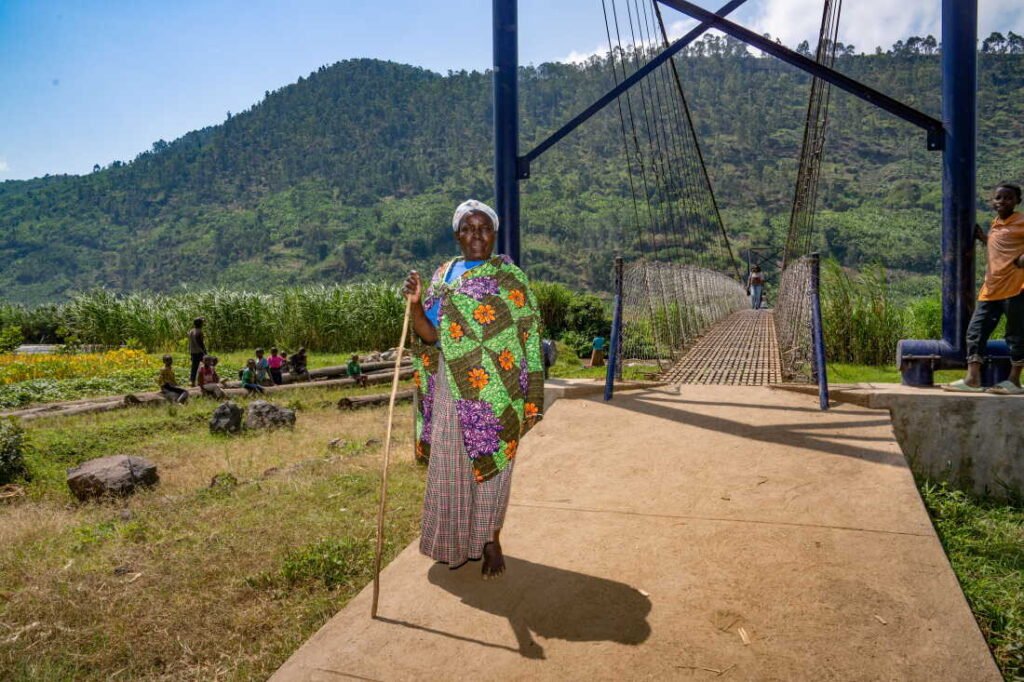
Naomi Nibishaka crosses the newly constructed pedestrian bridge over a river. She’s on her way to see her son and grandchildren, who live in a settlement on the other side. Claire Harbage/NPR hide caption toggle caption Claire Harbage/NPR MUKUNGA RIVER VALLEY, Rwanda — For Naomi Nibishaka, there’s life before the bridge, and life after the
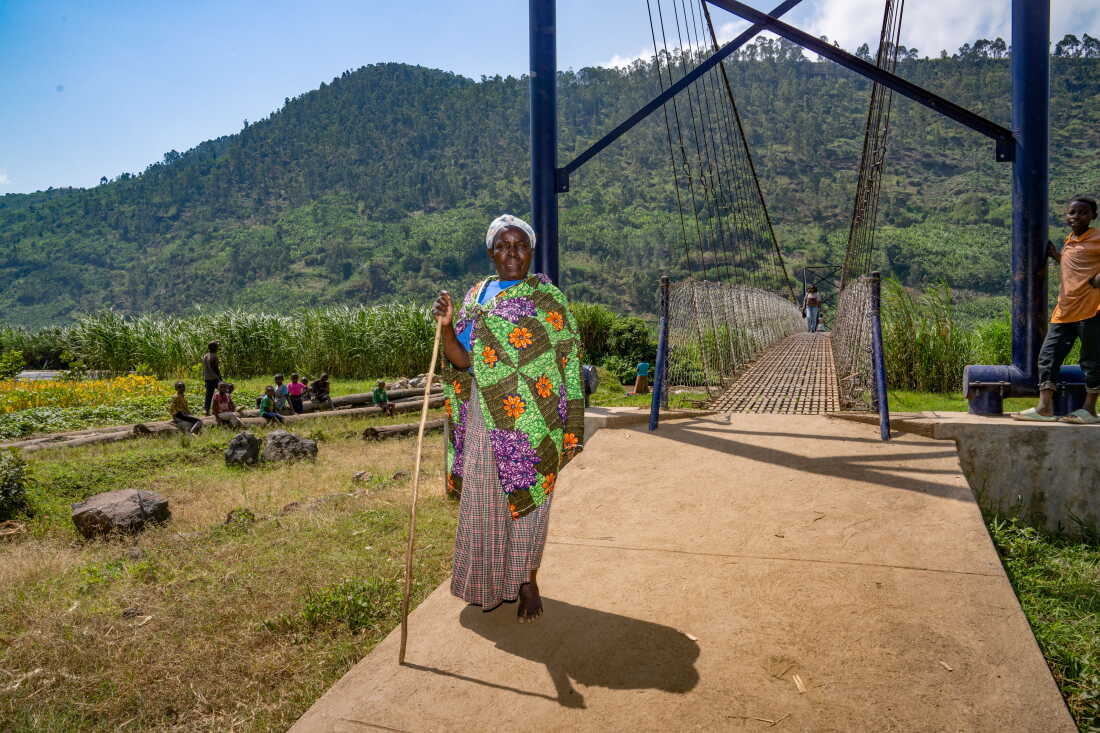
Naomi Nibishaka crosses the newly constructed pedestrian bridge over a river. She’s on her way to see her son and grandchildren, who live in a settlement on the other side.
Claire Harbage/NPR
hide caption
toggle caption
Claire Harbage/NPR
MUKUNGA RIVER VALLEY, Rwanda — For Naomi Nibishaka, there’s life before the bridge, and life after the bridge.
On a sunny summer day, the 76-year-old crosses the rushing waters of the Mukungwa river on a pedestrian suspension bridge.
Made of concrete and cable, it’s only 230 feet long — roughly the length of a city block. But it’s a game changer.
The bridge connects two settlements in a valley in northwest Rwanda that are separated by the river. People cross for all sorts of reasons. Certain services are only available on one side –- a health clinic, a school, a market. Farmers may cross to seek supplies or sell their harvest. Nibishaka is on her way to see her son and grandchildren, who live across the river from her settlement.
Before the bridge was built, there were crossing options — none of them great. You could hire a boat but it was expensive. Local authorities would rope together timber logs for a makeshift bridge, but in the rainy season, the logs would grow slippery and floods would wash them away.
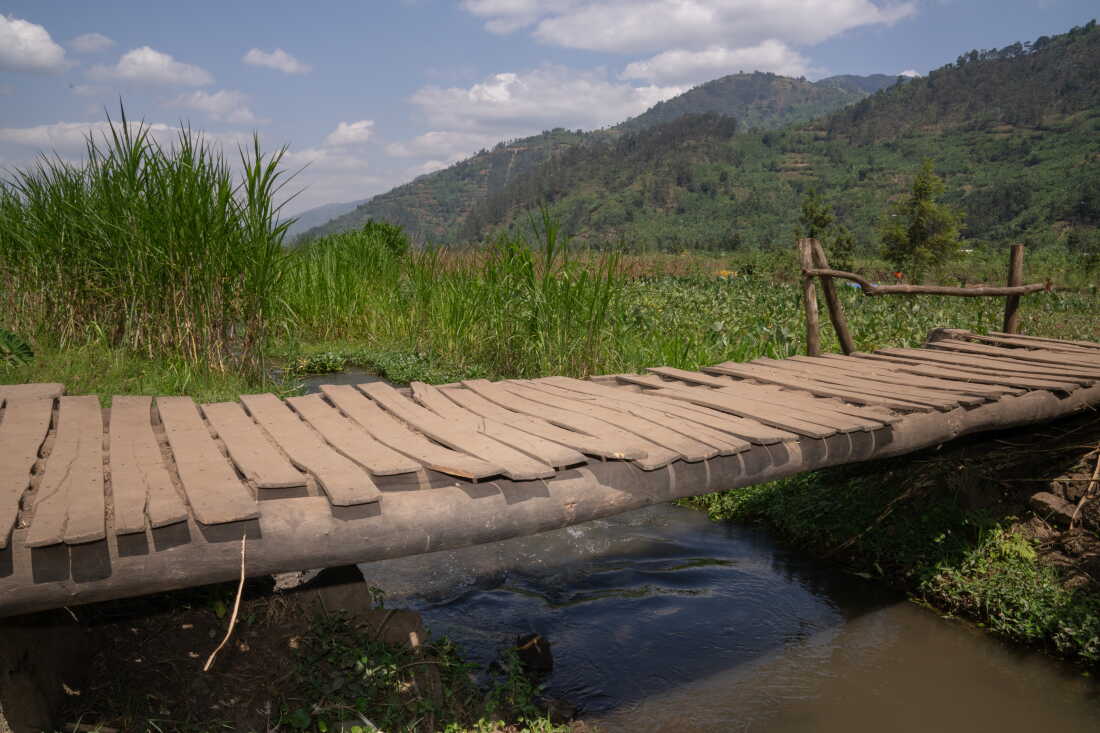
In the past, communities separated by a river would build a makeshift bridge of logs. But spring rains would make them slippery and sometimes wash them away.
Claire Harbage/NPR
hide caption
toggle caption
Claire Harbage/NPR
The other alternative was hiking to a narrower crossing — but that took 3 hours each way.
“When someone [who attempted the crossing] went missing, we would look for them, but if it was a rainy day, we would ask the other side if that person slept over,”
Nibishaka says. “And if they can’t find them, we would look for the body.”
Many people in the community drowned, Nibishaka says. Fearful parents pulled their children out of school if a river crossing was part of their commute. Farmers unable to cross saw their business suffer.
Then in 2025, this footbridge — called Cyangoga — was built. It’s one of 96 built in Rwanda since 2020 by the bridge-building nonprofit Fika. The name for this Kigali-based charity means “to arrive” in Swahili. Funding for the program came from the Rwandan government and donors like the U.S. Agency for International Development, before it was dismantled by the Trump administration.
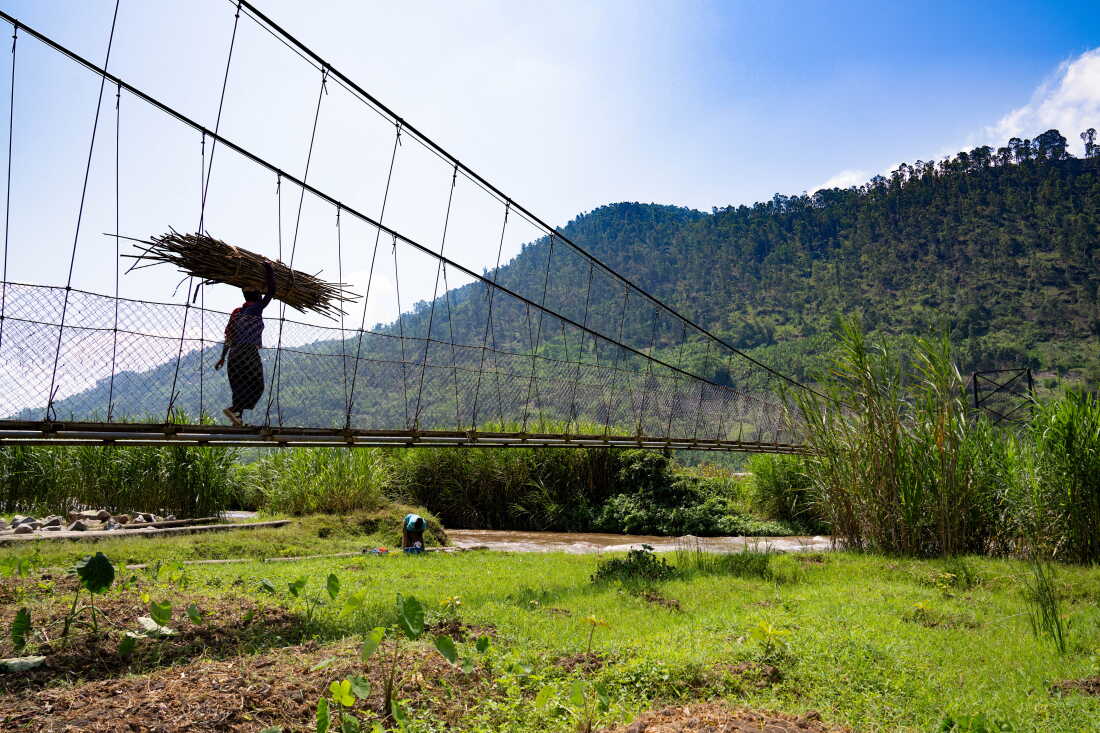
In remote parts of Rwanda, settlements on either side of a river might share services — a clinic and school on one side only, for example. A newly constructed bridge makes it easier to get to these vital services — and also allows farmers and other businesspeople to bring their goods from one community to another to sell.
Claire Harbage/NPR
hide caption
toggle caption
Claire Harbage/NPR
Until now, researchers had not studied the impact of the bridges Fika built. The Rwanda project offered an opportunity to assess what this simple piece of infrastructure might be able to accomplish.
Evan Thomas, professor of environmental engineering at the University of Colorado Boulder, is one of the researchers. “We collected tens of thousands of surveys from hundreds of villages and thousands of households to try to figure out: What changes when you get a bridge?”
Results are in
Their results, released in July, attest to a remarkable series of improvements.
“We found an increase in household consumption, an increase in household income, an increase in the amount of land people are cultivating, an increase in use of fertilizers, even an increase in the number of children going to school,” Thomas says.
For Nibishaka, the bridge has brought her freedom to move around — and a full stomach.
“Before, I would have to wait for my grandkids to bring me food every day. Some days I would be very hungry” she says. Now, the children can easily get food to her, and she can cross the river herself to visit them.
A tough terrain
Rwanda, known as the land of a thousand hills, is particularly challenging for infrastructure projects.
“The whole country is very mountainous, very steep and very wet,” says Devin Connell, Fika’s vice president of programs. “So to build infrastructure, or provide electrification across the country, it’s just a logistical and physically difficult task to do.”
The group mainly builds two types of bridges.
“This one is a suspension bridge, which is the type of bridge we build in valleys,” says Connell. “It has steel towers and a dead man anchor buried in the ground. And brings the walkway up above the floodplain.”
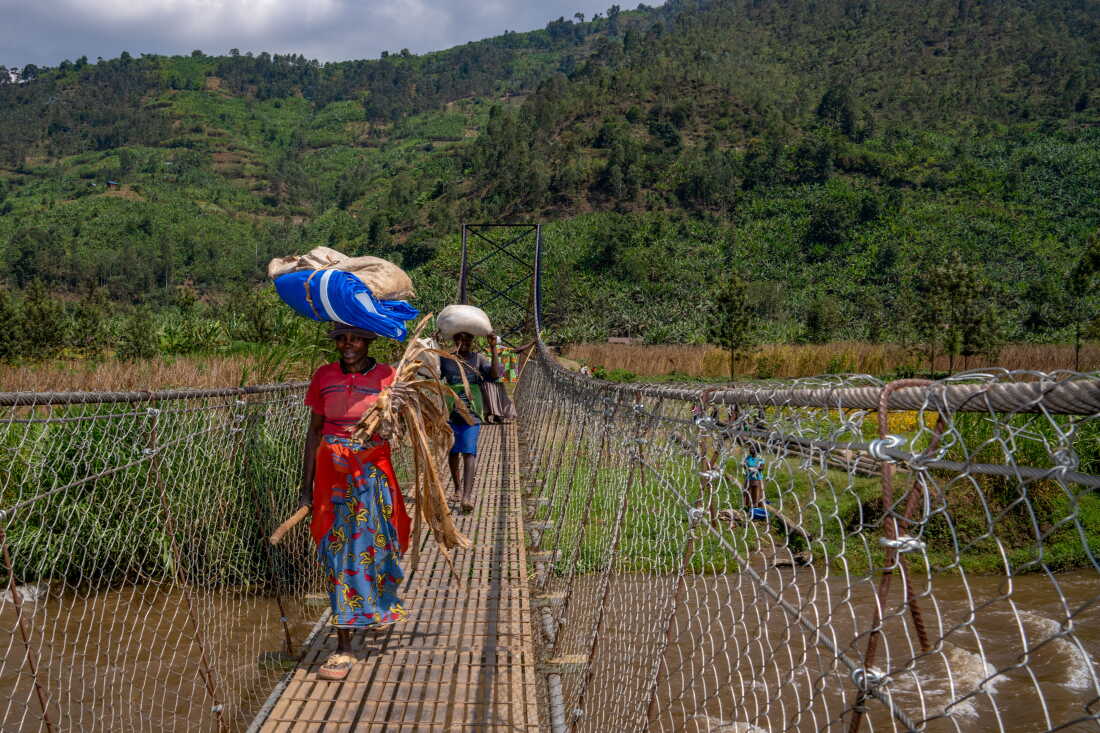
The Cyangoga Suspension Bridge, built by the nonprofit group Fika in rural Rwanda, connects communities that were divided by a rushing river and relied on a ferries or sometimes risky log bridges.
Claire Harbage/NPR
hide caption
toggle caption
Claire Harbage/NPR
The other kind of bridge is built for steep gorges, with hills on both sides.
“That’s where we build a suspended bridge and the cables sag down below, kind of classically like an Indiana Jones-style bridge,” he says.
Because of the challenging terrain, the bridges are designed to be constructed without heavy machinery.
On average, each bridge costs about $100,000. Thomas says it’s a cost-effective figure, especially considering the price of building in Rwanda’s terrain.
The results of the study offer up many instances of the power of the bridges.
In the Mugunkwa river valley, farmers who make banana wine more than tripled their output. And since services such as a health clinic, school and post office are only on one side of the bridge, communities on the other side have easier access. The health clinic saw a 40% increase in the number of people coming in.
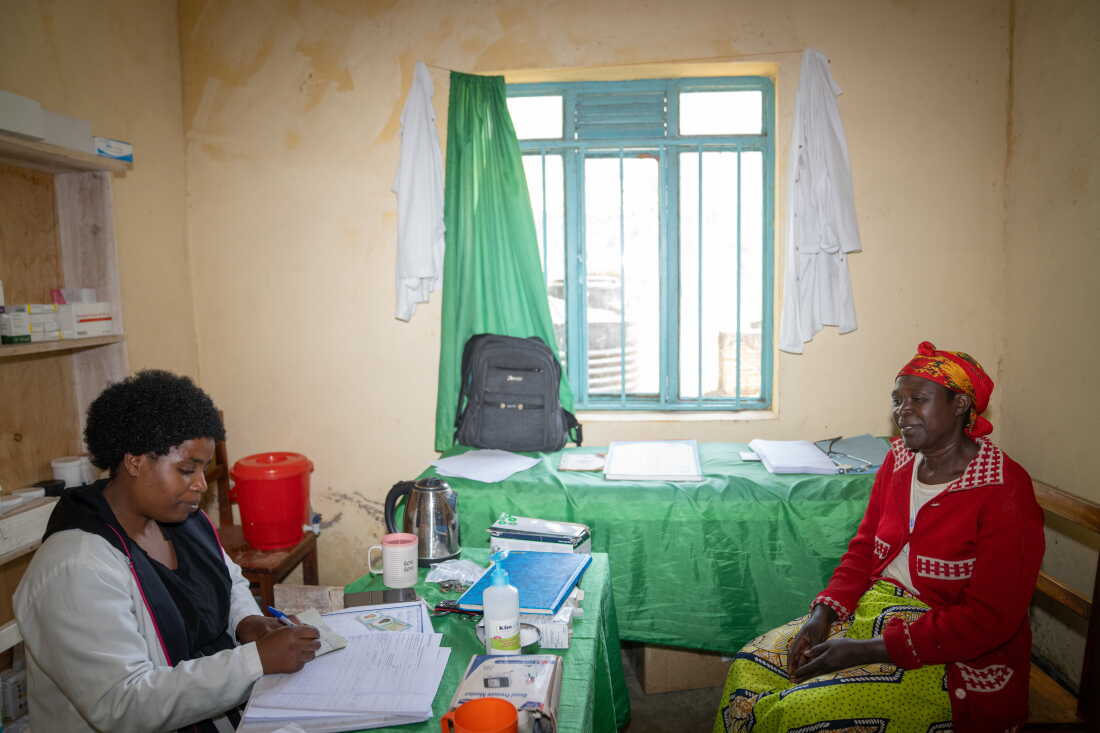
Nurse Diane Kwizera meets with Consolée Uwamaliya at a health facility near the Cyangoga Suspension Bridge, which spans a river that separates two communities. The bridge makes it easier for residents of the settlement on the other side of the river to come in for healthcare.
Claire Harbage/NPR
hide caption
toggle caption
Claire Harbage/NPR
The rate of return on investment was 120%, meaning the bridge paid for itself and more in the year since it was built.
The impact on schools is especially striking, says Marie Gorette Mutuyimana, a primary school teacher of 28 years who crosses the river twice every weekday to get to and from work.
For years, Mutuyimana had worked with parents in the valley, encouraging them to send their children to school, but deep down she knew it was the river that kept drop-out levels high.
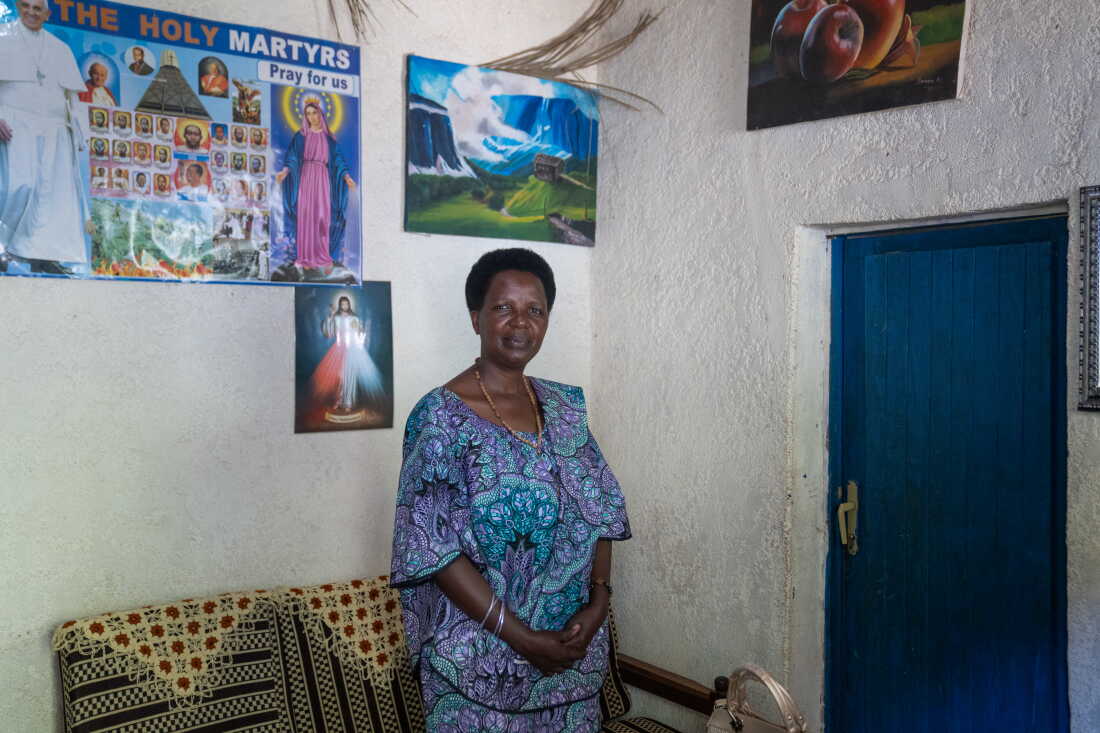
Marie Gorette Mutuyimana, 53, is a teacher at Gakoro school in Nyamutera, Rwanda. She has to cross the river to get to and from work and used to worry about how her students could get home safely during heavy rains. A new bridge has erased her worries.
Claire Harbage/NPR
hide caption
toggle caption
Claire Harbage/NPR
“Sometimes I invested my own money in renting bicycles for those students for a faster commute, and the parents were relying on me to ensure their safety,” Mutuyimana says.
“If it started raining while we were at school. I wouldn’t be able to concentrate on teaching, I would just worry about how we were all going to get home,” she says. The responsibility weighed heavily on her.
Now she says things are different: More than 134 students re-enrolled in the school. She says they’re excited to be back with their friends. And she can focus on teaching.
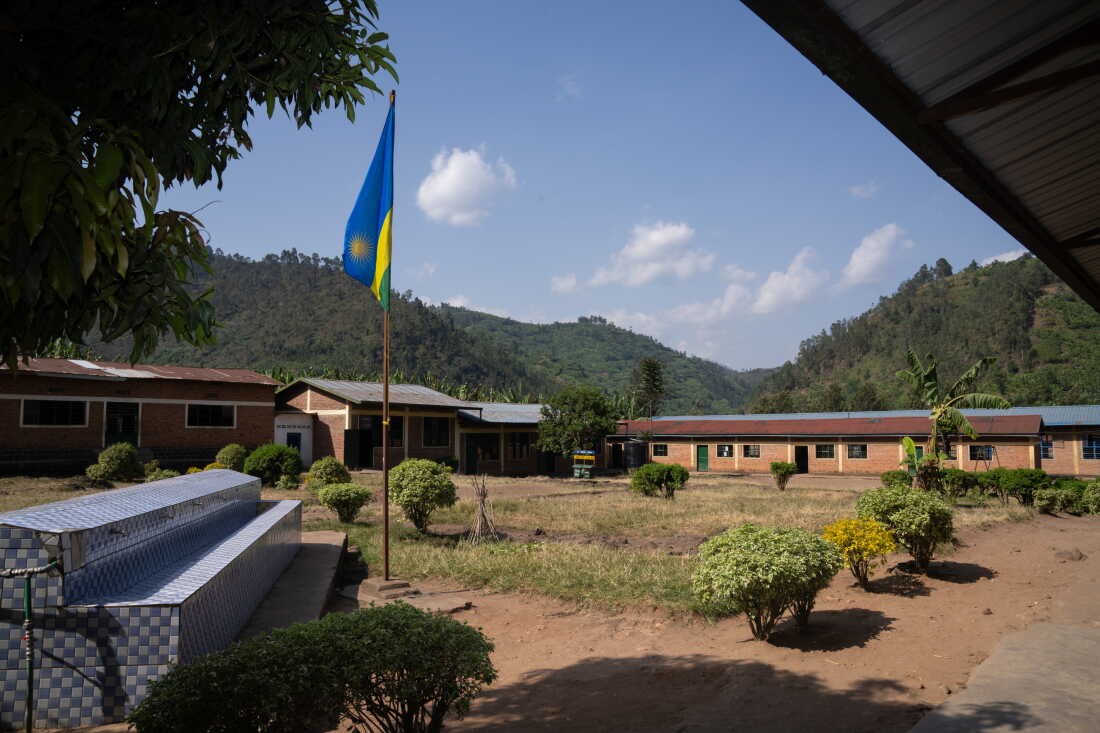
Gakoro School in Nyamutera. Teacher Marie Gorette Mutuyimana says that the new bridge has brought an increase in over 100 students from the community on the other side of the river.
Claire Harbage/NPR
hide caption
toggle caption
Claire Harbage/NPR
Lessons learned
The research shows how transformative infrastructure investments can be, according to Edward Miguel, a development economist at the University of California, Berkeley, who was not part of the research team.
“Solving that one fundamental transportation problem changes lots of economic decisions, farming decisions, and the payoff can be really big in the long run,” Miguel says.
It’s especially relevant, he says, in light of the funding shortages that have rocked the world of development assistance after the Trump administration’s overhaul of U.S. foreign aid. USAID used to be a big supporter of programs like this all over the world, Miguel says. Now, many lower income countries are struggling to fill the gap. A study like this can show them what’s worth investing in, according to Miguel.
“If I were in the government of Rwanda, looking at how important these investments are, in next year’s budget, I would start thinking about maybe allocating more money to transportation investments,” Miguel says.
What else is needed
Yet a bridge can’t solve all challenges that face remote communities.
Asked what they need for a better life, villagers told NPR they urgently needed roads, electricity and clean water. Miguel says the problems facing rural populations can be daunting.
“And sometimes people look at it and throw up their hands and go ‘oh my god, we solved the bridge, but now we need the road … we need electricity,” says Miguel. “But every time you make one of those investments, you improve people’s lives.”
For schoolteacher Marie Mutuyimana, the bridge was the start.
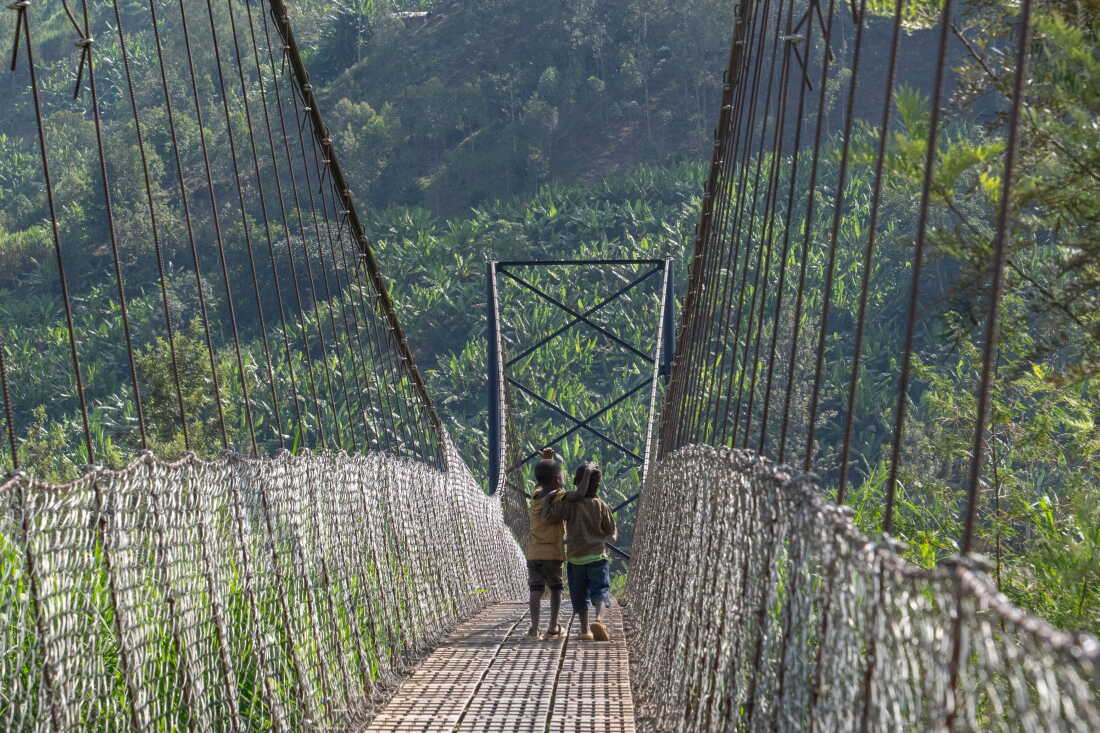
Two youngsters cross the Cyangoga Suspension Bridge.
Claire Harbage/NPR
hide caption
toggle caption
Claire Harbage/NPR
“Primarily, we needed to ensure the safety of ourselves and our children, and the ability to access services,” she says. “Now that we have that peace of mind, we can ask for the other things we need to improve our lives.”
{For more tech updates, stay tuned to our blog.|Keep following us for the latest insights.|Check back often for more exciting news!}