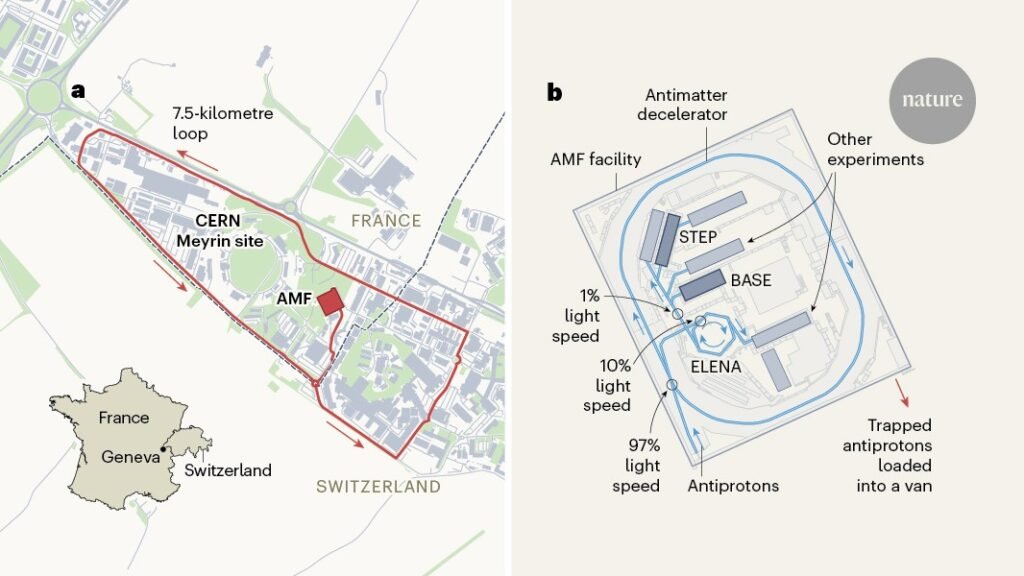
Scientists spend a lot of time ordering things: laboratory equipment, samples and consumables. What if a researcher’s to-do list included ordering an antimatter delivery? In March, the BASE Collaboration brought that reality one step closer. Writing in Nature, Leonhardt et al. sealed 92 antiprotons in a specialized ultrahigh-vacuum trap, loaded them into a truck and
Scientists spend a lot of time ordering things: laboratory equipment, samples and consumables. What if a researcher’s to-do list included ordering an antimatter delivery? In March, the BASE Collaboration brought that reality one step closer. Writing in Nature, Leonhardt et al. sealed 92 antiprotons in a specialized ultrahigh-vacuum trap, loaded them into a truck and drove them out of the Antimatter Factory (AMF) at CERN, Europe’s particle-physics laboratory near Geneva, Switzerland1. The antiprotons did not go very far, just on a 7.5-kilometre joyride through the lab grounds. But if antimatter can survive a few kilometres on the campus roads, it could, in principle, be delivered to research facilities much farther afield.
Competing Interests
The authors are colleagues of the BASE collaboration as a fellow scientists working at the CERN AD/ELENA facility, and thus interact with them regarding facility resources and long-term facility strategy.
For more tech updates, stay tuned to our blog.