Hello Nature readers, would you like to get this Briefing in your inbox free every day? Sign up here. Previous attempts to read charred scrolls have used X-ray CT alone, which assesses carbon-based materials. The technique can’t clearly identify writing because both the ink and papyrus contain carbon. (Jacob LaManna/NIST) Researchers have made their own
Hello Nature readers, would you like to get this Briefing in your inbox free every day? Sign up here.
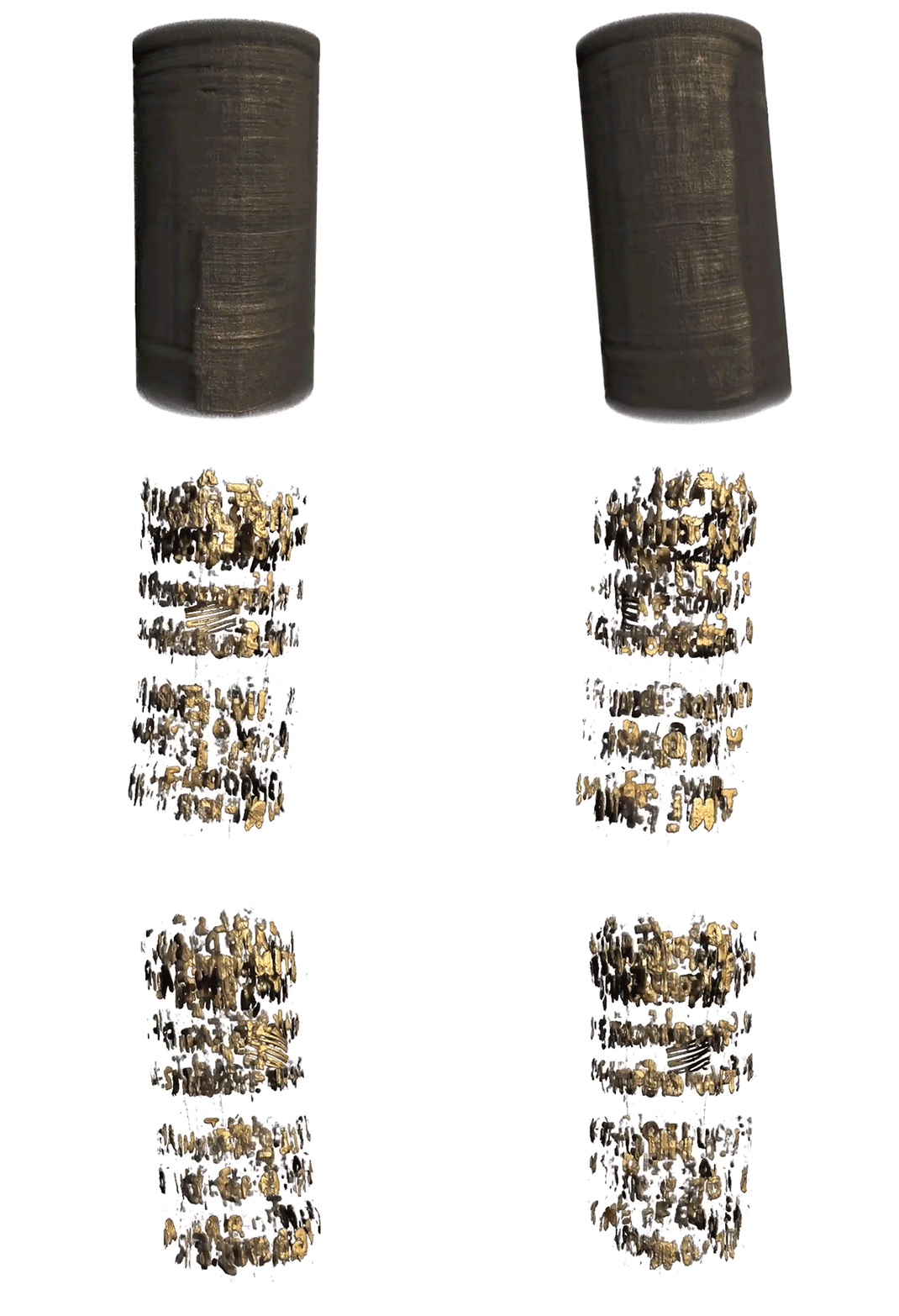
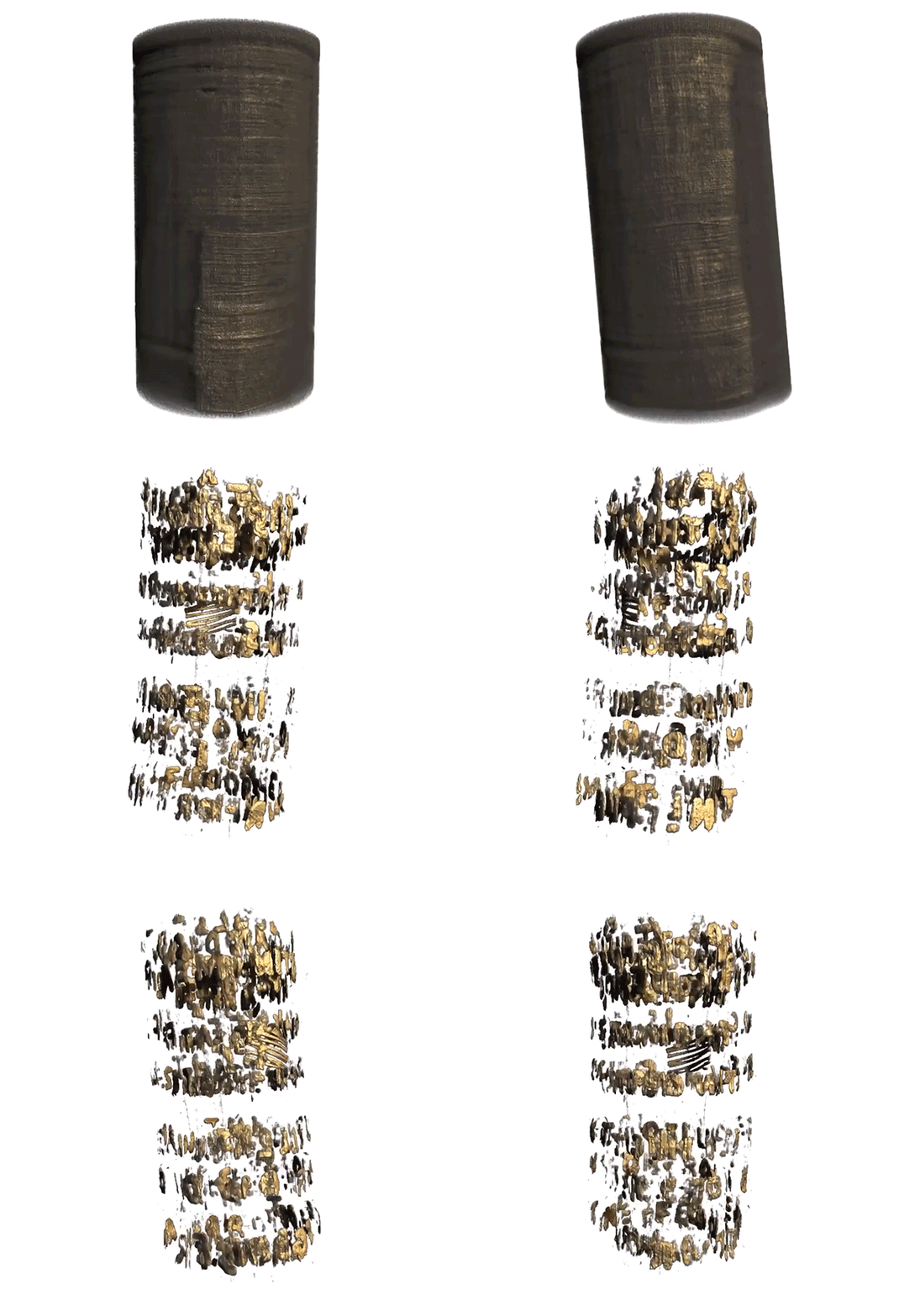
Previous attempts to read charred scrolls have used X-ray CT alone, which assesses carbon-based materials. The technique can’t clearly identify writing because both the ink and papyrus contain carbon. (Jacob LaManna/NIST)
Researchers have made their own burned, rolled-up papyri and showed that they can decipher the text by detecting the element lead in the ink. Using X-ray computed tomography (CT) and X-ray fluorescence to spot lead, the team was able to virtually unroll the scrolls and clearly read the text within. “The letters lit up like a Christmas tree,” says retired inventor and study co-author Douglas Seiler. This technique could help researchers read thousands of ancient scrolls recovered from the Roman town of Herculaneum, which were charred by the eruption of Vesuvius — if they contain ink.
Nature | 5 min read
Reference: PLoS ONE paper
Early next year, scientific-instrument maker Bruker will ship the first-ever scanning transmission electron microscope (STEM) that stably operates near absolute zero using liquid helium. The device — dubbed GAIA, for Generational Advance in Instrumentation for Analysis — can image materials at temperatures as low as about −266 °C (7 kelvin) for 30 hours or more. The advancement will open avenues for exploring never-before-seen properties of materials, and might also help to revolutionize quantum computing, researchers say.
Nature | 7 min read
Astronomers have detected radio waves emitted directly by Beta Pictoris b — the first time such signals have been observed from a planet outside our Solar System. Researchers managed to separate the planet’s emissions from those of its host star by choosing a candidate that is big, relatively close to Earth and nicely separated from its magnetically quiet star. The signal comes from auroral radio emissions, similar to those from the Northern and Southern Lights on Earth.
BBC Sky at Night Magazine | 5 min read
Reference: arxiv preprint (not peer reviewed)
Infographic of the week
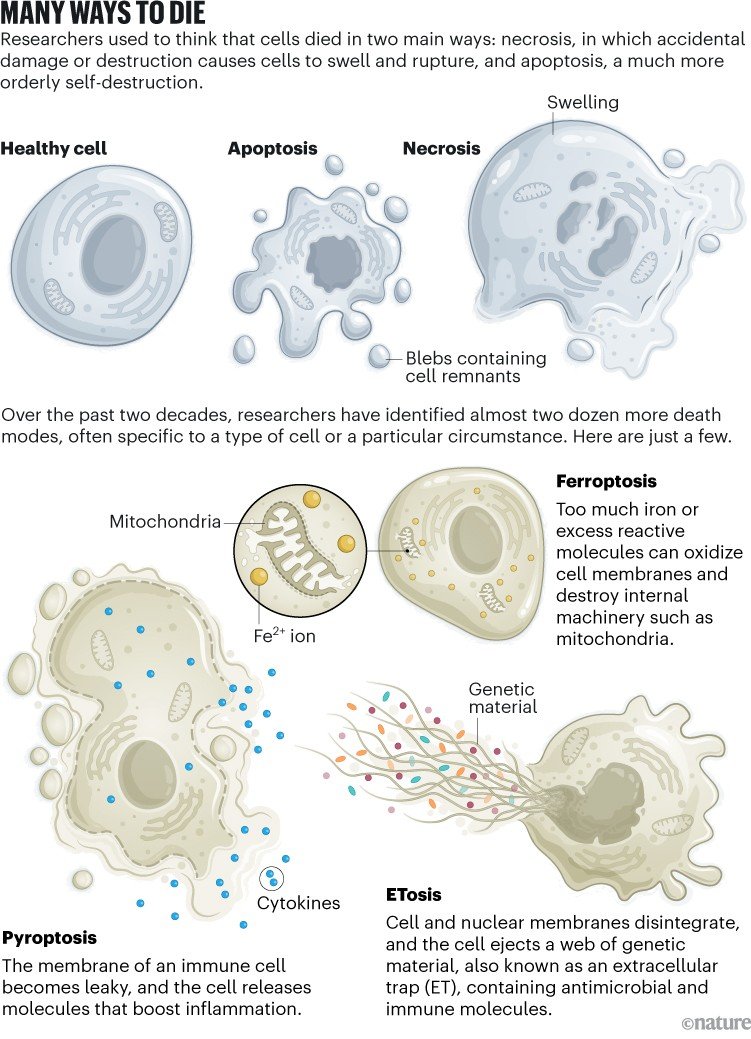
A feature this week explores a slew of previously unknown ways that cells can die, many uncovered only in the past year or two. Scientists are linking these newfound death pathways to diseases and eagerly investigating medical applications, such as killing cancer cells, calming inflammatory disease and even rescuing dying cells in the heart and brain. But studying cell death can be tricky. “If you have a successful cell-death experiment, your material disappears,” jokes cell biologist Scott Dixon. (Nature | 11 min read)
Features & opinion
There is growing concern that using AI can blunt memory and reasoning. The evidence so far is limited, but in general, friction is your friend: learning requires effortful cognitive processing, experts say. Thankfully, researchers are developing strategies to keep our brains nice and wrinkly. One technique, metacognition — the ability to think about, plan and monitor your own learning — can add an average eight extra months of student progress in school over a year, compared with students who are not taught it.
Nature | 11 min read
Suicide is a leading cause of death in the United States, and more than half of those deaths involve a gun. That’s why public-health experts and suicide-prevention advocates are arguing for firearms regulation, as part of an evidence-based strategy to limit access to lethal means for completing suicide. “That’s the one that will save the most lives,” says psychiatrist Paul Nestadt. For example, laws requiring that guns are locked up in homes where children live have been shown to reduce youth suicides. And requiring a permit to buy a gun was associated with at least a 15% decrease in gun suicide rates in Connecticut and Missouri.
KFF Health News | 12 min read
Reference: Annual Review of Public Health paper (from 2025) & Preventive Medicine paper (from 2015)
It’s Fat Bear Week! The annual face-off between the big, beautiful brown bears of Katmai National Park in Alaska is on now. These burly beasts’ glorious girth will help them survive their winter hibernation. Vote for your favourite chunky cubby here. I also highly recommend spending some time relaxing with the bears on the Brooks Falls live webcam.
Let me know about your favourite healthy, spherical animal — plus any feedback on this newsletter — to briefing@nature.com.
Thanks for reading,
Flora Graham, chief editor, Nature Briefing
With contributions by Jacob Smith
• Nature Briefing: Careers — insights, advice and award-winning journalism to help you optimize your working life
• Nature Briefing: Microbiology — the most abundant living entities on our planet — microorganisms — and the role they play in health, the environment and food systems
• Nature Briefing: Anthropocene — climate change, biodiversity, sustainability and geoengineering
• Nature Briefing: AI & Robotics — 100% written by humans, of course
• Nature Briefing: Cancer — a weekly newsletter written with cancer researchers in mind
• Nature Briefing: Translational Research — covers biotechnology, drug discovery and pharma
Keep following us for the latest insights.