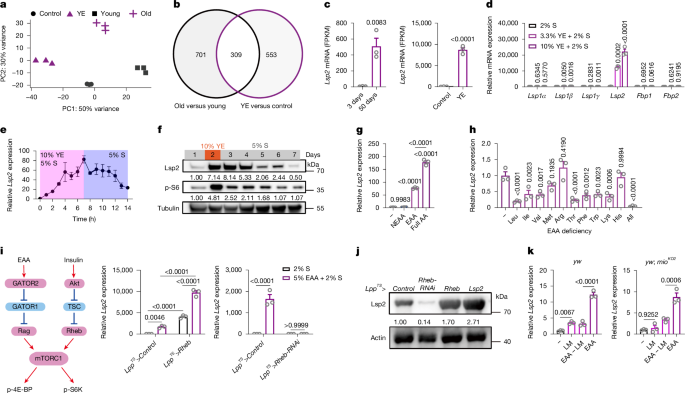
Liu, G. Y. & Sabatini, D. M. mTOR at the nexus of nutrition, growth, ageing and disease. Nat. Rev. Mol. Cell Biol. 21, 183–203 https://doi.org/10.1038/s41580-019-0199-y (2020). Article PubMed PubMed Central CAS Google Scholar Meyuhas, O. & Kahan, T. The race to decipher the top secrets of TOP mRNAs. Biochim. Biophys. Acta 1849, 801–811 https://doi.org/10.1016/j.bbagrm.2014.08.015 (2015).
Liu, G. Y. & Sabatini, D. M. mTOR at the nexus of nutrition, growth, ageing and disease. Nat. Rev. Mol. Cell Biol. 21, 183–203 https://doi.org/10.1038/s41580-019-0199-y (2020).
Google Scholar
Meyuhas, O. & Kahan, T. The race to decipher the top secrets of TOP mRNAs. Biochim. Biophys. Acta 1849, 801–811 https://doi.org/10.1016/j.bbagrm.2014.08.015 (2015).
Google Scholar
Thoreen, C. C. et al. A unifying model for mTORC1-mediated regulation of mRNA translation. Nature 485, 109–113 https://doi.org/10.1038/nature11083 (2012).
Google Scholar
Valzania, L., Alami, A. & Leopold, P. A temporal allocation of amino acid resources ensures fitness and body allometry in Drosophila. Dev. Cell 59, 2277–2286 https://doi.org/10.1016/j.devcel.2024.05.018 (2024).
Google Scholar
Fontana, L. & Partridge, L. Promoting health and longevity through diet: from model organisms to humans. Cell 161, 106–118 https://doi.org/10.1016/j.cell.2015.02.020 (2015).
Google Scholar
Obata, F. & Miura, M. Regulatory mechanisms of aging through the nutritional and metabolic control of amino acid signaling in model organisms. Annu. Rev. Genet. 58, 19–41 https://doi.org/10.1146/annurev-genet-111523-102042 (2024).
Google Scholar
Valvezan, A. J. & Manning, B. D. Molecular logic of mTORC1 signalling as a metabolic rheostat. Nat. Metab. 1, 321–333 https://doi.org/10.1038/s42255-019-0038-7 (2019).
Google Scholar
MacInnes, A. W. The role of the ribosome in the regulation of longevity and lifespan extension. Wiley Interdiscip. Rev. RNA 7, 198–212 https://doi.org/10.1002/wrna.1325 (2016).
Google Scholar
Bjedov, I. et al. Mechanisms of life span extension by rapamycin in the fruit fly Drosophila melanogaster. Cell Metab. 11, 35–46 https://doi.org/10.1016/j.cmet.2009.11.010 (2010).
Google Scholar
Johnson, S. C., Rabinovitch, P. S. & Kaeberlein, M. mTOR is a key modulator of ageing and age-related disease. Nature 493, 338–345 https://doi.org/10.1038/nature11861 (2013).
Google Scholar
Mannick, J. B. & Lamming, D. W. Targeting the biology of aging with mTOR inhibitors. Nat. Aging 3, 642–660 https://doi.org/10.1038/s43587-023-00416-y (2023).
Google Scholar
Hsieh, A. C. et al. The translational landscape of mTOR signalling steers cancer initiation and metastasis. Nature 485, 55–61 https://doi.org/10.1038/nature10912 (2012).
Google Scholar
Peter, D. et al. Molecular architecture of 4E-BP translational inhibitors bound to eIF4E. Mol. Cell 57, 1074–1087 https://doi.org/10.1016/j.molcel.2015.01.017 (2015).
Google Scholar
Gingras, A. C. et al. Hierarchical phosphorylation of the translation inhibitor 4E-BP1. Genes Dev. 15, 2852–2864 https://doi.org/10.1101/gad.912401 (2001).
Google Scholar
Morita, M. et al. mTOR controls mitochondrial dynamics and cell survival via MTFP1. Mol. Cell 67, 922–935 https://doi.org/10.1016/j.molcel.2017.08.013 (2017).
Google Scholar
Tatar, M., Post, S. & Yu, K. Nutrient control of Drosophila longevity. Trends Endocrinol. Metab. 25, 509–517 https://doi.org/10.1016/j.tem.2014.02.006 (2014).
Google Scholar
Teleman, A. A., Chen, Y. W. & Cohen, S. M. 4E-BP functions as a metabolic brake used under stress conditions but not during normal growth. Genes Dev. 19, 1844–1848 https://doi.org/10.1101/gad.341505 (2005).
Google Scholar
Tettweiler, G., Miron, M., Jenkins, M., Sonenberg, N. & Lasko, P. F. Starvation and oxidative stress resistance in Drosophila are mediated through the eIF4E-binding protein, d4E-BP. Genes Dev. 19, 1840–1843 https://doi.org/10.1101/gad.1311805 (2005).
Google Scholar
Zid, B. M. et al. 4E-BP extends lifespan upon dietary restriction by enhancing mitochondrial activity in Drosophila. Cell 139, 149–160 https://doi.org/10.1016/j.cell.2009.07.034 (2009).
Google Scholar
Bai, H., Post, S., Kang, P. & Tatar, M. Drosophila longevity assurance conferred by reduced insulin receptor substrate chicopartially requires d4eBP. PLoS ONE 10, e0134415 https://doi.org/10.1371/journal.pone.0134415 (2015).
Google Scholar
Grandison, R. C., Piper, M. D. & Partridge, L. Amino-acid imbalance explains extension of lifespan by dietary restriction in Drosophila. Nature 462, 1061–1064 https://doi.org/10.1038/nature08619 (2009).
Google Scholar
Beneš, H. et al. Adult expression of the Drosophila Lsp-2 gene. Dev. Biol. 142, 138–146 https://doi.org/10.1016/0012-1606(90)90157-e (1990).
Google Scholar
Sang, J. H. & King, R. C. Nutritional requirements of axenically cultured Drosophila melanogaster adults. J. Exp. Biol. 38, 793–809 https://doi.org/10.1242/jeb.38.4.793 (1961).
Google Scholar
Tiebe, M. et al. REPTOR and REPTOR-BP regulate organismal metabolism and transcription downstream of TORC1. Dev. Cell 33, 272–284 https://doi.org/10.1016/j.devcel.2015.03.013 (2015).
Google Scholar
Liu, G. Y., Jouandin, P., Bahng, R. E., Perrimon, N. & Sabatini, D. M. An evolutionary mechanism to assimilate new nutrient sensors into the mTORC1 pathway. Nat. Commun. 15, 2517 https://doi.org/10.1038/s41467-024-46680-3 (2024).
Google Scholar
Gu, X. et al. Sestrin mediates detection of and adaptation to low-leucine diets in Drosophila. Nature 608, 209–216 https://doi.org/10.1038/s41586-022-04960-2 (2022).
Google Scholar
Lu, J. et al. Sestrin is a key regulator of stem cell function and lifespan in response to dietary amino acids. Nat. Aging 1, 60–72 https://doi.org/10.1038/s43587-020-00001-7 (2021).
Google Scholar
Hwangbo, D. S., Gershman, B., Tu, M. P., Palmer, M. & Tatar, M. Drosophila dFOXO controls lifespan and regulates insulin signalling in brain and fat body. Nature 429, 562–566 https://doi.org/10.1038/nature02549 (2004).
Google Scholar
Figlia, G. et al. mTORC1 senses glutamine and other amino acids through GCN2. EMBO J. 44, 4825–4866 https://doi.org/10.1038/s44318-025-00505-1 (2025).
Google Scholar
Ye, J. et al. GCN2 sustains mTORC1 suppression upon amino acid deprivation by inducing Sestrin2. Genes Dev. 29, 2331–2336 https://doi.org/10.1101/gad.269324.115 (2015).
Google Scholar
Carvalho-Santos, Z. & Ribeiro, C. Gonadal ecdysone titers are modulated by protein availability but do not impact protein appetite. J. Insect Physiol. 106, 30–35 https://doi.org/10.1016/j.jinsphys.2017.08.006 (2018).
Google Scholar
Benes, H. et al. Overlapping Lsp-2 gene sequences target expression to both the larval and adult Drosophila fat body. Insect Mol. Biol. 5, 39–49 https://doi.org/10.1111/j.1365-2583.1996.tb00039.x (1996).
Google Scholar
Kapahi, P. et al. Regulation of lifespan in Drosophila by modulation of genes in the TOR signaling pathway. Curr. Biol. 14, 885–890 https://doi.org/10.1016/j.cub.2004.03.059 (2004).
Google Scholar
Bass, T. M. et al. Optimization of dietary restriction protocols in Drosophila. J. Gerontol. A 62, 1071–1081 https://doi.org/10.1093/gerona/62.10.1071 (2007).
Google Scholar
Clancy, D. J. et al. Extension of life-span by loss of CHICO, a Drosophila insulin receptor substrate protein. Science 292, 104–106 https://doi.org/10.1126/science.1057991 (2001).
Google Scholar
Tatar, M. et al. A mutant Drosophila insulin receptor homolog that extends life-span and impairs neuroendocrine function. Science 292, 107–110 https://doi.org/10.1126/science.1057987 (2001).
Google Scholar
O’Brien, D. M., Min, K.-J., Larsen, T. & Tatar, M. Use of stable isotopes to examine how dietary restriction extends Drosophila lifespan. Curr. Biol. 18, R155–R156 https://doi.org/10.1016/j.cub.2008.01.021 (2008).
Google Scholar
Yamamoto, R., Palmer, M., Koski, H., Curtis-Joseph, N. & Tatar, M. Aging modulated by the Drosophila insulin receptor through distinct structure-defined mechanisms. Genetics 217, iyaa037 https://doi.org/10.1093/genetics/iyaa037 (2021).
Google Scholar
Zanco, B., Mirth, C. K., Sgrò, C. M. & Piper, M. D. A dietary sterol trade-off determines lifespan responses to dietary restriction in Drosophila melanogaster females. eLife 10, e62335 https://doi.org/10.7554/eLife.62335 (2021).
Google Scholar
Yamamoto, R., Bai, H., Dolezal, A. G., Amdam, G. & Tatar, M. Juvenile hormone regulation of Drosophila aging. BMC Biol. 11, 85 https://doi.org/10.1186/1741-7007-11-85 (2013).
Google Scholar
Wek, R. C. Role of eIF2α kinases in translational control and adaptation to cellular stress. Cold Spring Harb. Perspect. Biol. 10, a032870 https://doi.org/10.1101/cshperspect.a032870 (2018).
Google Scholar
Kim, H. S. et al. Early-adulthood spike in protein translation drives aging via juvenile hormone/germline signaling. Nat. Commun. 14, 5021 https://doi.org/10.1038/s41467-023-40618-x (2023).
Google Scholar
Recasens-Alvarez, C. et al. Ribosomopathy-associated mutations cause proteotoxic stress that is alleviated by TOR inhibition. Nat. Cell Biol. 23, 127–135 https://doi.org/10.1038/s41556-020-00626-1 (2021).
Google Scholar
Sung, M. K. et al. A conserved quality-control pathway that mediates degradation of unassembled ribosomal proteins. eLife 5, e19105 https://doi.org/10.7554/eLife.19105 (2016).
Google Scholar
Romero-Pozuelo, J., Demetriades, C., Schroeder, P. & Teleman, A. A. CycD/Cdk4 and discontinuities in Dpp signaling activate TORC1 in the Drosophila wing disc. Dev. Cell 42, 376–387 https://doi.org/10.1016/j.devcel.2017.07.019 (2017).
Google Scholar
Kosakamoto, H. et al. Lsp2 links early-life diet to adult translation and lifespan in Drosophila. Nature https://doi.org/10.1038/s41586-026-11031-3 (2026).
Philippe, L., van den Elzen, A. M. G., Watson, M. J. & Thoreen, C. C. Global analysis of LARP1 translation targets reveals tunable and dynamic features of 5′ TOP motifs. Proc. Natl Acad. Sci. USA 117, 5319–5328 https://doi.org/10.1073/pnas.1912864117 (2020).
Google Scholar
Meyuhas, O. Synthesis of the translational apparatus is regulated at the translational level. Eur. J. Biochem. 267, 6321–6330 https://doi.org/10.1046/j.1432-1327.2000.01719.x (2000).
Google Scholar
Marygold, S. J. et al. The ribosomal protein genes and Minute loci of Drosophila melanogaster. Genome Biol. 8, R216 https://doi.org/10.1186/gb-2007-8-10-r216 (2007).
Google Scholar
Leader, D. P., Krause, S. A., Pandit, A., Davies, S. A. & Dow, J. A. T. FlyAtlas 2: a new version of the Drosophila melanogaster expression atlas with RNA-seq, miRNA-seq and sex-specific data. Nucleic Acids Res. 46, D809–D815 https://doi.org/10.1093/nar/gkx976 (2018).
Google Scholar
Hernández, G., Altmann, M. & Lasko, P. Origins and evolution of the mechanisms regulating translation initiation in eukaryotes. Trends Biochem. Sci. 35, 63–73 https://doi.org/10.1016/j.tibs.2009.10.009 (2010).
Google Scholar
Sun, J. et al. Drosophila FIT is a protein-specific satiety hormone essential for feeding control. Nat. Commun. 8, 14161 https://doi.org/10.1038/ncomms14161 (2017).
Google Scholar
Vidarsson, G., Dekkers, G. & Rispens, T. IgG subclasses and allotypes: from structure to effector functions. Front. Immunol. 5, 520 https://doi.org/10.3389/fimmu.2014.00520 (2014).
Google Scholar
Jones, D. D. et al. mTOR has distinct functions in generating versus sustaining humoral immunity. J. Clin. Invest. 126, 4250–4261 https://doi.org/10.1172/JCI86504 (2016).
Google Scholar
Yu, L. et al. IgG is an aging factor that drives adipose tissue fibrosis and metabolic decline. Cell Metab. 36, 793–807 https://doi.org/10.1016/j.cmet.2024.01.015 (2024).
Google Scholar
Ma, S. et al. Spatial transcriptomic landscape unveils immunoglobin-associated senescence as a hallmark of aging. Cell 187, 7025–7044 https://doi.org/10.1016/j.cell.2024.10.019 (2024).
Google Scholar
Jin, H. et al. TRIBE editing reveals specific mRNA targets of eIF4E-BP in Drosophila and in mammals. Sci. Adv. 6, eabb8771 https://doi.org/10.1126/sciadv.abb8771 (2020).
Google Scholar
Berman, A. J. et al. Controversies around the function of LARP1. RNA Biol. 18, 207–217 https://doi.org/10.1080/15476286.2020.1733787 (2021).
Google Scholar
Blagden, S. P. et al. Drosophila Larp associates with poly(A)-binding protein and is required for male fertility and syncytial embryo development. Dev. Biol. 334, 186–197 https://doi.org/10.1016/j.ydbio.2009.07.016 (2009).
Google Scholar
Narla, A. & Ebert, B. L. Ribosomopathies: human disorders of ribosome dysfunction. Blood 115, 3196–3205 https://doi.org/10.1182/blood-2009-10-178129 (2010).
Google Scholar
McGuire, S. E., Mao, Z. & Davis, R. L. Spatiotemporal gene expression targeting with the TARGET and gene-switch systems in Drosophila. Sci. STKE 2004, pl6 https://doi.org/10.1126/stke.2202004pl6 (2004).
Google Scholar
Osterwalder, T., Yoon, K. S., White, B. H. & Keshishian, H. A conditional tissue-specific transgene expression system using inducible GAL4. Proc. Natl Acad. Sci. USA 98, 12596–12601 https://doi.org/10.1073/pnas.221303298 (2001).
Google Scholar
Roman, G., Endo, K., Zong, L. & Davis, R. L. PKeep following us for the latest insights., a system for spatial and temporal control of gene expression in Drosophila melanogaster. Proc. Natl Acad. Sci. USA 98, 12602–12607 https://doi.org/10.1073/pnas.221303998 (2001).
Google Scholar
Zhang, S. et al. Eclosion muscles secrete ecdysteroids to initiate asymmetric intestinal stem cell division in Drosophila. Dev. Cell 59, 125–140 https://doi.org/10.1016/j.devcel.2023.11.016 (2024).
Google Scholar
Port, F. et al. A large-scale resource for tissue-specific CRISPR mutagenesis in Drosophila. eLife 9, e53865 https://doi.org/10.7554/eLife.53865 (2020).
Google Scholar
Piper, M. D. et al. A holidic medium for Drosophila melanogaster. Nat. Methods 11, 100–105 https://doi.org/10.1038/nmeth.2731 (2014).
Google Scholar
Kosakamoto, H. et al. Sensing of the non-essential amino acid tyrosine governs the response to protein restriction in Drosophila. Nat. Metab. 4, 944–959 https://doi.org/10.1038/s42255-022-00608-7 (2022).
Google Scholar
Zhai, Z., Boquete, J. P. & Lemaitre, B. Cell-specific Imd-NF-κB responses enable simultaneous antibacterial immunity and intestinal epithelial cell shedding upon bacterial infection. Immunity 48, 897–910 https://doi.org/10.1016/j.immuni.2018.04.010 (2018).
Google Scholar
Luo, S. et al. Drosophila ts RNAs preferentially suppress general translation machinery via antisense pairing and participate in cellular starvation response. Nucleic Acids Res. 46, 5250–5268 https://doi.org/10.1093/nar/gky189 (2018).
Google Scholar
Chen, T. et al. The Drosophila NPY-like system protects against chronic stress-induced learning deficit by preventing the disruption of autophagic flux. Proc. Natl Acad. Sci. USA 120, e2307632120 https://doi.org/10.1073/pnas.2307632120 (2023).
Google Scholar
Chothani, S. et al. deltaTE: detection of translationally regulated genes by integrative analysis of Ribo-seq and RNA-seq data. Curr Protoc Mol Biol 129, e108 https://doi.org/10.1002/cpmb.108 (2019).
Google Scholar
Chen, J. et al. Piwi regulates the usage of alternative transcription start sites in the Drosophila ovary. Nucleic Acids Res. 53, gkae1160 https://doi.org/10.1093/nar/gkae1160 (2025).
Google Scholar
Hoskins, R. A. et al. Genome-wide analysis of promoter architecture in Drosophila melanogaster. Genome Res. 21, 182–192 https://doi.org/10.1101/gr.112466.110 (2011).
Google Scholar
Cai, Z. Code release for “Lsp2 links mTORC1 to TOP mRNA translation and lifespan in Drosophila”. Zenodo https://doi.org/10.5281/zenodo.21473950 (2026).
Check back often for more exciting news!