Rokid has released their new smart glasses in Australia. Having reviewed other smart glasses, these were really an audio-only experience, sure you could capturing photos and videos, but you’d need your phone. The next generations glasses offer more, an ability to see information in front of your eyes with a technology called waveguides that show
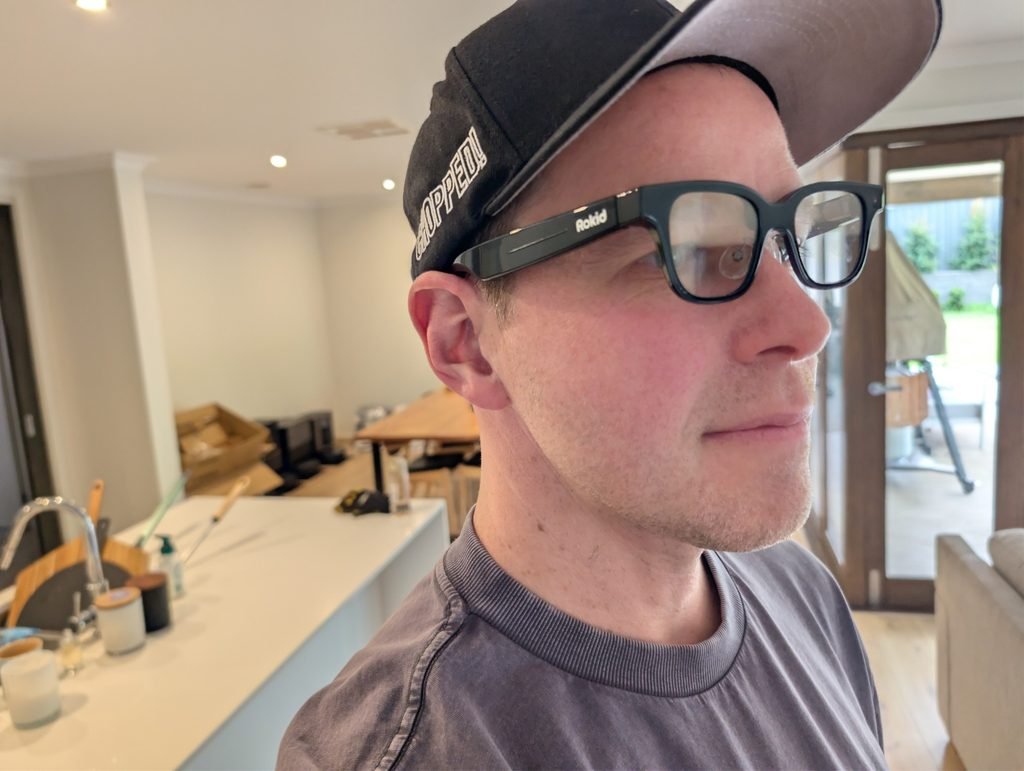
Rokid has released their new smart glasses in Australia. Having reviewed other smart glasses, these were really an audio-only experience, sure you could capturing photos and videos, but you’d need your phone. The next generations glasses offer more, an ability to see information in front of your eyes with a technology called waveguides that show an interface in the transparent lenses of the glasses.
I’ve been trying out the Rokid glasses for the past few weeks and having lived with them, they certainly offer a unique experience, and represent a very different proposition than the bulky augmented reality headsets we’ve seen in the past. These are very close to the size and weight of regular glasses, and are perhaps the smartest glasses I’ve experienced, however I do appreciate this space is moving very fast and these are likely the first of many that we experience in the coming months and years.
We’re all probably guilty of being on our phones too much, and that’s not surprising given the world of information, entertainment, education and communication it offers, but moving through the real world is interrupted by looking down at your phone. Wouldn’t it be great if you could call up digital information when you need it, and not have to reach for your pocket every time? This is what smart glasses with integrated displays offer.
If you buy these smart glasses, you gain the ability to snap photos, recording point of view video, take phone calls, ask an LLM a question, but it’s the display that’s the stand out here. Seeing real-time notifications is one option, but so is augmented navigation, or teleprompter-style text that scrolls as you read it.
I remember extremely early prototypes of this many years ago at CES, but now we have less or a science project and an actual consumer product you can buy.
Design
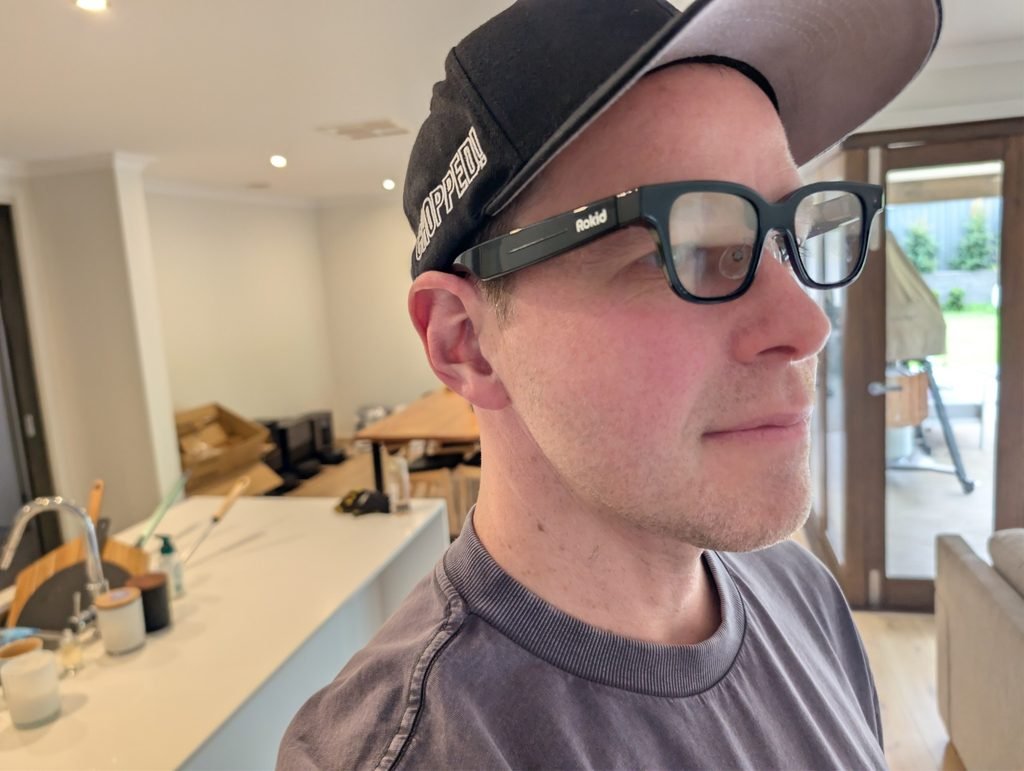
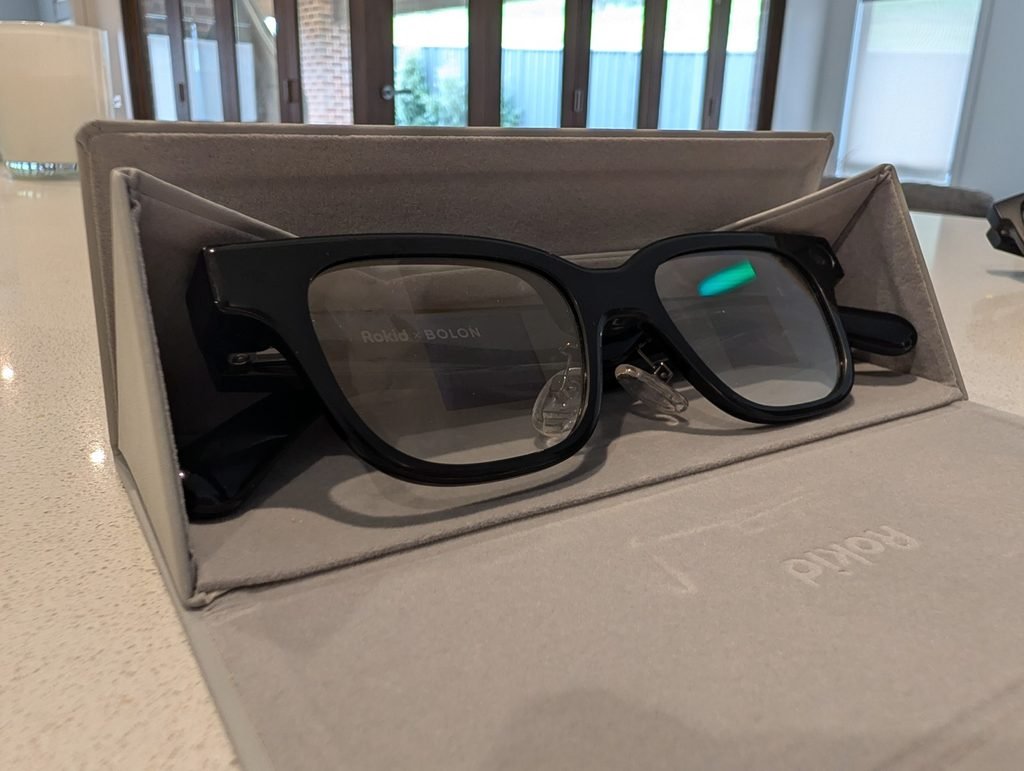
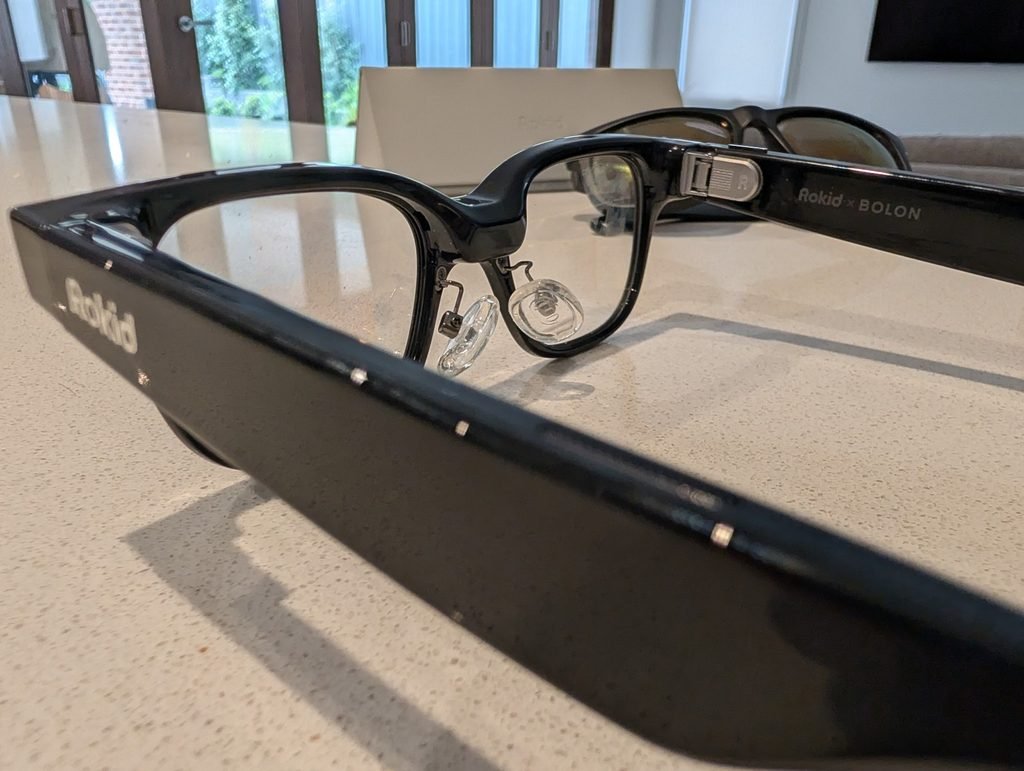
When it comes to wearable technology, aesthetics and comfort are just as critical as internal specifications. Rokid has managed to package a notable amount of hardware into a frame that weighs 49 grams. A high-polymer plastic frame with titanium alloy hinges, keeps the glasses impressively light, it’s almost surprising there’s battery and electronics in there, if you look closely, you may notice they are ever so slightly thicker frames than my regular glasses, but you’re honestly not paying much of a tech tax here.
The frames are IPX4 water resistance rated, giving them enough durability to survive light rain or sweat. While I don’t have prescription glasses, there’s a magnetic clip-on system that lets you snap on prescription lenses or sunglass tints over the main frame, if possible. This is an important feature, given the number of potential buyers who wear glasses these definitely need to be supported.
Inside the frames is a 210 mAh battery, significantly smaller than the 5,000mAh batteries found in our phones, which means it needs to be incredibly power efficient to achieve the battery life figures (Rokid claims you’ll get up to 12-hours). The smartness of smart glasses requires on-device processing power and for that, they turned to the Qualcomm Snapdragon AR1 platform, Qualcomm’s dedicated system-on-chip (SoC) designed specifically for sleek, lightweight smart glasses and AI-powered eyewear.
What stands out immediately once you inspect the lenses is the integrated display hardware. If you look at the glasses while they’re off, you can see just a very subtle, rectangles etched within the glass when tilting the frames.
Because the system uses diffractive optical waveguides, light leakage is present. The green text is visible not only to you, but also to anyone looking closely at your face while you read a prompt. It is functional and clever, though not an invisible experience if you expect complete discretion in public.
Display and Interface
Unlike audio-only alternatives such as the Meta Ray-Bans, Rokid equips both lenses with Micro-LED optical waveguide displays delivering up to 1,500 nits of peak brightness with a 30-degree field of view and a 480 by 400 resolution. Anyone who used the early VR headsets will be very familiar with FOV numbers, as they started off small and grew wider and higher over time. I expect the same to happen with smart glasses with integrated displays.
The text and interface graphics render entirely in a high-contrast monochrome green, so there’s likely coloured options on the way as well. For now, I’m happy with any colour, as this is brand new technology and I’m here for it. The quality of the text and graphics is impressive, definitely very readable, despite being close to your face. I would give any users a tip to experiment with the positioning of the displays, I found moving it up helped me see it when the glasses were positioned normally on my face, this will very per person.
In practical use, real-world readability varies depending on your surroundings. When viewing text against a solid or uniform background, the green characters look sharp, crisp, and easy to read. However, when walking outdoors against a busy, visually complex background, readability drops and it takes deliberate effort to distinguish the interface from the world behind it.
The software experience is something we should talk through.
When you put on the glasses, they take around 30 seconds to start up, and will show you the Rokid logo the entire time.. I think that could be improved.
The glasses run Rokid’s lightweight YodaOS-Sprite platform, an operating system that has already received several over-the-air updates since unboxing, to refine core stability.
The out of the box apps include items like a teleprompter and navigation app, along with the ability to interact with GPT, but you can’t at least not year, bring your own LLM. This means if you want to use Gemini, or Grok, you can do by voice commands are simply passed to your phone via Bluetooth. This would be infinitely more valuable if you asked for an image or diagram, chart, a map and were able to see it in front of your eyes.
One thing I really enjoyed was the notifications from your phone being shown on the display. This was really helpful to understand if you need to respond, in the case of an important text or email, or simply use it as information, like new X posts from your favourite creators. These use cases are very similar to that of a smart watch, although these are hands-free.
Having used the glasses, it definitely feels like this is just the start there’s a world of opportunities unlocked by having a platform to display information to you, while still seeing the physical real world.. this really is augmented reality in a great form factor. While there is an Agent Store that let’s you install a couple of dozen apps, these are typically entry-level games, more akin to tech demos than being actually useful. I feel this is the disadvantage of building your own system, rather than relying on larger platforms like WearOS from Google that has a massive developer community already.
There’s still a familiar action button and swipe gesture bar on the side of the frame, which allows you to interact with the glasses, along with voice commands.
One usability quirk that needs refinement in software updates is wear detection. The glasses usually wake up automatically when you open the arms and place the glasses on your head, it’s seamless, and makes it intuitive, like DJI’s drones turning on when you unfold them, use the gesture as an indication the user intends to use the product – smart.
There were however multiple occasions where the glasses simply failed to register that they were being worn. To resolve this, I would take them off, fold the arms closed to force a shutdown, unfold them to boot back up, and put them on your face again. It generally fixes the issue, but it interrupts what should be an immediate, seamless hands-free experience.

Performance
Outside the bootup time, the Qualcomm’s Snapdragon AR1 platform paired with 2GB of RAM and 32GB of internal storage is pretty snappy in terms of performance. The glasses capture still photos at 12 megapixels (3024 by 4032 resolution) and point of view video at resolutions up to 3K at 30 frames per second using a Sony sensor.
Camera quality is solid for a wearable device and very usable and definitely fine for sharing on social media. I did notice the video stamps ‘Rokid Glasses’ on the lower-left of the video which should be an option to remove.
While the quality won’t rival a flagship smartphone sensor for serious photography, that isn’t the primary objective here. The real benefit lies in capturing spontaneous point of view moments without the delay of pulling a phone from your pocket, where the difference between capturing a memory or missing it entirely is measured in seconds.
Audio playback is provided by dual linear directional open-ear speakers and the sounds around you (and your voice) is captured by a quad-microphone array that I was impressed with. For everyday voice calls while driving or pottering around the house, performance is completely acceptable. Call recipients report clean, natural voice pickup with no audible degradation compared to speaking through a regular phone. The open-ear audio design lets you stay tuned into your surroundings, though it naturally struggles against loud ambient competition like lawnmowers or heavy traffic where sealed earbuds with active noise cancellation would normally step in.
Privacy and Recording Indicators
Privacy has become a major talking point around camera-equipped smart glasses, and Rokid addresses this directly through hardware signaling.
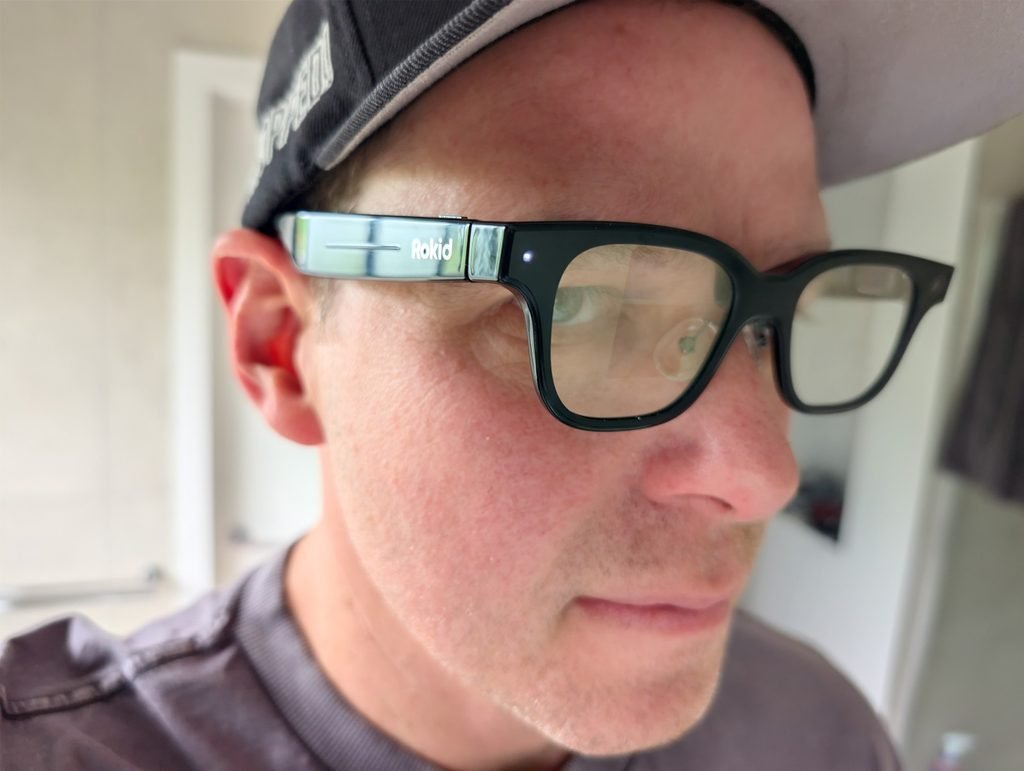
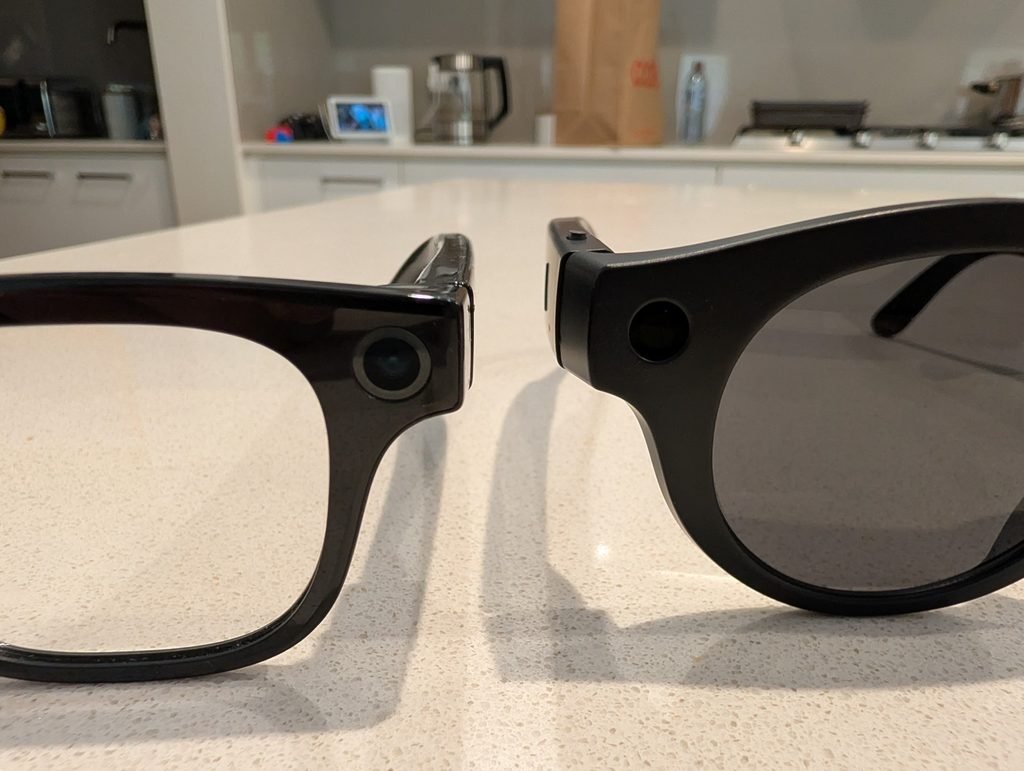
Rather than copying Meta’s approach of placing a camera lens on one hinge and a matching symmetrical LED circle on the other, the Rokid Glasses take a different route. Rokid integrates the recording LED ring directly around the camera sensor itself on a single camera array.
When you capture a photo or record video, the circular LED ring illuminates clearly around the lens. Because the light is wrapped directly around the camera aperture, looking at the lens inherently directs eyes straight to the indicator light. It is very noticeable to anyone in front of you, making it immediately obvious when the device is actively capturing media and providing reassurance for those concerned about discreet recording.
Battery and Charging
Battery endurance easily supports realistic, burst-driven use cases for a pair of glasses like this. Because the 210 mAh battery and display waveguides sleep automatically until summoned by voice, notifications, or manual touch inputs, the battery does not drain rapidly from continuous screen time.
The goal here isn’t continued video playback and therefore the energy use is far less than what you’d ordinarily imagine for something powering 2 displays. For typical usage bursts, like walking, driving, voice calls, or capturing quick photos, the internal cells hold up without issue.
When the time comes to top up power, Rokid uses a proprietary magnetic charging adapter that clicks onto the outside tip of one temple arm and terminates in a standard USB-C port. While the magnetic connection is secure and functional, having to carry a bespoke adapter is a mild inconvenience. Given how tightly packed the miniature electronics and frame batteries are, engineering a direct USB-C port on the glasses themselves is challenging, but eliminating the extra adapter would make daily charging much simpler.
Rokid also produces an official charging carry case that provides up to 10 full recharges and reaches 80 percent in 20 minutes, as well as an optional Power Capsule accessory. However, this charging case is sold separately and not bundled in the standard retail packaging, meaning buyers must rely on the magnetic dongle cable out of the box.
Features
The Rokid Glasses are packed with technology designed to keep you connected and productive without looking at a screen. Here is a breakdown of the key functionalities included in this device and what they will do for you in daily use.
Dual-eye Micro-LED displays
These tiny internal waveguide screens project monochrome green information directly into your line of sight at up to 1,500 nits of brightness. For a user, this means you can read text messages, follow speaking notes, view navigation prompts, or see translated subtitles without ever having to look down at your phone, keeping you engaged with the world around you.
12MP first-person camera
A built-in Sony sensor allows you to capture high resolution photos and video up to 3K at 30 frames per second completely hands-free. This is perfect for capturing spontaneous moments exactly as you see them, which is incredibly useful for content creators or parents who want to record memories while staying in the moment.
AI model integration
Users can interact with a voice assistant that leverages leading language models to answer questions and process information. This transforms the glasses into a wearable search engine and smart assistant, allowing you to ask questions and receive immediate audio and heads-up visual feedback while on the move.
Real-time language translation
The glasses can listen to spoken words and provide live translated subtitles right before your eyes across 89 different languages. If you travel frequently or conduct business internationally, this feature acts as a personal interpreter, breaking down communication barriers in real time.
Directional open-ear audio system
Integrated linear directional speakers and a four-microphone array handle music playback, phone calls, and voice commands without blocking your ear canal. This allows you to listen to audio or take calls while remaining fully aware of your surroundings, which is essential for safety when walking or commuting.
Magnetic lens system
A modular design that lets you snap on sunglass covers or prescription frames depending on your vision needs and the weather. This ensures that the smart glasses can genuinely replace your standard eyewear, adapting to bright outdoor environments or your specific optical requirements in seconds.
Issues and opportunities
While there is a lot to love about this bold step into spatial computing, the Rokid Glasses have room to evolve. As we talked about in the design and display sections, there’s a lot to like about the waveguide displays, but they could benefit from a wider field of view, colours and ultimately the software experience is the biggest deficit right now.
While features like the teleprompter and navigation work well, there’s a very limited number of times I need that functionality, and YodaOS-Sprite could provide so much more by way of information.. even visual notifications which is arguably one of the best features, could show the image of a social media post, not just the poster’s name and text.
That issue with the inconsistent wear detection that requires a physical reboot, really needs work and should be improved to be rock solid in future versions. Also for smart glasses to be adopted in a big way, there’s certainly a growing expectation from users that they want to BYOM (bring your own model) like Grok or Gemini or Meta, particularly now as we command our agents.
Price and availability
The Rokid Glasses are officially available in Australia with local consumer support and a 12-month local warranty.
You can buy the Rokid Glasses for the full recommended retail price of $1,099 AUD directly from the official Rokid Australia product page.
For that price they represent a premium over the audio-only smart glasses, but are still reasonably priced for something that has integrated displays, a newer technology that often comes at a significant premium.
Overall
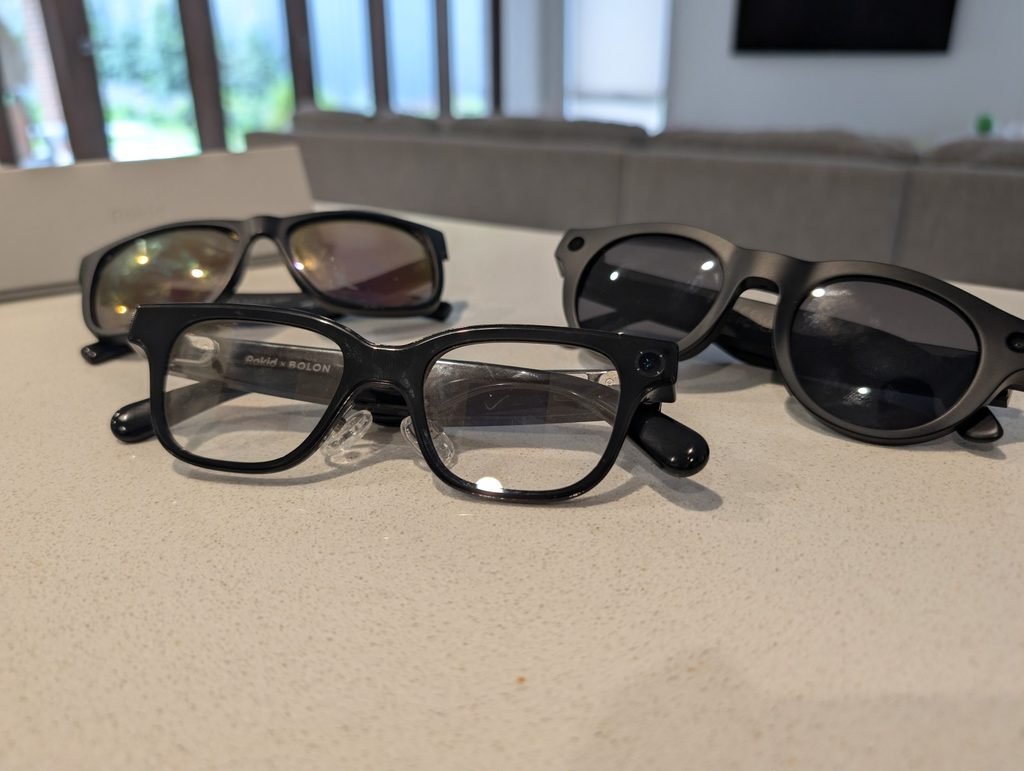
The Rokid Glasses mark a significant evolution in the smart glasses industry. By integrating functional heads-up displays, it offers new functionality that audio-only options simply don’t. The regular bases of hands-free recording, allows you to capture moments you otherwise would have missed, with friends, family or the environment you’re in, like capturing nature as you see in on a bike ride.
The hardware formfactor is impressive, with the engineering required to integrate the technology into glasses that tip the scale at just 0.49 grams, it’s a credit to the engineers at both Rokid and that decision to use the Qualcomm’s Snapdragon AR1 silicon was a good one.
Whether you should invest your money into these versus the competition, really comes down to how much you value the display piece of the puzzle. You can get a lot of the same functionality for half the price if you don’t need or want the displays, but that’s also what makes these special.
At $1,099 AUD, its a premium investment, a long away from the $40 servo sunnies I’ve bought in the past. With technology, particularly new, miniaturised tech, it’s going to cost a premium and maybe it gets commoditised in the future, but for now, that’s the price if you want the features. For me the ability to be informed, leave the phone in the pocket and capture spontaneous moments when needed, make this a great device for tech enthusiasts.
Keep following us for the latest insights.