Sauna scientists Dr. Hans Hägglund (from left), Earric Lee and Ashley Mason take a steam in the Japanese sauna at The Well in Oslo, Norway. They are part of a group of international researchers studying the potential health benefits of sauna and other heat therapies. Siv Dolmen for NPR hide caption toggle caption i Siv

Sauna scientists Dr. Hans Hägglund (from left), Earric Lee and Ashley Mason take a steam in the Japanese sauna at The Well in Oslo, Norway. They are part of a group of international researchers studying the potential health benefits of sauna and other heat therapies.
Siv Dolmen for NPR
hide caption
Siv Dolmen for NPR
For more on the science of healthy living, try NPR’s Health newsletter.
Scientists have long marveled at how the human body tolerates extreme heat — and what that means for our health.
In the late 1700s, British scientists ran bold experiments on thermoregulation, subjecting themselves (and a dog) to a piping hot room and observing that — unlike the steak and eggs accompanying them — their own bodies did not cook.

The acute physiological response to heat is now well understood.
Faced with extreme temperatures, our blood vessels dilate, heart rate speeds up and blood is pushed to the skin where it’s cooled down as we sweat. Our body releases hormones and activates heat shock proteins that protect our cells.
This understanding of our physiology has shaped medical care, for example, with heat-related illness. However, the other side of the equation — the potential therapeutic benefits of heat exposure — have received considerably less attention from modern medical science.
Meanwhile, age-old practices, such as sauna, built around stressing the body with heat are enjoying newfound popularity.
From social sauna meetups to the broader wellness and optimization movement, the level of public interest has surprised even long-time devotees like Dr. Hans Hägglund, a hematologist and stem-cell researcher at the Karolinska University Hospital in Stockholm.

Sanna Bendiksen Landhaug (left) and Ida Hellum Reppen take an early morning sauna at Sukkerbiten in Oslo, Norway. Sukkerbiten is the Oslo Sauna Association’s cluster of many small saunas in a variety of styles, lined up along a pier.
Siv Dolmen for NPR
hide caption
Siv Dolmen for NPR
“It’s really booming,” says Hägglund, dubbed the “sauna doctor” in his home country thanks to a popular book he authored on the subject. “Unfortunately, there is still not very much evidence out there.”
At least, not the caliber of studies that Hägglund and other scientists can point to if they want medical societies and government agencies to view sauna and other forms of heat therapy as a bonafide intervention — a lifestyle approach that can be recommended for preventing and treating chronic health conditions.
But Hägglund and a small group of international scientists are pushing to make this happen — and organize what’s been a niche and disparate area of research.
Bringing science to the sauna
In late September, about 15 of them convened for the first time at the International Heat Therapy Research Symposium to hash out how to rigorously study heat therapy — a bucket that includes Finnish sauna, infrared, hot water immersion and more — and to form an organizing scientific body that will help steer the field forward.
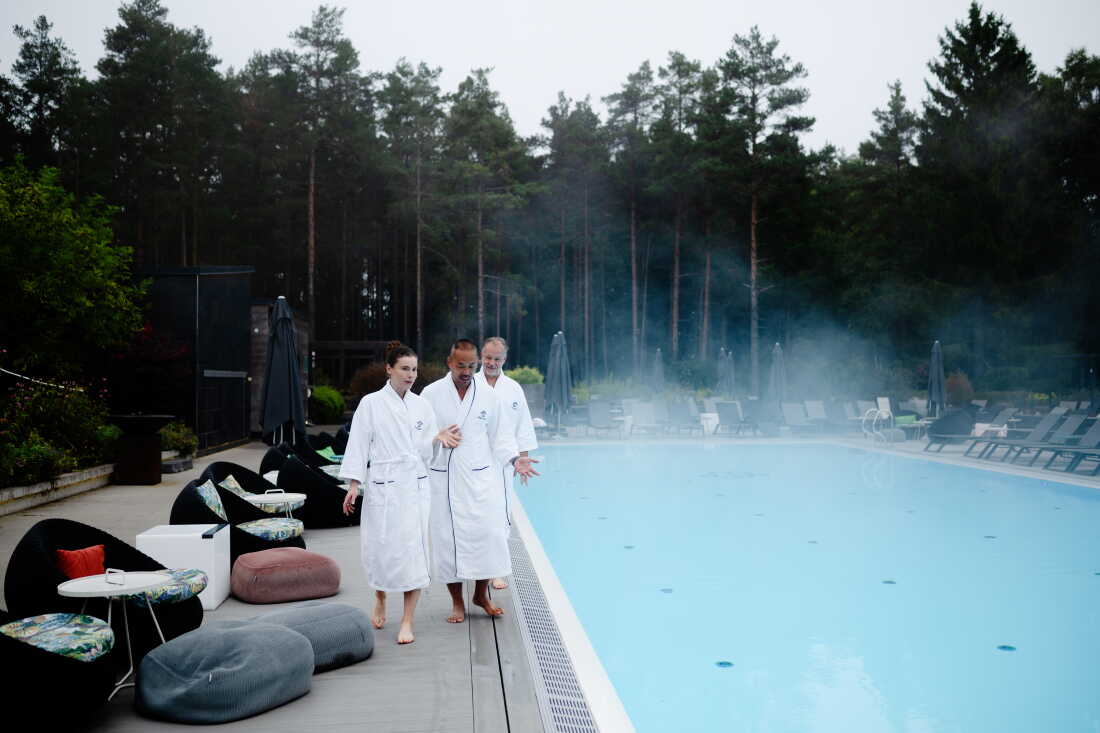
Sauna scientists Ashley Mason (from left), Earric Lee and Dr. Hans Hägglund are some of the international scientists who gathered for the International Heat Therapy Research Symposium in September at The Well in Oslo, Norway.
Siv Dolmen for NPR
hide caption
Siv Dolmen for NPR
The two-day gathering was held at a trendy resort outside Oslo, Norway, called The Well, where nude bathing is the norm and essential-oil-infused rituals, based on traditions like the German Aufguss, are held throughout the day. It took place on the eve of the International Sauna Congress, an event that attracts hundreds of sauna lovers and experts every four years.
Some of the symposium’s organizers, like Ashley Mason, a clinical psychologist at the University of California, San Francisco, acknowledge their goal is partly to dispel the whiff of wellness hype.
“We want to introduce this as an actual field of research, not something fringy, or woo-woo,” says Mason, an associate professor of psychiatry and behavioral science who is currently running trials on heat therapy for depression, sleep and other aspects of mental health.
While sauna has been studied on and off for decades, very little of that research comes from well-controlled human trials. And it’s often hard to draw firm conclusions from what evidence does exist; the studies are small, the methods vary significantly and key measurements are sometimes missing.
“We’re all over the place,” Mason says. “If we want to be taken seriously, we need to have consistent terms, so that people understand how to refer to and talk about our work.”
The nuances of measuring environmental humidity and body temperature, or how to best define heat therapy, may be afterthoughts to the average sauna-goer, but all of this matters enormously when pulling together data from different countries and institutions.
Earric Lee, a postdoctoral researcher at the Montreal Heart Institute who’s spearheading the initiative, says scientists first need to agree on standards. That’s a painstaking process involving dozens of other experts that will ultimately set the stage for the kind of larger, multisite trials that can get at some fundamental questions for scientists and the public.
What are the actual benefits? How often do you need to go? What are the risks? Just how hot does it need to be?
“People want information. I know ‘listen to your body’ doesn’t cut it,'” says Lee, “but I really can’t give you recommendations, and that’s the honest truth of it.”
Early evidence suggests benefits from sauna exposure
There are certainly reasons to believe heat – delivered as a strong stimulus in a time-limited manner — holds promise for health.
“Passive heat therapy,” as it’s known in the scientific literature, works the cardiovascular system in ways that are similar to light physical activity and delivers some of the same benefits, such as improvements in blood pressure, arterial stiffness and vascular health.
Some experiments also indicate improvement in markers of inflammation, though, here, as with many areas, the findings are not conclusive, says Lee.
There’s particular interest in how heat can help people with cardiovascular and metabolic conditions, as well as the elderly, says Ant Shepherd, a professor of clinical environmental physiology at the University of Portsmouth in the U.K.
For example, his lab has shown spending time in a hot tub improved resting metabolic rate and some measures of insulin sensitivity for people with Type 2 diabetes.
“Exercise is king, exercise is medicine, but for those who can’t do that easily, can we get some of the same effects?” he asks. “It looks like we can.”
In one of the only randomized controlled trials on sauna bathing, Lee has found that adding it to an exercise regime conferred added benefits for people at risk of cardiovascular disease. He’s now running a trial on patients undergoing cardiac rehabilitation.
Separately, several research groups are exploring whether heat can help treat depression, building on a landmark study that showed meaningful decreases in symptoms after one session in a special infrared machine.
“We’ve got lots and lots of lovely little studies,” says Shepherd, “The governments aren’t going to listen until we put the hardcore, randomized-control trials in front of them.”
Sauna research gathers steam
The uptick in recent scientific interest largely stems from a series of observational studies done in Finland.
The first — published just over a decade ago — showed using the sauna four to seven times per week was associated with a 40% to 60% lower risk of cardiovascular disease and death, compared to those who only went once a week.
“It was a strong signal and the impetus for a lot of labs to stand up and say, ‘Hey, there might be something here,'” says Lee, who earned his Ph.D. working with the research leader of the group at the University of Eastern Finland, Dr. Jari Laukkanen.

Sauna scientists Ashley Mason (right) and Dr. Hans Hägglund towel off after a session in the Japanese sauna at The Well, Oslo, Norway.
Siv Dolmen for NPR
hide caption
Siv Dolmen for NPR
Subsequent studies suggested other benefits, like lower rates of Alzheimer’s, respiratory disease and lower markers of chronic inflammation. Long-running studies from Japan have also linked regular hot tub use with lower risk of cardiovascular disease.
While promising, experts stress you can only extrapolate so much from this kind of observational data because it relies on self-reports and the results can be skewed by other factors.
“The effects are quite large, so we’re fairly optimistic, but that’s about as far we can go as scientists,” says Shepherd.
In countries where heat practices are deeply interwoven into society — such as Finland and Japan — public funding has supported some of this research. In the U.S., the National Institutes of Health is funding Mason’s work related to mental health.
The Montreal Heart Institute’s Lee says this newly formed research group hopes to secure funding from public agencies in Europe, but the kind of expensive, large-scale trials that scientists dream of doing may largely rely on foundations and private funders, too.
The Oslo symposium was funded by the Norwegian Sauna Society, the wellness resort where it took place and the Sauna Research Foundation, a nonprofit backed by a Minnesota-based longevity entrepreneur and several other private funders.
While not at the gathering, Laukkanen, who has led much of the influential research on sauna in Finland, said he welcomes the effort to organize the field and look for ways to replicate their findings in other parts of the world.
The challenge with conducting the necessary studies, he notes, are the same as with other lifestyle habits like exercise or diet.
“They are really demanding,” said Laukkanen, a professor of internal medicine at the University of Eastern Finland, “Pharmaceutical companies are doing this kind of study, but they have the resources. We don’t have those yet.”
{For more tech updates, stay tuned to our blog.|Keep following us for the latest insights.|Check back often for more exciting news!}