
Microsoft is making its largest ever investment in Australia, committing billions of dollars to expand its local data centre footprint and training programs. This move is designed to position the nation as a global leader in the rapidly evolving artificial intelligence economy. The tech giant has announced that A$25 billion in capital and operational expenditure
Microsoft is making its largest ever investment in Australia, committing billions of dollars to expand its local data centre footprint and training programs. This move is designed to position the nation as a global leader in the rapidly evolving artificial intelligence economy.
The tech giant has announced that A$25 billion in capital and operational expenditure by the end of 2029 will significantly expand Microsoft’s Azure AI infrastructure across Australia. This infrastructure spend is aimed at meeting the soaring demand for cloud computing and AI services across the country.
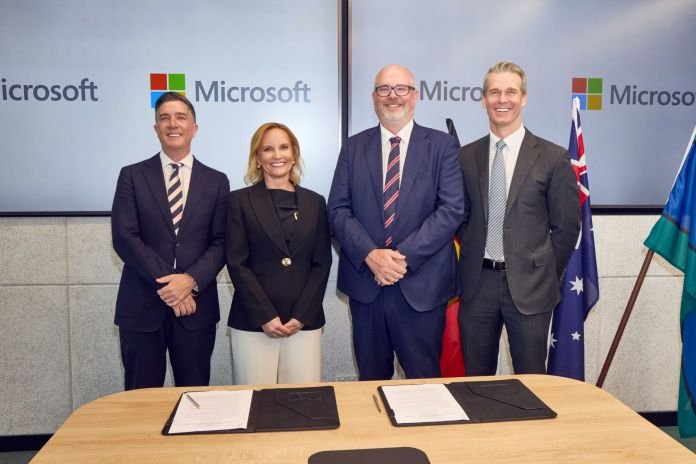
Microsoft ANZ President Jane Livesey and Minister Tim Ayres sign a Memorandum of Understanding between Microsoft and the Australian Government, joined by John Galligan and Assistant Minister Andrew Charlton.
By expanding its data centre presence in Sydney and Canberra, Microsoft is ensuring that Australian businesses and government agencies have the low-latency access they need. This local capacity is critical for developing and deploying sophisticated AI models that require significant processing power.
Massive expansion of digital infrastructure
The investment will see Microsoft increase its computing capacity by approximately 250% over the next few years. This scale is unprecedented for the Australian market and reflects the speed at which AI is being integrated into modern workflows.
This infrastructure isn’t just about servers and racks; it is about providing the foundation for the next generation of Australian innovation. From startups to established enterprises, having this level of hardware locally available changes the game for software development.
The expansion will help ensure that Australia remains a competitive destination for tech investment. It provides the necessary digital plumbing to support everything from generative AI tools to complex data analytics used in mining and agriculture.

Addressing the AI skills gap
Building the infrastructure is only half the battle, as the industry currently faces a significant shortage of skilled workers. Microsoft has pledged to help bridge this gap by providing training opportunities for 300,000 Australians.
This initiative aims to equip the local workforce with the skills needed to build and work with AI technologies. It covers a broad spectrum, from basic digital literacy to advanced technical certifications for developers and engineers.
“A priority for us is to ensure that everyone can benefit from the AI era. This investment will help create the workforce of the future, ensuring Australians have the skills they need to succeed in the jobs of tomorrow.”
Steven Worrall, Managing Director, Microsoft Australia and New Zealand.
By partnering with TAFEs and other educational institutions, Microsoft is creating pathways for people to pivot into tech roles. This is a vital component in ensuring the massive infrastructure investment can actually be utilised to its full potential.
Enhancing national cybersecurity
As AI adoption grows, so does the complexity of the threat landscape, making security a top priority for this rollout. Microsoft is collaborating with the Australian Signals Directorate (ASD) to strengthen the nation’s cyber defences.
The partnership includes the launch of the Microsoft-ASD Cyber Shield (MACS), which aims to improve the protection of Australian citizens and businesses. This initiative focuses on the joint detection and analysis of cyber threats in real-time.
This proactive approach is designed to stop attacks before they can cause significant damage to the economy. By sharing intelligence and leveraging AI-powered security tools, the ASD and Microsoft can stay ahead of sophisticated actors.
“This collaboration is a significant step forward in our mission to make Australia the most secure place in the world to connect and do business. AI is a powerful tool for defenders, and we are putting it to work for all Australians.”
Abigail Bradshaw, Head of Australian Cyber Security Centre, ASD.
Economic impact and the AI opportunity
The economic potential of AI for Australia is significant, with reports suggesting it could add billions to the national GDP. This investment acts as a catalyst, encouraging other firms to accelerate their own digital transformation journeys.
Microsoft’s commitment is expected to create thousands of jobs during the construction phase of the data centres alone. Long-term, the ripple effect through the tech ecosystem will create even more high-value roles in software engineering and data science.
Prime Minister Anthony Albanese has welcomed the investment, noting that it aligns with the government’s goals for a more resilient economy. It places Australia at the forefront of the global conversation regarding responsible AI development.
The move also reinforces the importance of the Pacific region in the global tech landscape. Australia is increasingly seen as a safe and stable hub for data storage and processing, away from more volatile geopolitical zones.
Driving innovation in the public sector
Government services stand to benefit immensely from increased AI capacity and improved security protocols. From more efficient processing of claims to better urban planning, the applications within the public sector are vast.
The increased capacity in Canberra specifically caters to the needs of federal agencies that require high-level security clearances for their data. This allows the government to innovate while maintaining the strict sovereignty requirements essential for national security.
AI can help automate many of the mundane administrative tasks currently bogging down public servants. This frees up resources to focus on more complex policy issues and direct service delivery to citizens.
The future of AI in Australia
While there is much excitement around generative AI tools like Copilot, the underlying infrastructure is what makes it possible. Microsoft’s multi-billion dollar commitment ensures that Australia isn’t just a consumer of these tools, but a place where they are built.
The combination of infrastructure, skills training, and security makes this a holistic approach to national tech development. It sets a high bar for other global tech giants operating within the Australian market.
As we look toward the end of the decade, the success of this investment will be measured by the growth of the local tech sector. With 300,000 newly trained workers, the potential for Australian-made AI solutions is higher than ever.
The focus now shifts to how quickly businesses can integrate these capabilities into their daily operations. The tools are being provided, and the capacity is being built; now it is up to Australian innovators to seize the opportunity.
For more information, head to https://news.microsoft.com/en-au/




















Leave a Comment
Your email address will not be published. Required fields are marked with *