
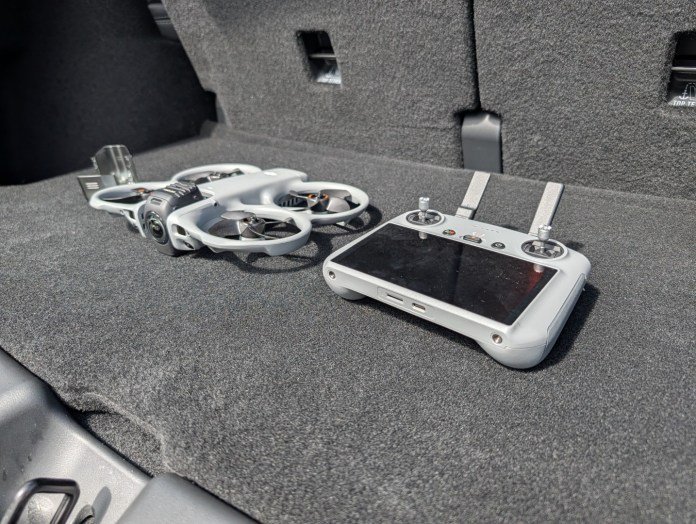
DJI’s introduced handheld 360 cameras a few years ago, but have now implemented their dual-camera system on a drone, welcome the DJI Avata 360. Not only can you fly this with a standard controller, but you can also step into that video in a FPV headset. I’ve flown the original DJI FPV drone, followed by
DJI’s introduced handheld 360 cameras a few years ago, but have now implemented their dual-camera system on a drone, welcome the DJI Avata 360. Not only can you fly this with a standard controller, but you can also step into that video in a FPV headset.
I’ve flown the original DJI FPV drone, followed by the the original Avata, and that FPV experience is the closest experience you’ll have to feeling like you’re flying, while standing on the ground. By adding the upgrade of a 360 camera with the low-latency and high quality of the Avata 360, this experience becomes even more impressive and immersive.
This drone is designed for those who want to capture everything at once, allowing content creators to focus first on flying through an enviornment, and playing director after the fact. This allows you to spend more time flying and less time focused on the precise direction of the drone to capture the action.
While the drone offers the now familiar prop guards to protect your propellors, what about those delicate cameras? DJI have crafted a great solution here. The dual cameras which automatically merge the footage to a single 360 output, are positioned on a rotating head, so when the drone comes in to land, this flips around creating a safe platform for the drone to land on, importantly protecting the lenses.
While Antigravity was first to market with their A1 dedicated 360 camera drone, DJI has waited to perfect the formula with a more robust, “pro-grade” approach. One of the immediate differences is the low-latency on the video transmission, critical when flying close to objects, allowing you as a pilot to react and avoid impacts, any delay can risk the shot and even the drone.
Whether you are a professional cinematographer looking for a unique perspective or a tech enthusiast, the Avata 360 is definitely worth considering, it’s a great entry into this field. It takes the stress out of framing by capturing a full spherical view, ensuring you never miss a moment of the action with the added reliability DJI is known for.

Design
The design of the DJI Avata 360 is a significant departure from the standard Avata 2, but it does feel like part of the same family. It features a more robust frame to accommodate the dual-lens 360-degree camera system. Unlike the single-lens setup of its predecessors, this model utilises two 1/1.1-inch sensors positioned to capture a seamless 360-degree field of view.
The signature integrated propeller guards remain, which continue to make this drone one of the safest options for flying indoors or in close proximity to obstacles, a stark contrast to the Antigravity A1 which opted for a folding, exposed-propeller design.
The Avata 360 feels and looks familiar, offering removable batteries, micro-SD card, USB-C port and the standard array of sensors integrated into the body to detect objects in its path.
When it comes to the controller options, you have two options, depending on the combo you purchase. The familiar DJI RC2 is great in the hands, offers a large touchscreen display and offers great control over the drone. The RC Motion 3 controller is also a very approachable option for those new to flying and who are looking for a simplier option.
One important metric of the Avata 360 is the weight, tiping the scales at 455g, it seems they gave up trying to fit it into the the same regulatory exemptions as the sub-250g category and given what they delivered, I think that was a good choice. Trying to cram everything that is the Avata 360 into a very restrictive weight envelope, would have significant compromises and it’d be a worse product for it.
When it comes to travel, it’s easy to thow on the lens cover and slip it in a back pack, unscrew the controller sticks and place them into the back of the RC2 and be on your way in seconds. If you’re travelling with the headset, and fly more accessories like additional batteries, then having somewhere to store everything, like the frunk of an EV is a great option.

Performance
In terms of flight performance, the Avata 360 is impressively stable despite the unique aerodynamics of its dual-lens housing. It leverages the O4+ video transmission system, providing an incredibly reliable and low-latency feed to the DJI Goggles 3 or the RC 2 remote. In Sport mode, the drone remains punchy and responsive, whereas the Antigravity A1 has often been criticised for feeling a bit “weak” and lacking the punch needed for aggressive FPV maneuvers.
The imaging performance is where this device truly outclasses the competition, offering 8K/60fps HDR video. The Antigravity A1 was a pioneer in bringing 8K 360 to the skies, but it was limited to 30fps and lacked a professional log profile. DJI’s inclusion of 10-bit D-Log M and a larger f/1.9 aperture ensures much better dynamic range and low-light performance. Battery life holds steady at approximately 23 minutes, which is essentially identical to the A1’s standard battery, though DJI’s flight stability in wind is noticeably superior.

Features
The DJI Avata 360 offers a range of features, the detail of which you can read through below.
8K/60fps flagship 360-degree imaging
The dual 1/1.1-inch square CMOS sensors capture high-framerate 8K video, allowing for much smoother slow-motion reframing in post-production. It also captures 120MP spherical photos in both JPEG and DNG RAW formats for maximum editing flexibility.
Omnidirectional obstacle sensing with LiDAR
This model provides a complete safety bubble using a vision system supplemented by forward-facing LiDAR. This enables the drone to detect obstacles even in low-light conditions down to 1 lux, making it significantly safer to fly backward or sideways while using ActiveTrack 360 to follow a subject.
Flexible dual-mode camera system
A standout innovation is the rotating camera module that allows users to switch between a full 360-degree capture and a traditional Single Lens FPV mode. In Single Lens mode, the drone functions like a standard Avata, recording 4K/60fps footage with a 200-degree field of view.
O4+ full HD video transmission
This updated system delivers a crystal-clear 1080p/60fps live feed with a massive range and superior anti-interference performance. The connection remains stable in urban environments, ensuring the pilot maintains a high-bitrate 180 Mbps link for precise navigation.
360-degree virtual gimbal and spotlight free
The drone uses its spherical data to simulate a 360-degree virtual gimbal, allowing for infinite rotation and tilt control in post-production. Additionally, the Spotlight Free feature automatically locks onto a moving subject and assists with camera movement, letting the pilot focus entirely on the flight path.

Issues and opportunities
While the 360-degree footage is often seemlessly stitched together, there has been the odd time where I can identify where the stich occurs. Thankfully this is rare and I think is being improved through software updates.
The workflow for 360-degree footage still requires a lot of hardware, so anything DJI could do to help optimise would be appreciated. The raw, uncompressed footage is also massive, so if you want to use this regularly, you’ll need to make sure you have the hard drive space to deal with it.
I will say, while DJI gets a lot right with the Avata 360, the setup process between the drone, controllers and headset could definitely be simplified.

Price and availability
The DJI Avata 360 is available in Australia through various retailers, with several combos to suit your wants and needs. It is positioned quite competitively in Australia, starting at A$799 for the drone only (includes 1x battery), that steps up to A$1,159 for the DJI RC2 controller and at the top end goes to A$1,619 for the Fly More Combo (includes DJI RC2 + 3x batteries + Charing hub and sling bag).
The final combo is the Motion Fly More Combo which is the same A$1,619 price but comes with the same 3x battery, charging hub and sling bag, but instead includes the DJI Googles N3 and RC Motion 3 controller, rather than the DJI RC2).
- DJI Store Australia: $1,619 (Fly More Combo with RC 2)
- The Good Guys: $1,159 (Drone with RC 2)
- D1 Store: $799 (Drone Only – requires existing compatible goggles/controller)

Overall
The DJI Avata 360 is another masterclass in drone design, features, performance, battery life and video quality. The company has successfully combined the thrill of FPV with the versatility of a high-end 360-degree camera.
Having the ability to edit the footage after the fact, using the free DJI Studio desktop software is transformative. This software has been through a couple of updates since I first used it and it’s really evolving to be quite powerful. If your already running Adobe Premier, there’s a plugin DJI Reframe – Plugin for Adobe Premiere, but that’s only for the Mac, this will allow you to edit the 360 footage from DJI, helping speed up your workflows.
If you are looking for a drone that offers great quality, smart protections both digitally and physically through propeller guards, and don’t want to compromise on visuals, then the Avata is a great option.
The drone is probably most appealing to those who need the “reframe later” flexibility, but those looking for FPV with low-lag and high visual quality, then you should definitely consider the Avata 360. I’ve certainly enjoyed using it during this review and look forward to the software workflows continuing to improve over time.















Leave a Comment
Your email address will not be published. Required fields are marked with *