Tired of milling about polished networking events, balancing a cocktail and lukewarm appetizers while attempting to shake hands and answer the question, “So, what do you do?”, workers are turning away from the happy hour and toward events that take them back to their preschool roots. Groups from Boston to Boise are hosting events to
Tired of milling about polished networking events, balancing a cocktail and lukewarm appetizers while attempting to shake hands and answer the question, “So, what do you do?”, workers are turning away from the happy hour and toward events that take them back to their preschool roots.
Groups from Boston to Boise are hosting events to meet twin needs: IRL connection and AI practice. It’s a grown-up version of “parallel play” that organizers hope will lead to more meaningful interactions than sipping discounted margaritas, and prove more fun than clumsily vibe-coding at home alone. The meetups include AI agent building workshops, hackathons, walk-and-talks, and fitness classes curated for specific industry founders.
The trend is a twist on networking for our times. People want to meet in person, but are still retraining their social skills after Covid. The events draw from hackathons and take on a new urgency: Companies hungry for AI-skilled workers are brushing up against a job market brimming with candidates desperate to learn AI and stand out. Anxious they’ll be left behind, people are showing up not just to make a new connection, but to make sense of a rapidly evolving AI landscape.
“You can spend all your time, every single day, looking at apps or looking at a blog, or looking at a podcast to see what they’re doing,” Andrea Huspeni, the founder of pet brands Bye Bye Dog Breath and This Dog’s Life, tells me. She attended an event put on by a group called AI After 5 this month, as she’s learning to use AI to keep her operating costs down. “But that is different than going to an event in person and hearing other people’s experiences, other people’s use cases, and other people’s hacks.”
On a Tuesday evening in downtown Manhattan, some 60 people gathered under dim lights in a modern, industrial space for a sold-out event. It wasn’t a raucous happy hour or a fireside chat with tech industry leaders. They were there for a hands-on workshop to build AI agents.
The evening, bookended with food and drinks to start and time to chat after, felt more like a classroom than a typical networking event. That’s by design. Some attendees had their eyes locked on a presentation about the basics of agent building; others peeled off into pairs, sitting close together in booths with their own laptops, speaking in hushed voices about the projects on their screens.
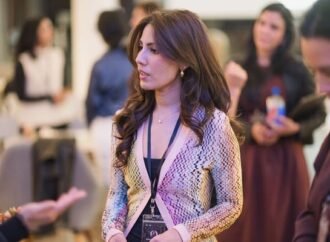
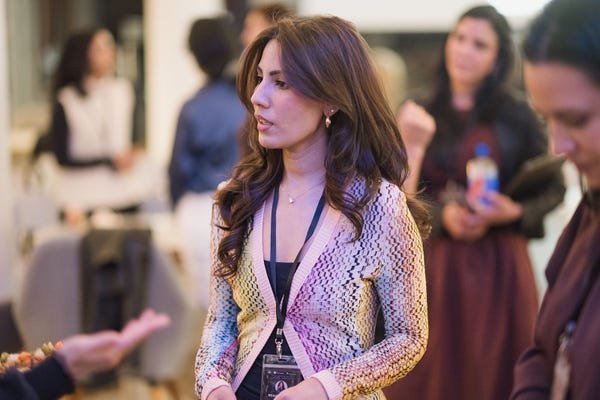
Mina Abdulla, who started AI After 5 this year to help women learn how to use AI, walked from table to table, checking in on dyads like a teacher making rounds in a classroom. She insists that this isn’t just more work after the workday, which is already increasingly filled with AI. It’s fun, she says, and the format takes people back to learning as a kid — experimenting and solving problems side by side. “Learning is a social thing,” she says. “It’s making AI feel more approachable.”

Ben Kelmer for AI After 5
As AI reshapes the way we work, non-technical employees especially worry they’ll be left behind — and these workshops draw people from across industries and roles. “People don’t feel like they can do it on their own, and they get stressed,” says Paige Kehoe, who founded Audacious AF this year, a networking group for women building with and learning AI. That pressure pushes more people to attend training or try to train themselves on their own time.
Traditional forms of networking have failed to meet the moment. A Harris Poll conducted on behalf of staffing firm Express Employment Professionals late last year found that three-quarters of workers felt networking had become more transactional and less about personal connections. People socialize with coworkers less, and happy hour participation fell by 9% this year, as rising prices and remote work drain some of the appeal.
But people want to hang out. Attendance at microevents grew by 23% in 2024, according to Eventbrite data. Last year, nearly 60% of people said they wanted to attend events where they could socialize around an activity, and where making connections wasn’t the main focus. The number of community AI hackathons put on via Devpost, a platform for in-person and online hackathons, jumped from 369 in 2024 to 706 last year. A search of Luma shows there are about a dozen similar AI building workshops and meetups in New York City over the next week, and typically two or three such events a day in San Francisco.
Unpolished, come-as-you-are events tap into a trend that’s been brewing for years: a push for authenticity. Instead of panels with canned answers and humble bragging at happy hours, people can come to these workshops and admit they need help.
“Everyone’s just so tired of all of the really perfect put-together content that companies were pushing out,” Kehoe says. She held her first workshop for women who wanted to learn to work with Claude this spring. They had room for about 50 people, but nearly 1,000 joined the waitlist, she says.
No-Code NYC has hosted events since 2018, building a community for people who weren’t technical by trade but wanted to learn to use drag-and-drop coding tools or might be toying with the idea of working as developers. Its founder, Erik Israni, tells me that interest has expanded because of AI. Developers coming to his events want to brush up on AI skills, as do people who would never have considered themselves technical. The developers can better explain concepts to the newbies, but those outside the traditional tech world pick up on the concepts and act on them quickly, Israni says, and there are benefits for people on either side of that divide in coming together. “There’s an uncertainty in the future for what anyone’s job is going to look like, for what skills they’re going to need,” Israni says. As AI has shaken job prospects, it’s also making coding more accessible for those willing to dive in. “Not only is there a sense that I can do this, but there’s also a sense of FOMO.”

Ben Kelmer for AI After 5
Some companies have brought similar formats in-house to train staff. Tariq Shaukat, CEO of Sonar, a software company focused on verifying AI code, tells me the company recently hosted an in-person hackathon for the technical team, bringing remote workers together with office staff. In that one week, he estimates the team made more progress in developing new skills than they had in the previous four months.
“Getting them together in this unstructured environment with everyone with a little bit of playtime helped give people the space and freedom to kind of learn and experiment,” he says. “There’s a lot of tribal knowledge development and sharing that’s happening.”

People working on their own projects want to socialize, but they need loose industry connections perhaps less than they need tangible AI skills. They also feel a time crunch to learn the latest technologies. “People are also scaling faster, iterating faster,” says Anna Kaplan, founder of Narrativ by AK, a storytelling and branding firm for founders. “That’s why people are more picky about the events they go to.”
This new version of networking resonates with people who still feel socially stifled after years of remote work and school, and who feel too many of their social interactions are mediated by algorithms. These events are an antidote to the loneliness workers feel, as well as frustration over a broken job-hunting process. People want to optimize their lives and learn AI skills through experimentation and peer sharing. They’re picky about the homework they’re taking on. And if they make a friend or connection in addition to a new AI agent, that’s a nice bonus.
Business Insider’s Discourse stories provide perspectives on the day’s most pressing issues, informed by analysis, reporting, and expertise.
{For more tech updates, stay tuned to our blog.|Keep following us for the latest insights.|Check back often for more exciting news!}