
Shopify has unveiled its Fall ’26 Edition, called Exponential, and the theme is clear from the first page. AI agents are now a core part of how Shopify expects people to shop, and how it expects merchants to run their stores. This is the tenth Shopify Editions showcase, and it’s a big one. The Editions
Shopify has unveiled its Fall ’26 Edition, called Exponential, and the theme is clear from the first page. AI agents are now a core part of how Shopify expects people to shop, and how it expects merchants to run their stores.
This is the tenth Shopify Editions showcase, and it’s a big one. The Editions page lists more than 200 individual updates, but the headline items are about connecting Shopify’s catalogue, cart and checkout to AI agents like ChatGPT, Claude, Copilot, Gemini and Grok.
For Australian merchants, there are also some practical local changes, including Shop Pay Installments and more payout currencies in Shopify Payments.
What Australian merchants get
Australian merchants can now offer Shop Pay Installments, letting shoppers pay over time, including longer-term interest-free options, without leaving the Shop Pay checkout.
According to Shopify’s help documentation, Shop Pay Installments in Australia is in early access. To use it, your business entity needs to be located in Australia, with an Australian Shopify Payments account and selling and payout currencies set to AUD.
It works on orders between A$50 and A$30,000, including discounts, shipping and taxes. It’s powered by Affirm, and Australian customers must pay with a debit card, with credit cards not supported.
Shopify Payments is also adding more payout currencies across Australia, France, Singapore and Hong Kong, so a cross-border sale lands in the currency it was made in. For Australian businesses selling overseas, that could mean fewer conversion steps between the sale and the bank account.
Shop Campaigns, Shopify’s ad program that only charges when an ad drives a sale, is also expanding to more than 35 new markets, with Australia among them.
Shopify hasn’t announced any Australian pricing for the new features in this Edition.

What Shopify’s local lead says
“Australian retailers are operating in an increasingly complex environment. Customer expectations are rising, AI is changing how people discover and buy products, and businesses are under constant pressure to manage costs while finding new ways to grow.
The challenge isn’t just keeping up with these changes, but being able to adapt quickly and take advantage of new opportunities. That’s where having everything connected makes a real difference. With our latest innovations, we’re showcasing the benefits of Shopify’s network effect.
Bringing more of Shopify’s capabilities together to help local businesses simplify their operations, reach customers wherever they shop, and grow with greater confidence.”
James Johnson, Head of Enterprise ANZ, Shopify.
Running your store from an AI chat
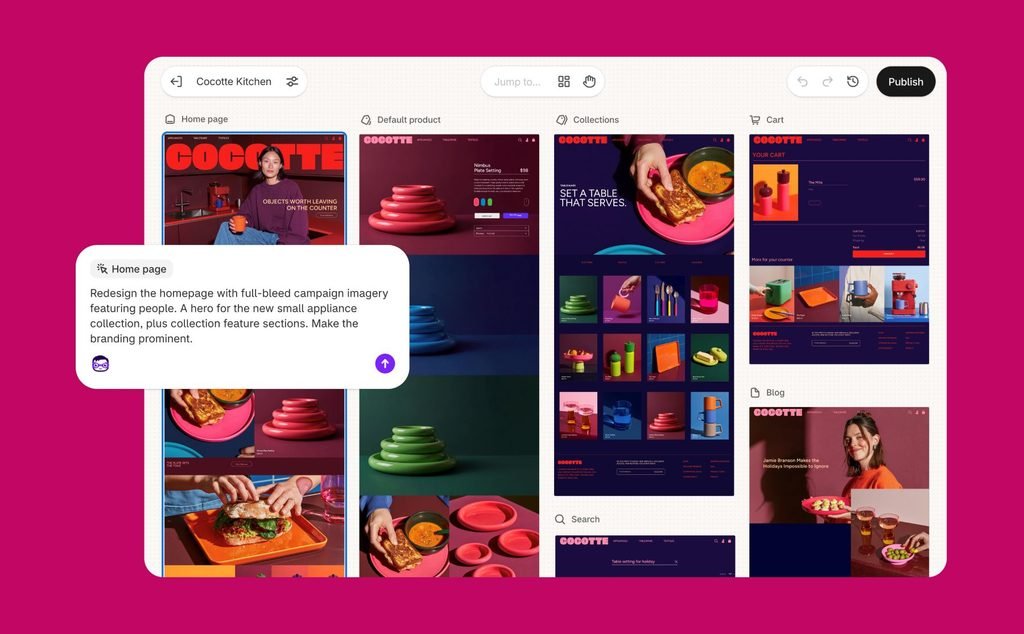
The biggest change for merchants is Shopify Connectors for AI agents. Merchants can connect Shopify to the AI agents they already use, then manage products, inventory, orders and performance without leaving the conversation.
The connectors now work with nine agents:
- ChatGPT
- Claude
- Claude Duet
- Copilot
- Gemini
- Grok
- Grok Bot
- Muse
- Perplexity
Shopify’s pitch is that business ideas often start as a question in an AI chat, so the next step may as well happen there too. Aspiring entrepreneurs can even turn an idea into a storefront preview in the same chat.
Shopify’s own assistant, Sidekick, has also been rebuilt. It can now run calculations, write code, search the internet and remember what a merchant teaches it. Importantly, Shopify says Sidekick still needs the merchant to approve its changes. That’s the right call. Letting an AI loose on your product catalogue without a review step is a fast way to end up with a mess.
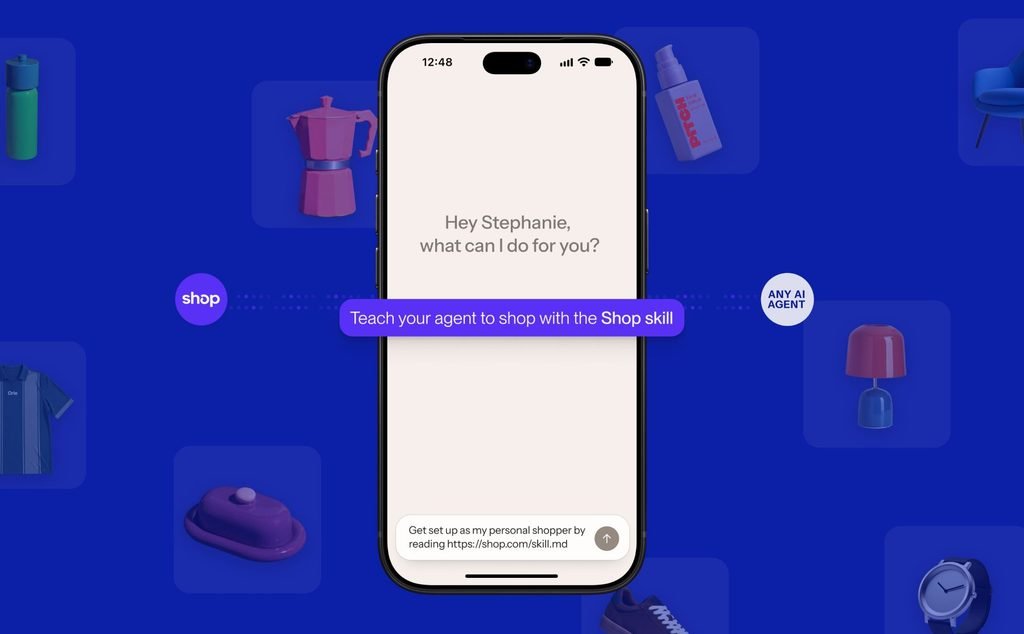
Shop.md turns any AI agent into a personal shopper
On the shopper side, the big new item is Shop.md, a skill that turns an AI agent into a personal shopper.
Buyers point ChatGPT, Claude or another agent to shop.md, and it can search more than a billion products, check out with Shop Pay and track orders. Because the agent can draw on a buyer’s preferences, sizes and order history from Shop, it can find relevant products from Shopify merchants.
Shop Pay checkout is also coming to personal AI agents, starting with Muse from Meta, Claude Duet and Instinct. Claude Duet, Grok Bot and Instinct also offer Shop Pay for brands that aren’t on Shopify.
Shopify says more than 400 million people already use Shop Pay, and that its security model carries over to agents. The buyer stays in control of their purchases, and their card is never shared with the agent. For agent purchases from merchants off Shopify, Shop Pay uses tokens from Mastercard, Visa and Discover, with American Express coming soon.
That card point matters. The obvious worry with AI shopping agents is handing over payment details to a chatbot. Keeping the card out of the agent’s hands entirely is a sensible design.
Every Shopify store is now agent-ready
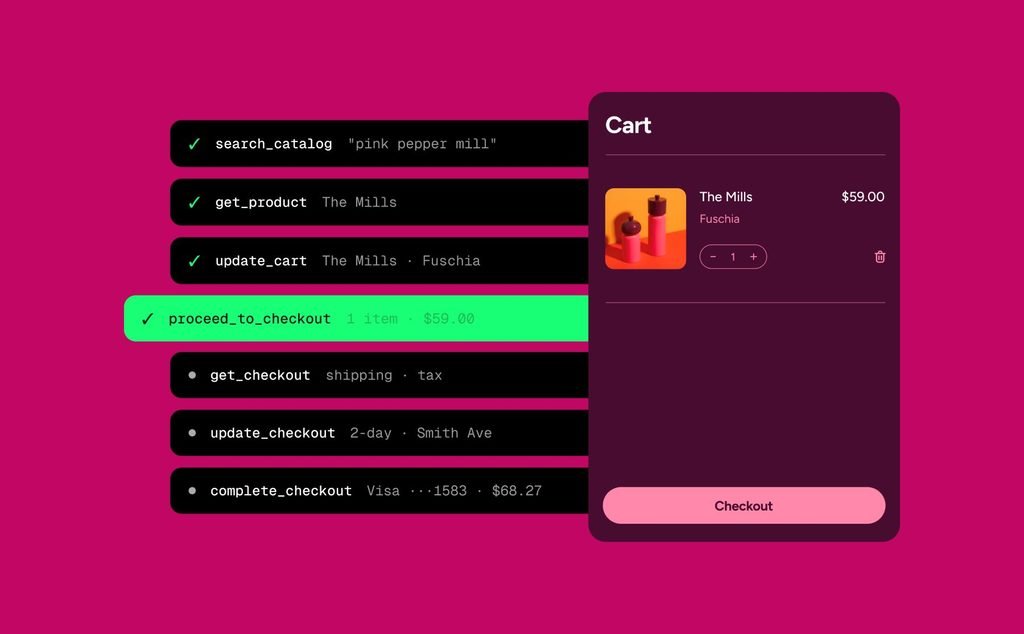
The most significant change for developers, and arguably for every merchant, is WebMCP on storefronts and checkout.
WebMCP is a set of tools on every Liquid and Hydrogen storefront and checkout that expose structured data. Browser agents can use them to search products, update the cart and complete checkout once the buyer approves, with the same validation as the checkout page.
Shopify says every Shopify store is now ready for agents, with no setup required. Instead of an agent reading screenshots and simulating clicks, it gets structured data back, so it can shop a Shopify storefront more quickly and reliably.
It’s a smart move. Today’s browser agents are slow and clumsy because they’re trying to use websites designed for humans. Giving them a proper interface solves that. The release doesn’t say whether merchants can opt out, which some will want to know.
Merchants control what agents say about them
One of the more thoughtful additions is Knowledge base, a new page at Sales channels > Agentic in the Shopify admin.
It lets merchants review and publish the facts AI agents get about their store, like return windows, shipping destinations and gift services. Shopify drafts these facts from the storefront and suggests updates, but agents that ask Shopify about a store only get facts the merchant has published. Nothing Shopify drafts reaches an agent without the merchant’s sign-off.
Alongside that, a new admin view shows whether a store is eligible for Shopify Catalog, which is where ChatGPT, Copilot, Meta, Instinct and other agents get product information. It also links to fixes for anything in the way.
If AI agents become a real sales channel, being missing from that catalogue would be like being missing from Google. This view is worth checking.
Tools for developers
Shopify is also opening up its shopping infrastructure to developers.
Any developer can now build on the Shop MCP at shop.dev, with no key needed to start. It runs on the same Catalog and checkout behind ChatGPT, Copilot, Muse and Instinct, including more than a billion products, checkout with Shop Pay and order tracking.
There’s also a new Shopify app security check command in Shopify AI Toolkit and Shopify CLI. It runs locally and directs the developer’s coding agent to review the app’s codebase, the configuration of every extension point and its dependencies. Each finding identifies the affected file and line, its severity, why it matters and a code example of the fix. Shopify says it targets common vulnerability patterns such as unauthenticated routes, cross-shop data access and unverified webhooks.
“Developers are part of the same flywheel as merchants. Whatever they build makes Shopify better for the merchants who use it, that brings more merchants on board, and the next developer has even more to build for.”
Vanessa Lee, VP of Product, Shopify.
Payments, fraud and Shop updates
Beyond AI, there’s plenty more:
- Shopify Protect brings risk and disputes tools into the admin, with a Rule Builder for merchants to write and test their own fraud rules. Shopify says Shopify Payments prevents more than 12,000 high-risk payments every minute, at no extra cost.
- New local payment methods in Shopify Payments include Alipay, WeChat Pay, MB WAY, OXXO, Satispay, Scalapay and GrabPay.
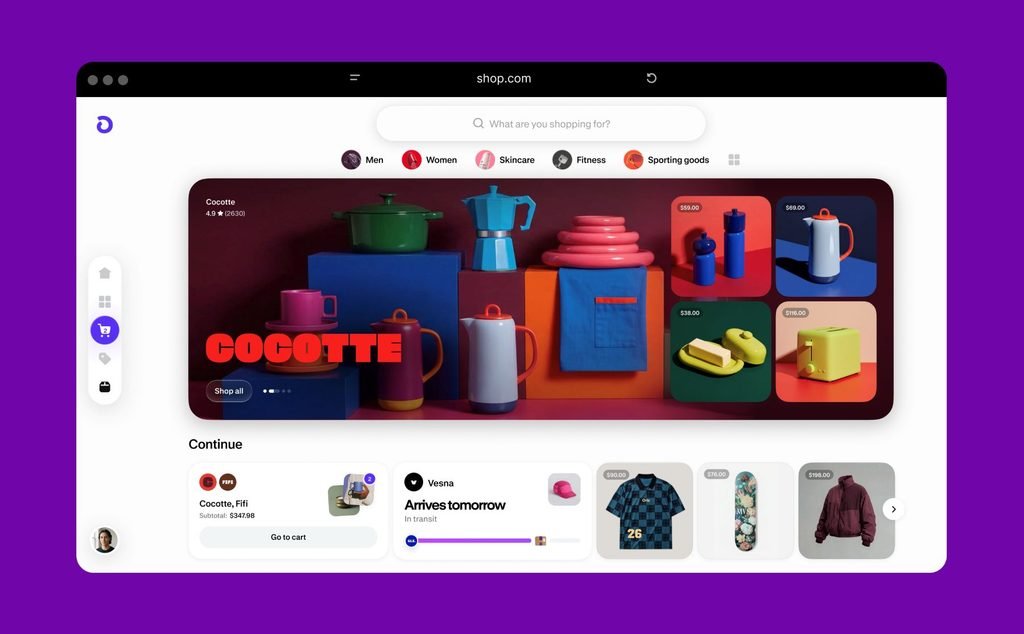
- Shop.com gives Shop a new home on the web, with shoppable posts, editorial curations and package tracking. Shopify says traffic to Shop is growing even faster on the web than in the app.
- Universal Checkout in the Shop app lets shoppers buy from multiple merchants in one checkout, while respecting each merchant’s extensions and validations.
- Shopify POS can recognise more in-store customers through Shopify’s network, and Shopify says a known in-store customer has over 60% higher lifetime value than an unknown one.
- Recent carts in Shopify POS now work across devices.
The bottom line
This Edition is Shopify betting big that AI agents will become a major way people shop. Whether Australian consumers actually start buying through ChatGPT or Claude in large numbers is still an open question, but Shopify is making sure its merchants are ready if they do.
For Australian merchants, the most practical things to look at today are Shop Pay Installments, now in early access locally, and the new Knowledge base and Catalog eligibility tools. Those let you control how AI agents see your store, which could matter a lot later.
The agent features are impressive on paper. The real test will be how well they work in practice, and how much merchants trust an AI to act on their behalf.
For more information, head to Shopify.
For more tech updates, stay tuned to our blog.