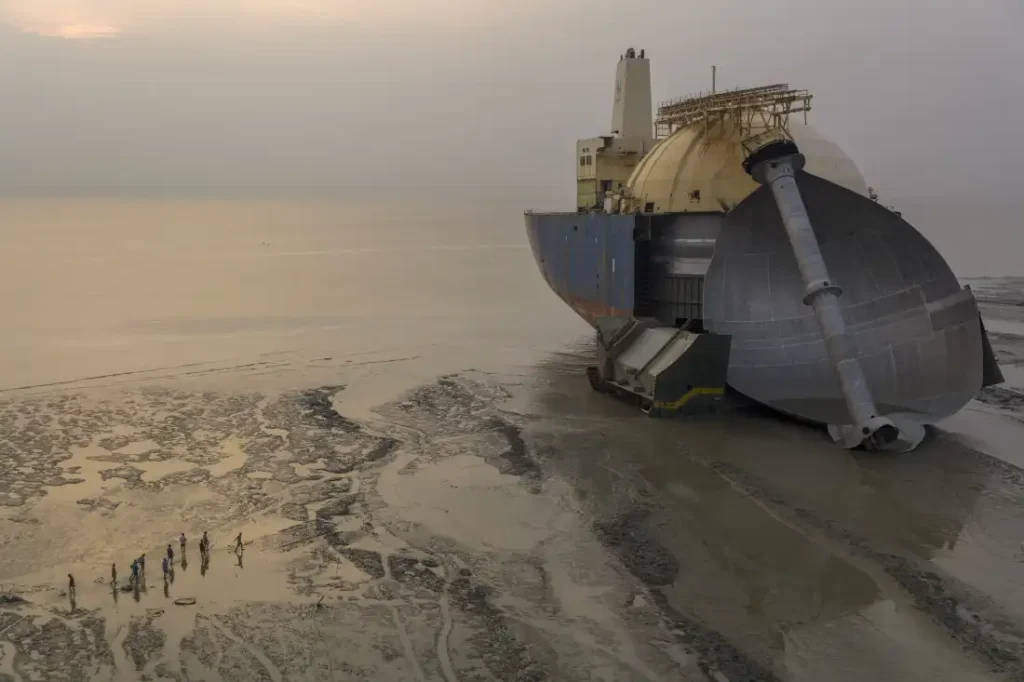
It’s a mega-recycling effort: A crew of 60 men use blow torches and winches to break down a ship that had carried liquid natural gas. Tons of metal parts will be harvested to resell overseas. This photo by George Steinmetz, from the Bay of Bengal in Bangladesh, is the overall winner in the 2026 Siena
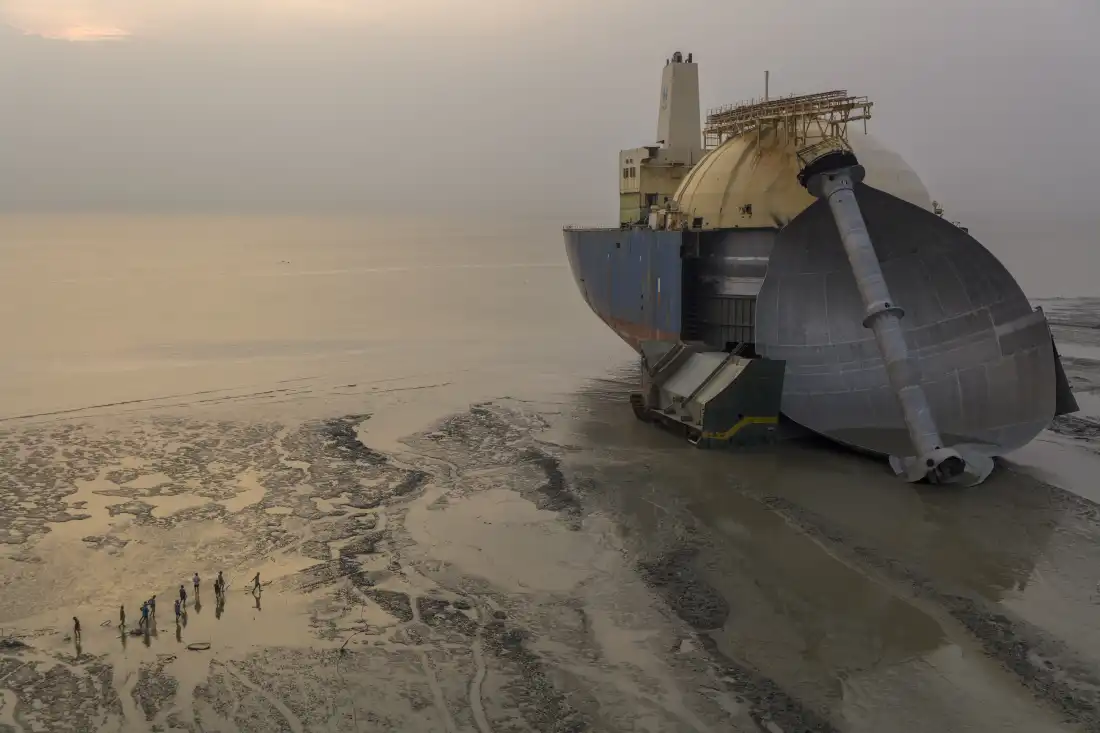
It’s a mega-recycling effort: A crew of 60 men use blow torches and winches to break down a ship that had carried liquid natural gas. Tons of metal parts will be harvested to resell overseas. This photo by George Steinmetz, from the Bay of Bengal in Bangladesh, is the overall winner in the 2026 Siena Drone Photo Awards contest.
George Steinmetz
hide caption
George Steinmetz
It looks like a spacecraft that settled gently onto a golden beach.
Off the coast of Bangladesh, an enormous vessel lies stranded on the mudflats, its steel hull partially dismantled as workers mill around it. This unusual aerial view of a tanker, specially designed to transport liquified natural gas used for cooking, electricity and transport, won photographer George Steinmetz the top prize — overall winner of the 2026 Siena Drone Photo Awards.
Each year, the Siena Drone Photo Awards highlight bird’s-eye views of our planet, revealing landscapes, livelihoods and human stories often invisible from the ground. Here, we’ve selected some of this year’s winning and highly commended photographs, focusing on the countries of the Global South.
In an interview with NPR, Steinmetz says he’s been long fascinated by Bangladesh’s shipbreaking industry, where enormous vessels from around the globe, nearing the end of their working lives, are dismantled and their materials recovered for reuse. The photograph is titled “Shipbreaking on the mudflats, Bay of Bengal.” Steinmetz sent up his drone north of Chattogram (Chittagong), along this 13-mile coastal strip, offering a stark glimpse into what this industry is like.
He was exploring the relationship between human populations and the environment for a book project and saw the industry as an extraordinary example of recycling on a vast scale.
Photographing it proved surprisingly difficult. The ship breaking industry has faced criticism from environmental organizations, human rights groups, labor unions and non-governmental organizations for its unchecked pollution, the leeching of chemicals into the sea and dangerous working conditions. Shipyard owners are wary of journalists and photographers. Local photographers initially warned Steinmetz that securing access might be nearly impossible.
Undeterred, he surveyed and photographed the entire coastline north of Chattogram with his drone, searching for a vessel that would make an especially striking photograph. He eventually settled on the liquid natural gas tanker. “The trick for me was to find the right ship, that was in a really interesting state of disassembly. And these tankers are very unusual boats. It just looked weird, like some kind of a spaceship. It takes workers a long time to break it down. And then they have to wait for the tide to be right so they can pull the pieces ashore. They have big winches and boats that they use to get the stuff ashore.”
He was able to convince the owner of the tanker to allow him to photograph it. The timing of the drone photo was crucial. Steinmetz wanted to capture the vessel at low tide, when the surrounding mudflats were exposed and workers could be seen moving around its enormous hull. Their tiny figures would look like ants, giving viewers a sense of the ship’s mammoth scale. He spent several days photographing the vessel, returning as the tides shifted and the workers continued to take the ship apart for scrap metal.
After graduating from Stanford with a degree in geophysics in 1979, Steinmetz had first dreamed of photographing landscapes from above while hitchhiking across Africa, often traveling on the roofs of trucks.
In 1996, National Geographic agreed to finance an aerial photography project around the Sahara, for which Steinmetz learned to fly a motorized paraglider. “It was like being in a flying lawn chair or [sitting on] the front of a spoon,” he says. Drones have now completely transformed aerial photography, allowing photographers to capture the world from perspectives that were once difficult, expensive or impossible to achieve, Steinmetz says.
Today, armed with a drone rather than a paraglider, he continues to explore how a view from the sky can reveal stories that remain invisible from the ground.
Southern Turkey: Carpet Fields
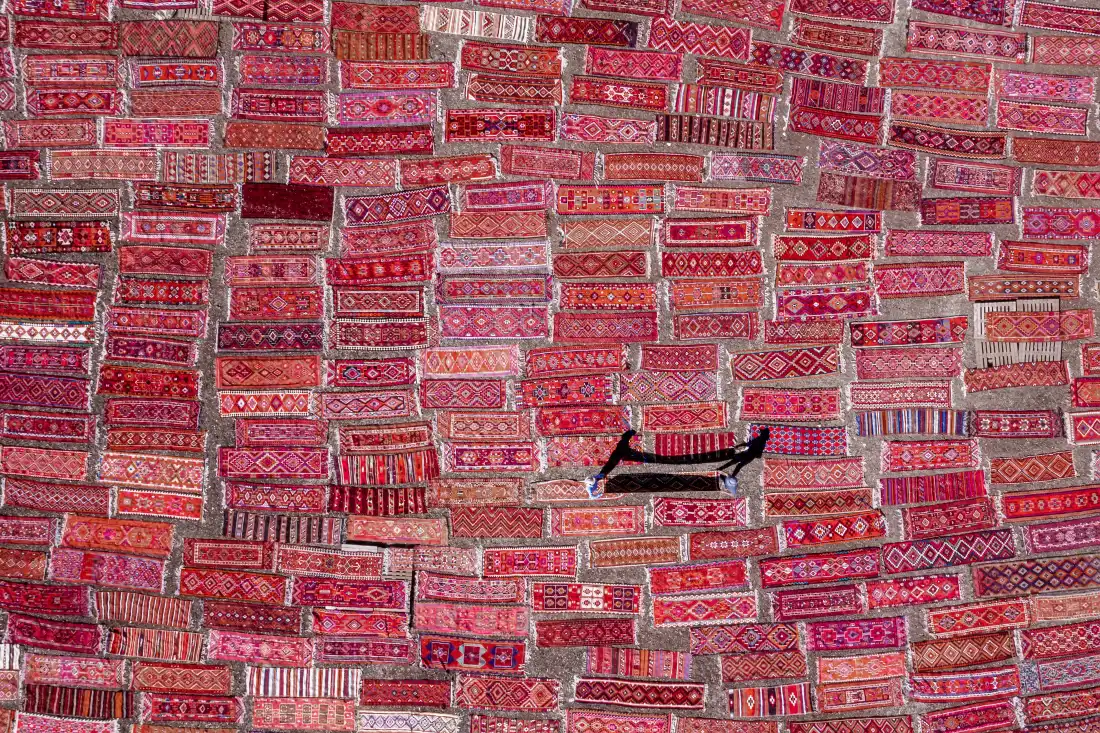
Fields of handwoven carpets transform into a visual tapestry, laid out under the sun to dry. The weeks, even months, of exposure to intense sunlight gives handmade rugs their immensely sought-after, softly faded colors.
F. Dilek Yurdakul
hide caption
F. Dilek Yurdakul
Why would anyone spread hundreds of beautiful carpets across open fields, leaving them exposed to a blazing Mediterranean sun for weeks or even months?
In southern Türkiye, this is part of a traditional process that gives handmade rugs their immensely sought-after, softly faded colors. Under the intense sunlight, the vibrant reds, blues and other hues gradually mellow into glowing, muted tones.
For Ankara-based documentary photographer and lawyer Dilek Yurdakul, the drone was not simply a technical choice. It was an essential storytelling tool. “I wanted to create an image that first attracts the viewer through its beauty but then invites them to look deeper, to discover the people, traditions and cultural memory behind it,” she says. The photograph won first place in the contest’s People section.
Yurdakul traveled six hours in blistering heat from Ankara to the Döşemealtı district of Antalya to capture this spectacle. “The first sight was astonishing. The fields were far larger than I had imagined. Thousands of carpets and kilims in different colors, sizes and patterns stretched across an enormous landscape,” she says. From above, the carpets resemble a giant patchwork quilt, almost as if melded together, but her photograph captures the shadows between these slices of color.
The aerial perspective allowed her to bring together several layers of the story in a single frame, she says: the artistic richness of Anatolian craftsmanship, the scale of the landscape and the human labor that connects them.
“For me, this was a visual metaphor for the invisibility of labor. In many societies, the people whose work sustains everyday life remain largely unseen and unrecognized.”
East Java, Indonesia: Tumpak Sewu’s Majestic Waterfall
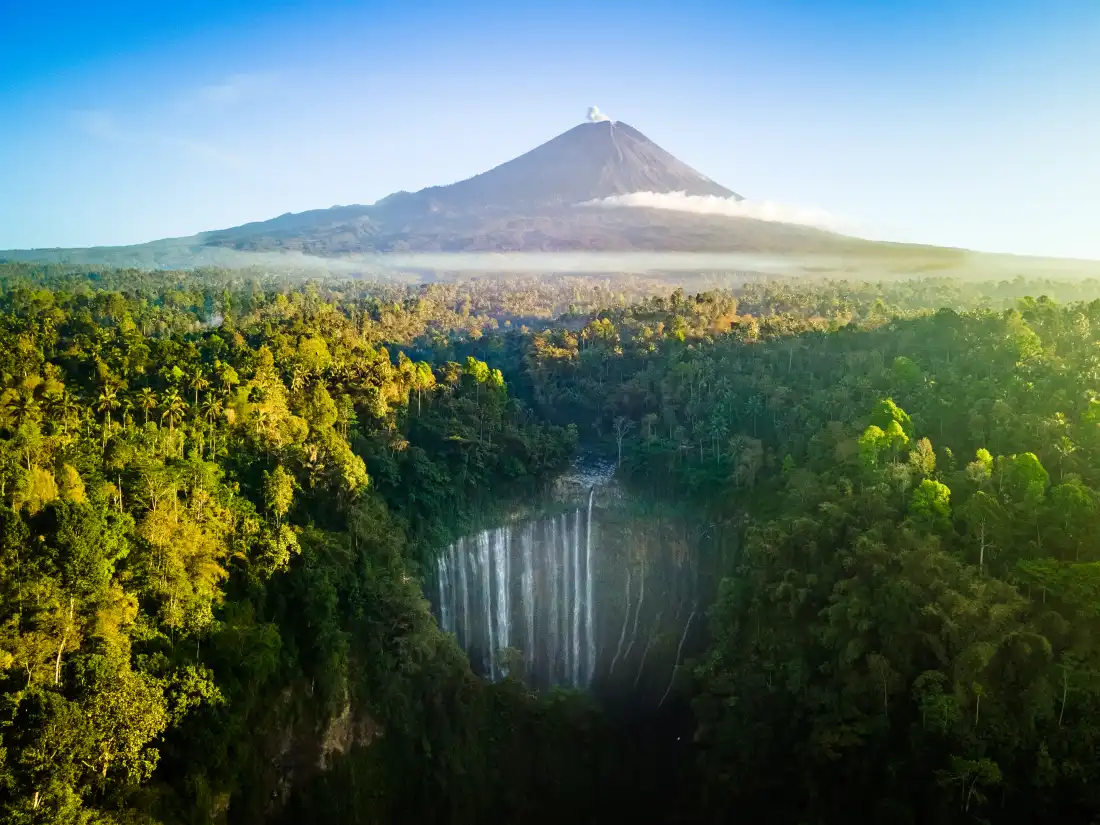
The Tumpak Sewu waterfall in Indonesia cascades from the cliffs. The drone’s eye view shows Senaru Volcano rising in the distance, sending smoke into the sky.
Colas Decloitre
hide caption
Colas Decloitre
In this photo, highly commended in the Nature category, an imposing horseshoe-shaped waterfall spills over the cliffs of East Java, Indonesia, at sunrise. Boston-based, French-British drone photographer Colas Decloitre had hoped to capture the interesting shape of the waterfall with Mount Semeru rising behind it. What he hadn’t anticipated was catching the active volcano behind the waterfall, glowing red and writhed with ash, in the middle of an eruption.
“The only way to get the right alignment of the waterfall and the volcano is with a drone, as you can only be on the side of the waterfall yourself,” he says. Using his drone, he could position the waterfall against the volcano, revealing an intriguing landscape that could only be viewed from the air.
Argentine Puna: The Last Ember
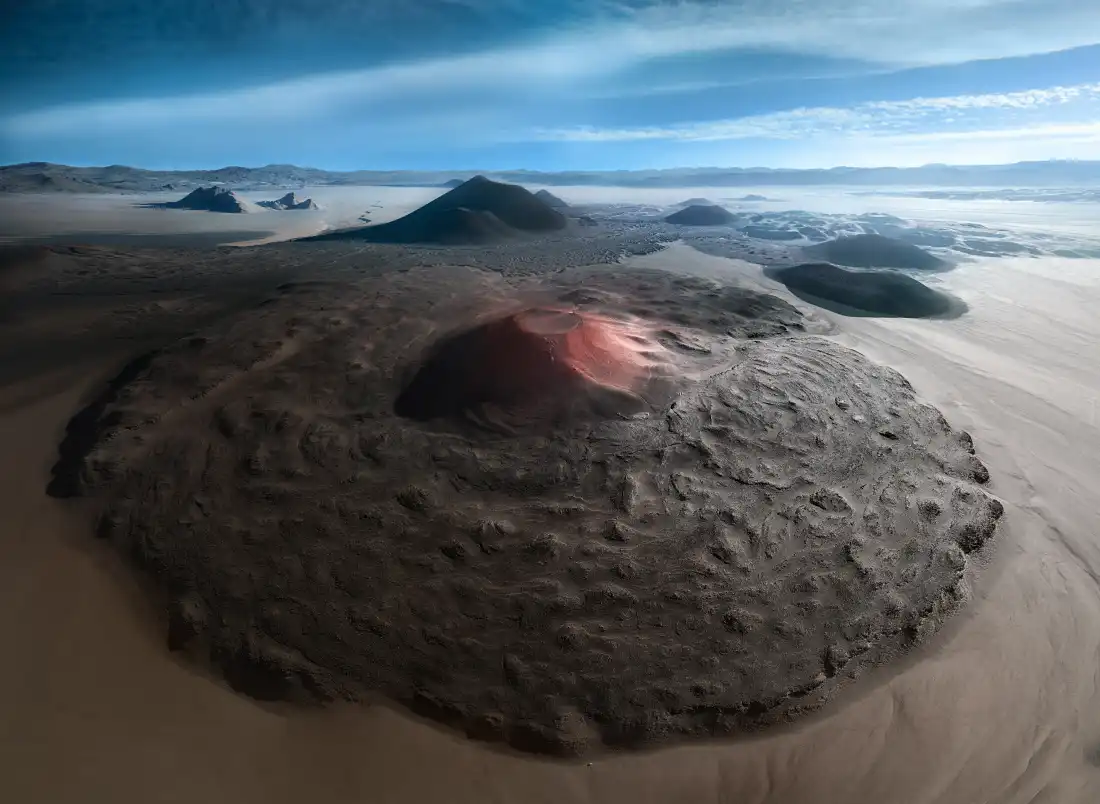
A small scoria cone glows crimson amid the volcanic deserts of the Argentine Puna. Surrounded by ancient lava flows, ash deposits and wind-sculpted terrain, it stands as a final ember in a landscape forged by fire.
Isabella Tabacchi
hide caption
Isabella Tabacchi
It looks like the glowing eye of a fiery monster.
It’s actually a volcanic cone, the pile of rock, ash and hardened lava that builds up around the mouth of the volcano over time.
The Last Ember, by Italy-based photographer Isabella Tabacchi, is an example of how a drone photo has the power to transform landscapes into a dream-like quality. It was a commended entry in the Nature category.
The photo was taken in the Argentine Puna, a vast, remote, high-altitude plateau in the Andes of northwestern Argentina: a landscape of volcanoes, ancient lava fields, salt flats and desert mountains. The cone’s reddish color comes from iron-bearing minerals in the volcanic rock, while the surrounding dark terrain consists of lava that cooled and hardened long ago.
Exploring these volcanic landscapes requires careful planning, long journeys across remote terrain and constant attention to the conditions. “At high elevations, the thin air and rapidly changing weather can also make drone operations more demanding,” Tabacchi says.
Her winning photo was a case of serendipity.
“I captured it during an exploratory flight, while studying the volcanic landscape and experimenting with different compositions,” she says. “It wasn’t even photographed during the golden hour [shortly after sunrise or before sunset] which is usually the time I prefer for landscape photography.”
“When I reviewed my photographs, I found myself much more attracted to this earlier composition. There was something about the geometry of the lava field, the small red cone and the immense volcanic wilderness surrounding it that felt far more powerful to me than the warmer, more traditionally dramatic light of the other photograph.”
It reminded Tabacchi of an important lesson she learned throughout her photographic career: Extraordinary landscapes don’t always need extraordinary light to create a compelling image.
“Sometimes the strength of a photograph comes from the subject itself, its shapes, its geological history and the unexpected perspective from which we discover it,” she says.
Lake Natron: What Lies Beneath
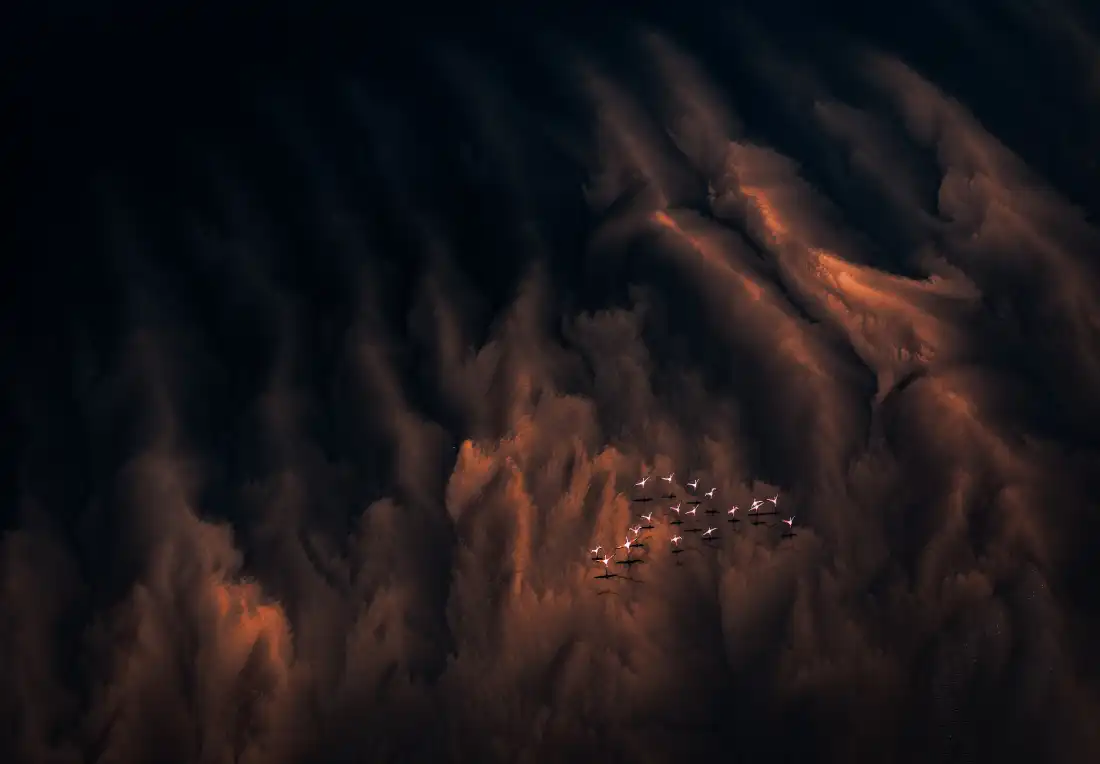
Lesser flamingos fly over Lake Natron, on the Tanzania-Kenya border, where sediment plumes move beneath the water’s surface.
Holly Kirkland
hide caption
Holly Kirkland
Another commended entry in the Nature category is Holly Kirkland’s “What Lies Beneath.”‘ At first glance, it looks like someone splashed ink over a canvas. But what seem like tiny specks of ink are actually lesser flamingos flying over Lake Natron, near the Tanzania–Kenya border. A former kindergarten teacher from Delaware, Kirkland is a self-taught photographer and plans to relocate to Kenya in the year ahead to build a larger body of aerial work.
This photo wasn’t taken with a drone. (Siena does accept other aerial photography entries in the drone category). Kirkland took the shot on a Sony A1 Mark II with a 70-200mm f/2.8 lens while hovering over the landscape in a helicopter, strapped into her seat with the door flung open.
The photograph reflects the ecosystem of the Rift Valley soda lakes — highly alkaline environments where these birds thrive as the dominant species. They are called soda lakes because they contain exceptionally high concentrations of dissolved sodium carbonate and sodium bicarbonate, the same chemical compounds found in household baking soda and washing soda.
These caustic waters would burn the skin of most other animals, but flamingos have evolved specific adaptations to turn this harsh landscape into a sanctuary. For instance, they have extra leathery, scaly skin on their legs to withstand chemical burns and specialized salt glands in their nasal cavity to filter out the excessive salt. It’s an important breeding ground for these birds, Kirkland says, with an unusual landscape, like an entirely different world, with “painterly looking plumes of sediment under the surface of the lake.”
“I’ve never seen anything like it,” she says.
“I think that when you’re looking down, there’s just so many different layers of beauty that you see from above that you could never see from the ground,” she says.
Kazakhstan: Alien Land
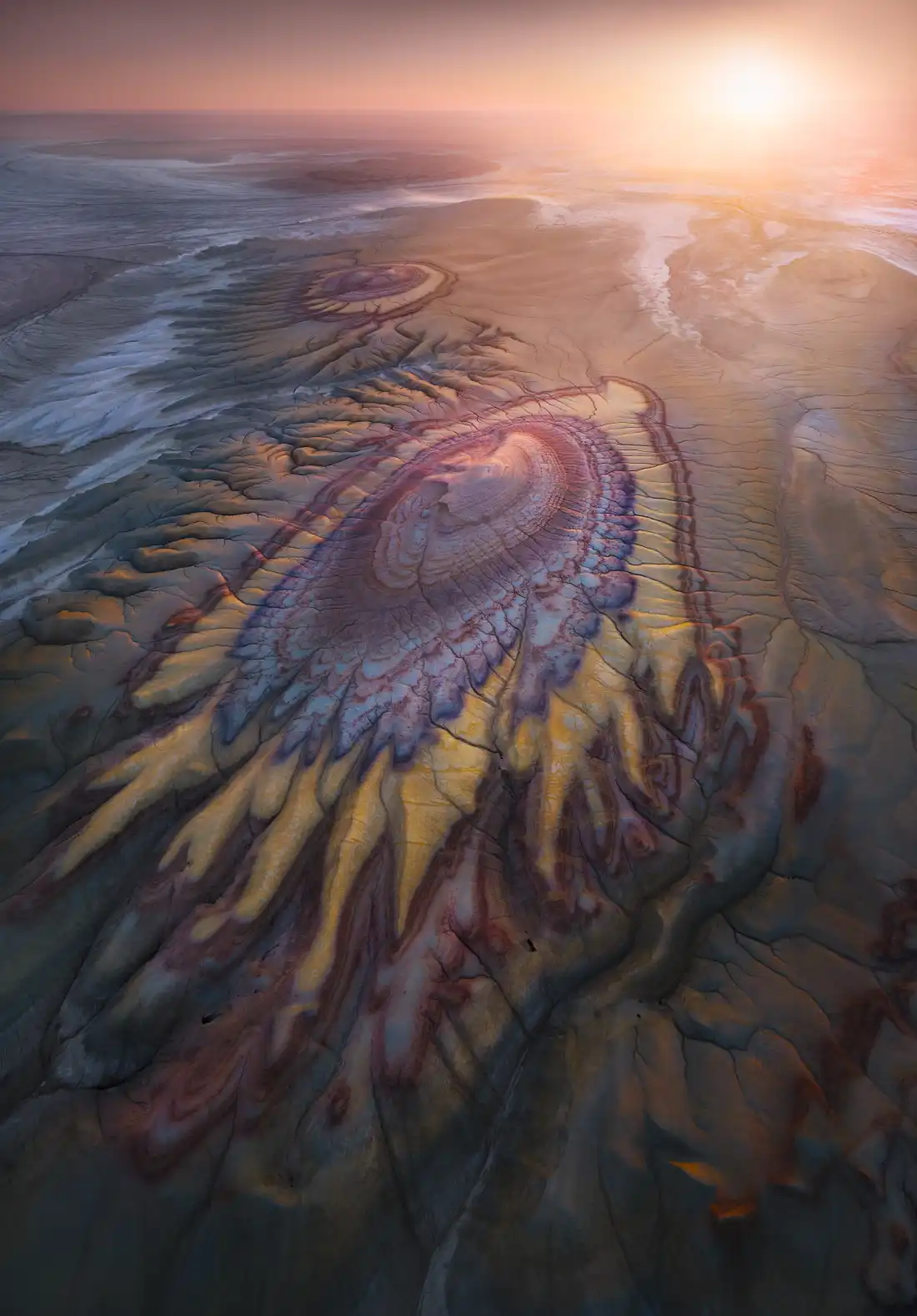
Millions of years of sediment deposition, tectonic activity and erosion created this formation in Mangystau. The geologic patterns are illuminated by the last light of day.
Isabella Tabacchi
hide caption
Isabella Tabacchi
Another highly commended photo in the Nature category by Italy-based photographer Isabella Tabacchi, the Alien Land depicts the layers and patterns of deposited sediments, tectonic movements and erosion over millions of years — natural geological formations in Mangystau, Kazakhstan.
“My fascination with Kazakhstan began in a rather unexpected way,” says Tabacchi. “I was flying from Tokyo to Rome when our plane encountered considerable turbulence while crossing Kazakhstan. I remember becoming curious about the vast country beneath us. In my imagination, it seemed like a land of remote, mysterious places, still waiting to be explored.”
In 2024, she traveled there for the first time. The formation featured in Alien Land, which she nicknamed Jellyfish (their branching patterns reminded her of a jellyfish swimming through water), was the result of extensive research rather than a chance encounter.
“I spent countless hours studying satellite imagery, searching for unusual geological shapes and patterns in the Mangystau desert,” she says. “Together with my guide and best friend Sav, I then explored the region in a Toyota Land Cruiser 4×4, trying to locate these formations on the ground. It was an extraordinary experience, turning shapes I’d discovered on a screen into real landscapes that I could finally photograph.”
Mangystau is one of the strangest, wildest, and most mysterious places Tabacchi has ever visited. “There’s something about its immense, almost empty landscapes that makes me feel completely isolated from the rest of the world, as though I’m standing at the edge of infinity,” she says. “It’s a feeling I find difficult to experience anywhere else: a mixture of solitude, freedom and wonder.”
Cox’s Bazar, Bangladesh: Rohingya Life Between Aid and Uncertainty
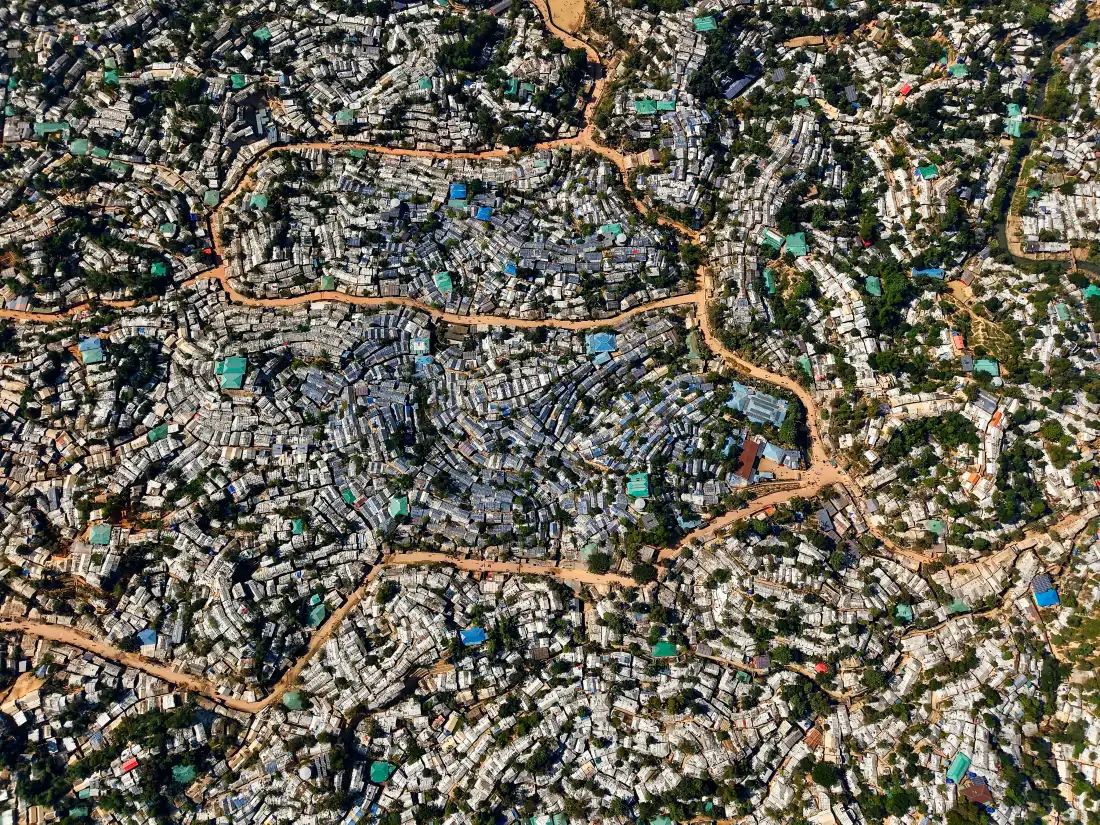
The Rohingya settlement in Bangladesh from above shows the overcrowded camps where these displaced people now live.
Shahedul Islam Sadik
hide caption
Shahedul Islam Sadik
More than 1 million Rohingya refugees currently live in Bangladesh, primarily concentrated in congested camps around Cox’s Bazar. Shahedul Islam Sadik, a student at the Faculty of Fine Arts, University of Rajshahi in Bangladesh, says he has always wanted to tell their stories.
His drone shot of the settlements was commended in the Urban category . “I wanted to document how a humanitarian crisis had reshaped not only the lives of displaced people, but also [show] the natural and geographical landscape of their place of refuge. The photograph is therefore about more than population density; it also captures the visible consequences of a prolonged crisis,” he says.
Sadik was struck by how densely populated and congested the settlements are. “What stayed with me most, however, was the sense that receiving assistance does not necessarily mean having the life one wants,” he says. “Life in the settlements can feel confined, without the freedom they once had in their homeland.”
He wanted viewers to notice not only the lack of physical space but also what it represents in the refugees’ lives. “For me, the drone photograph captures more than overcrowding; it reflects a lack of personal space, freedom and room to breathe, both literally and figuratively,” he says.
Bangladesh: Ferry boats, Dhaka
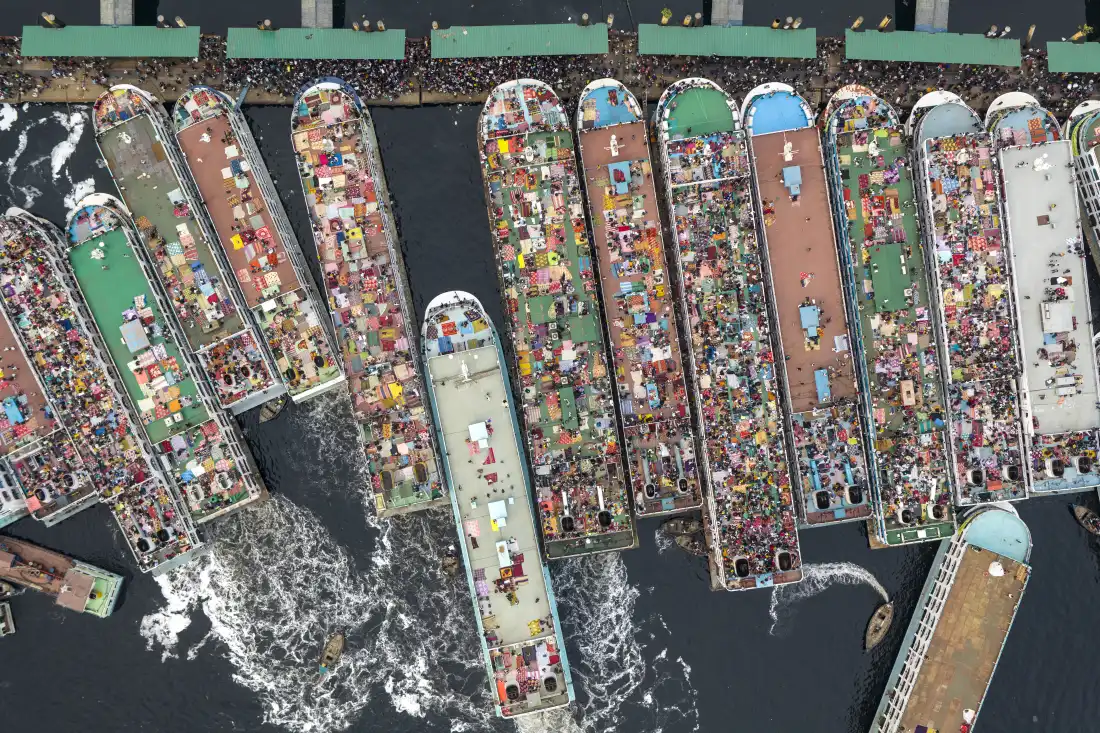
Passengers on the ferry boats at the Sadarghat Launch Terminal before the start of the Eid al-Fitr holiday on March 18, 2026. Although a new bridge was recently built across the Padma River, the rivers are still major passenger transportation routes. Due to rapid urbanization, the majority of people in Dhaka were born in rural areas and go to their ancestral home for the weeklong holiday.
George Steinmetz
hide caption
George Steinmetz
A burst of color and celebration fills the waterways of Dhaka, Bangladesh, as thousands of people make their way home for Eid, one of the most important festivals in the Islamic calendar.
Every year, the holiday triggers a massive exodus from the capital, as migrant workers and other residents travel to their hometowns to reunite with family. Ferries, packed with passengers and their belongings, become a vital means of transport.
For photographer George Steinmetz, the scene offered a striking contrast to his photograph of Bangladesh’s shipbreaking industry. This photo was commended in the Urban category. From above, the crowded boats, their brightly colored decks and passengers’ festive clothing create a vibrant patchwork against the river.
“I’ve never seen a ferry terminal like that,” he says. Dhaka’s Sadarghat Launch Terminal is widely recognized as one of the largest and busiest river ports in the world, frequented by 50,000 people every day.
“It’s such a joyous scene,” he says. “They have shopping bags full of gifts of food to bring to their families. When it’s packed with people, I knew would be really epic. And again, it’s like they look like ants.”
Steinmetz captured the scene using a drone launched from the rooftop of a building overlooking the waterfront. But he almost missed the opportunity. The skies were overcast, and rain began falling shortly after his drone made the photograph. Had the rain started any earlier, he might have been unable to fly his drone.
For Steinmetz, drones offer the freedom to explore a scene from different angles, searching for the perfect composition rather than settling for the first striking view.
“I don’t just want to get a picture. I want to get the best possible picture,” he says.
Kamala Thiagarajan is a freelance journalist based in Madurai, South India. She reports on global health, science and development and has been published in The New York Times , The British Medical Journal , the BBC, The Guardian and other outlets. You can find her on X: @Kamal_t.
For stories about life in our changing world, subscribe to NPR’s Global Health newsletter.
{For more tech updates, stay tuned to our blog.|Keep following us for the latest insights.|Check back often for more exciting news!}