Less than an hour’s train ride from central Tokyo, ecologist Kei Uchida walks through glades of mountain cherry trees and meadows filled with susuki grass as tall as an elephant. The researcher smiles when he spots something by the trail: a tangled orb of grass stalks, at about knee height. It is the nest of
Less than an hour’s train ride from central Tokyo, ecologist Kei Uchida walks through glades of mountain cherry trees and meadows filled with susuki grass as tall as an elephant. The researcher smiles when he spots something by the trail: a tangled orb of grass stalks, at about knee height. It is the nest of the tiny Eurasian harvest mouse (Micromys minutus), a species that has been on the decline in this area and has been targeted for protection.
Ecosystems depend on people: don’t abandon them
Volunteers saved this location around Mount Tenran from development 30 years ago, and today they monitor its plants and animals, thin its forests and even plant and harvest rice — all in the name of biodiversity. Here, nature needs people. In the shallow water of the rice paddy, fish as small and arched as an eyebrow swim, and just above the water’s surface, dragonflies mate. At dusk, fireflies dance above the fields.
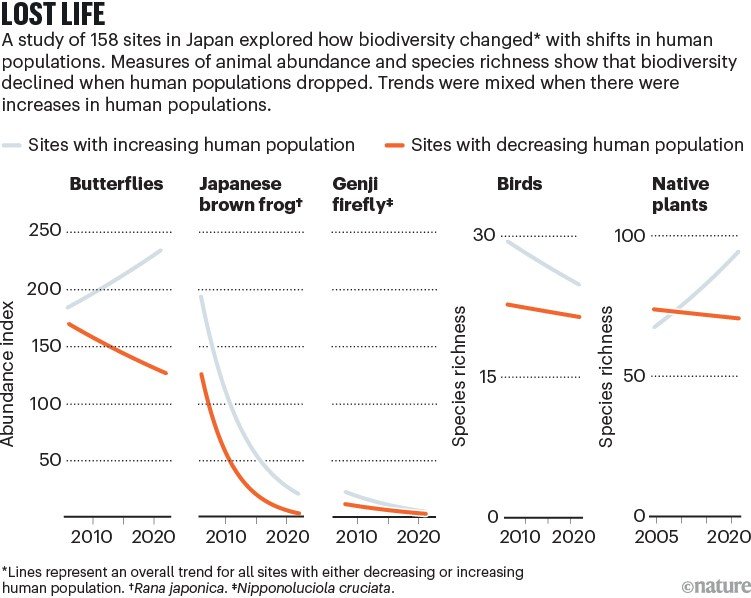
Uchida, an environmental scientist at Tokyo City University in Yokohama, and his colleagues included this site in a study of thousands of species in more than 150 wooded, agricultural and ‘peri-urban’ landscapes in Japan1. Unsurprisingly, they found that the diversity and abundance of most species declined at sites where the human population was growing. But they also found that biodiversity declined in places where the number of people was decreasing (see ‘Lost life’). This result — and others like it in different parts of the world — contradicts the common assumption that when people leave, nature always thrives.
Japan and many other nations are seeing a vast emptying of rural areas as people flock towards urban centres. Studies2 are showing that this can have a detrimental effect on biodiversity in the depopulated areas, which creates new challenges. Rather than simply setting up and managing protected areas, conservation officials must consider whether and how to recruit, train and support people to be permanent parts of some ecosystems.
I’ve joined Uchida and local volunteers to learn more about how human activity can increase biodiversity. Uchida says that this area is a typical satoyama landscape — a term that combines the words for village and mountain. “Agriculture and living things can coexist,” Uchida says. But Japan’s satoyama are being lost to depopulation and urbanization.
In this area near Mount Tenran, as in many woodlands across Japan, humans spent centuries cutting trees for fuel and removing fallen leaves for fertilizer. That opened up the forest and benefited specific plants and insects. But when that activity stopped, the forest became dense and closed in again. “We have used the woods for 1,000 years, but not lately,” Uchida says. Now, young students are being given small handsaws and taught the centuries-old art of woodland thinning.
Kojima Tsubasa, a volunteer nature monitor, shows me where he sits in the evenings to count fireflies. There are two types here: the smaller heike fireflies (Aquatica lateralis), which prefer rice fields; and the larger, brighter genji fireflies (Nipponoluciola cruciata), associated with running streams. “It’s rare to see both at once,” he says, proudly. Four days ago, Tsubasa says, he counted 60 fireflies at this paddy. Often, he is not alone. Japanese urbanites, yearning for the charm of the countryside, come here to watch the fireflies at dusk. But after the show, they get on the train and return to the brighter lights of Tokyo.
Missing people
Most Japanese people now have to travel to see fireflies — whereas once the insect’s bright beauty was right outside their homes. It’s a trend seen the world over. As recently as 1950, nearly 40% of the global human population lived in the countryside. According to United Nations data, just 19% of the world’s 8.2 billion people now live in rural areas. The global rural population is expected to peak in the 2040s and decline thereafter.
In some countries, that rural decline is well under way. Japan’s total population shrank by four million between 2015 and 2025, and the rural population is shrinking even faster. In 2025, just 8.6% of its population was classified as rural. Peter Matanle, an independent environmental social scientist who worked with Uchida on the biodiversity study, calls Japan a “vanguard country” that other nations can learn from when it comes to depopulation. European Union data, for example, show that between 2015 and 2024, rural areas in Europe lost 0.2% of their population per year. Furthermore, rural communities tend to have older populations than do urban communities, a harbinger of further depopulation.
Uchida and his co-authors studied the effects of this demographic shift by examining data on 464 species of bird, butterfly, firefly and frog as well as nearly 3,000 plant species collected in various landscapes across Japan over periods of 5–17 years, starting in 2004. They found that biodiversity declined in areas where there was greater disruption of the landscape — either by people moving in and building infrastructure or by agricultural intensification, in which corporate farms replace smaller, family-run operations.
Rewilding the planet: how seven artificial islands could help a dying Dutch lake
They also documented declines in biodiversity in places abandoned by people. Although that might seem paradoxical, the researchers note that when irrigation ceases, amphibians and many insects can no longer reproduce; other ecological niches are lost as well. The resulting dry, abandoned landscape is too fragmented for many species to recolonize. “Leaving it alone isn’t doing anyone any good,” Matanle says.
Similar relationships between rural depopulation and biodiversity have been documented in Europe. A study of 70 sites in Albania, Bulgaria, Croatia and Greece found that rural abandonment in these countries had “a consistent negative effect on bird communities”2. The species hit hardest were those that populate farmlands, according to the researchers. A European Commission monitoring scheme found that populations of farmland birds in Europe declined by 58% between 1980 and 2024, as agriculture intensified in some locations and moved out of others.
Birds are not the only organisms that have thrived in human landscapes. In Sweden, ‘semi-natural grasslands’, which have been cleared by humans and are kept open by livestock, are prime habitat for one-third of the country’s threatened species, and can contain up to 40 plant species per square metre3. As people left the countryside after the Second World War and land use evolved away from extensive pastures, the total area of these grasslands decreased by more than 90% in some regions4. In many cases, the removal of grazers led to the land being converted to row crops or forest — due to either spontaneous growth of trees or intentional planting for timber. Both types of forest are less biodiverse than the semi-natural grasslands they replaced.
In Spain, ecologist Francisco Lloret, at the Autonomous University of Barcelona, says that as people leave the countryside, biodiversity falls because some species are losing habitat and others are losing food. Vultures and other scavengers, for example, have relied on livestock for centuries, but that source of food is disappearing.
A revolution is sweeping Europe’s farms: can it save agriculture?
Wooded or herbaceous areas on the edges of fields are also in decline. In Mediterranean countries such as Spain, fields are often bounded by herbaceous borders — or by dry stone walls, which shelter many vertebrates and invertebrates. When such walls are knocked down to make larger fields for modern agricultural systems that require fewer people, those organisms are lost.
Why do so many species thrive in low-intensity farming landscapes? The mechanisms behind the relationship vary from species to species, say researchers. Some organisms prefer the standing water of rice fields, some tend towards the grasslands kept open by mowing or livestock, and some thrive at the edge of a forest. But the overarching themes of research seem to be that many species rely on the maintenance of a mosaic of habitat types and regular, modest disturbance through activities such as seasonal flooding, livestock grazing, burning, thinning and patchy clearing. Inhabited landscapes that experience such disruptions often host more species than a large expanse of undisturbed forest does.
These are the Arcadian landscapes of the Romantic poets, of The Wind in the Willows (1908) and of My Neighbor Totoro: culturally beloved ecosystems that have supported a suite of species since at least the Iron Age. “Biodiversity has evolved in the last millennia with people and human activities,” Lloret says. Some species might even have evolved to fit better into human landscapes. However, Lloret cautions that there are no universal rules. Context is king. In some places, depopulation increases biodiversity. Top predators, such as wolves, often do best in places without people. In the tropics — home to the most biodiverse places on Earth — few countries are experiencing depopulation and habitat loss is a much greater concern.
How nature needs people
In response to biodiversity losses linked to rural depopulation, a team of conservation researchers in the Czech Republic and Poland have called for small-scale farming as a conservation tool to save farmland birds5. As a bonus, such farming communities would provide “high aesthetic and heritage values”, the team argues. Uchida and his colleagues suggest “a new interventionist wilding” to complement rewilding efforts that seek to set up nature to run itself. Some schemes run by the EU aim to support farmers and biodiversity, but they’ve been criticized as being ineffective6.
After my hike with the volunteers and Uchida, we emerge from the forest just as the sky opens and rain begins to pour. We go to a nearby bakery for a Japanese snack called curry bread, and I ask the question that has been on my mind all day: who will do the work of creating habitats for vulnerable species in the countryside in the future?
Check back often for more exciting news!