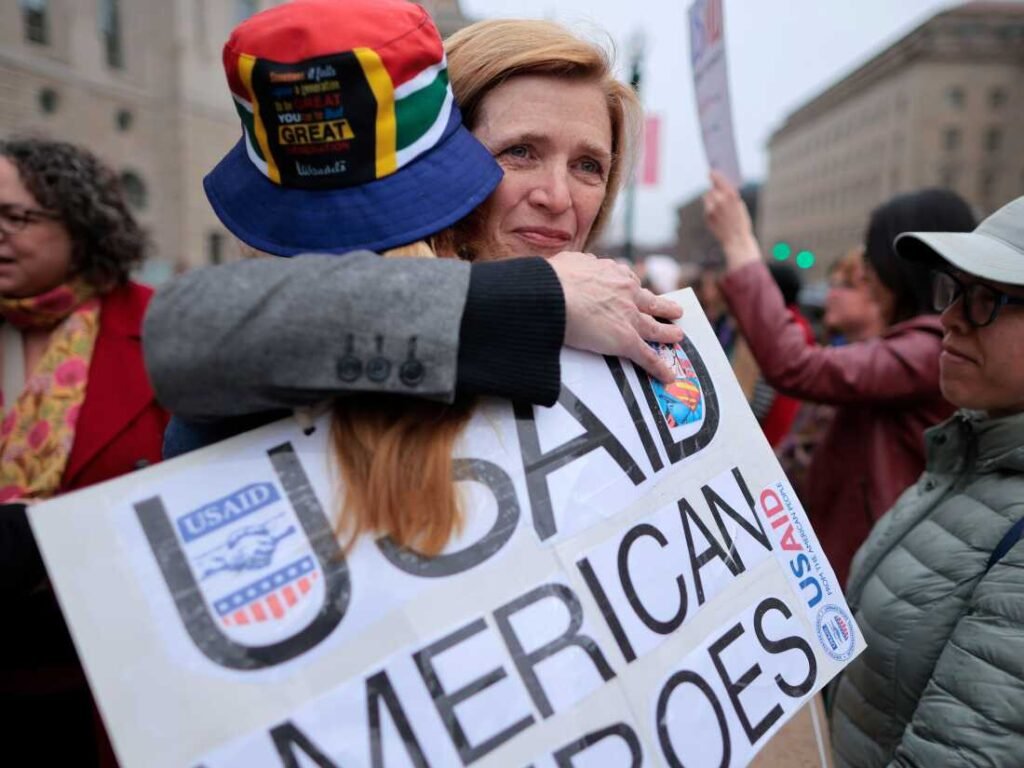
Ambassador Samantha Power (center), former director of the United States Agency for International Development (USAID), hugs laid-off employees and supporters outside the agency’s headquarters on February 27, 2025 in Washington, DC. Chip Somodevilla/Getty Images hide title toggle title Chip Somodevilla/Getty Images When Samantha Power left the U.S. Agency for International Development headquarters in Washington, DC,
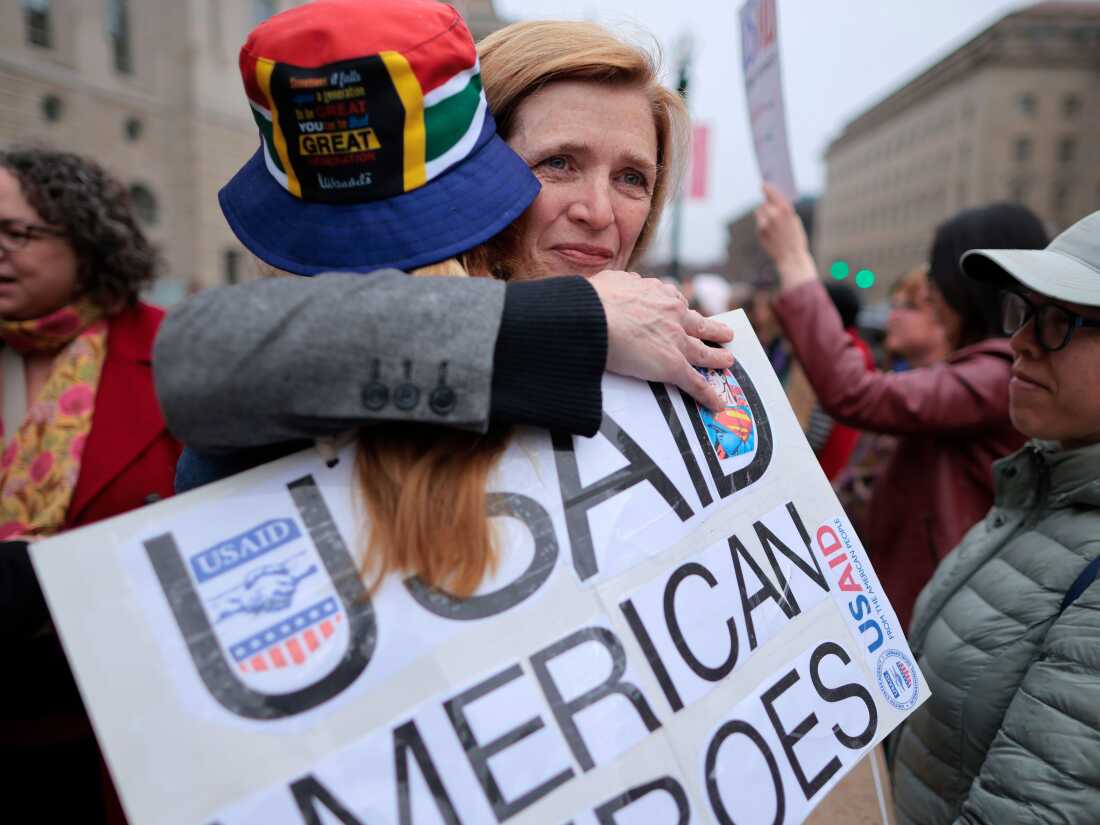
Ambassador Samantha Power (center), former director of the United States Agency for International Development (USAID), hugs laid-off employees and supporters outside the agency’s headquarters on February 27, 2025 in Washington, DC.
Chip Somodevilla/Getty Images
hide title
toggle title
Chip Somodevilla/Getty Images
When Samantha Power left the U.S. Agency for International Development headquarters in Washington, DC, for the last time on January 20, 2025, she had no idea what would become of the agency she had led under the Biden administration for the past four years.
Within days, the new Trump administration had ended all US foreign assistance, halting thousands of programs around the world (including emergency life-saving ones) and began dismantling USAID.

“I was both shocked and horrified,” Power said in an interview with NPR. “I couldn’t believe in the first instance that a human being would stop assistance, particularly life-saving assistance, without taking into account the human consequences or trying to do it in a way that allows people to make adjustments.”
Power was the last confirmed administrator of the 64-year-old agency: USAID officially closed in July 2025. It had employed about 15,000 people worldwide and managed thousands of programs aimed at fighting disease and poverty. Only a handful of former agency employees now work at the State Department, and most programs were canceled.
A year later, Power is still grappling with the loss and legacy of USAID and is filled with outrage over the administration’s treatment of its staff.
“It was very cruel, and it was as if cruelty was the point,” Power says of the way the administration carried out the takedown.
Still, Power remains hopeful that there is enough bipartisan support for foreign aid in Washington that the agency can be reconstituted in some form in the future.
This interview has been edited for length and clarity.
When you realized what the Trump administration intended to do with USAID, what did you do?
I did what so many did: I went and appealed to the Republicans. [in Congress]who he knew were close to the president and great supporters of USAID. They initially worked with me and other people behind the scenes to try to restart this program and get a waiver for it, but at some point they clearly decided that it was in their own interest to move forward. [with President Trump]”.

Many former USAID employees who spoke to NPR described feeling in a prolonged grieving process during those six months from when the Trump administration began dismantling USAID until its official closure in July 2025. How did you feel during that time?
For a long time, I think I grieved not only the agency, but also the sense of helplessness I felt toward the people who had worked faithfully in the Biden administration under my leadership, in collaboration with me.
This was a mini cataclysm for 15,000 USAID workers around the world. Each of them had faithfully served our country. They certainly weren’t doing it for money; They did it out of a sense of purpose and mission. And not being able to support them, knowing that they were not going to be able to pay the rent, knowing that some of them had to take their children out of daycare; the personal anguish that they were feeling, combined with the questions about their livelihood and the existential questions in terms of their careers that they were going through, I just wanted to be able to do something, and I felt tremendously ineffective in that period.
How do you think the loss of USAID is being felt around the world?
I think of that village that is not electrified because Power Africa, which had brought expanded and improved electric power to 150 million people in the short time it had been operating, no longer exists. What does it mean to not have US-funded election observers in some parts of the world when we know that many democratic trends are going in the wrong direction and that AI leads to massive job displacement? What does it mean that there are far fewer independent media scrutinizing whether governments are stealing from their people and serving as a check and balance?
When anti-corruption civil society organizations are closed, as has happened around the world, because they were defunded by USAID and the State Department, things are lost that will not be measured here and now, but will cause really negative ripple effects over generations.
A year after the agency closed, NGOs and aid groups appear to be continuing their work. Why do you think we should continue talking about what happened with USAID?
USAID was created by John F. Kennedy, and over the decades, the amount of goodwill this agency has earned for the United States and the American people is impossible to quantify, because it simply has no limits.
Walking away from USAID is, in addition to being cruel, incredibly foolish. It’s literally like having the best brand and saying: let’s invent a new brand, even though this is undoubtedly the most popular, most loved and most respected arm of American foreign policy in the world. Although not without its flaws, Americans want to help, and that’s what USAID really understood.
Trump administration officials say they are now more agile and efficient in responding to disasters than when USAID existed. When you look at the responses to the current Ebola outbreak and the earthquake in Venezuela, what do you see?
I see a better response, not an adequate response, but a better response from the US State Department to the Myanmar natural disaster, and clearly getting faster and devoting more resources to the Venezuela response, in part, because of the significant military and foreign policy investment made in Venezuela, in part because Marco Rubio definitely cares a lot about Venezuela personally, but for some reason, doing more is better.
But I think the biggest gaps are not the ones that are causing or earning headlines like earthquakes, hurricanes, and Ebola; It’s the fact that many things aren’t even measured in terms of health metrics anymore. Around HIV, for example, or in some communities, the cost of the loss of US assistance for girls’ education around the world, it’s not a metric that people, social scientists or economists, haven’t yet figured out how to nail down.
Critics of USAID say the agency created dependency among low-income countries, and I know this is a problem you were trying to solve during your tenure. The Trump administration argues it is making countries more self-sufficient by cutting aid and making deals with governments. Do you think the administration’s argument is justified in that sense?
Government-to-government assistance, which is actually something that the Trump administration is doing more and more, was something I was very excited about and we had launched a big new government-to-government strategy. [during my term]. But it was actually decades-old congressional concerns about whether governments were stealing resources from USAID that caused USAID and other foreign assistance arms of the U.S. government move through non-governmental actors.
So I welcome that shift towards government to government. Proper oversight is required to ensure that dollars go where they need to go, and firing all the USAID people who performed the oversight is not the solution.
Do you think there is a world in which USAID returns?
I should go back. Will it be a political challenge for President Trump’s supporters to accept a return to [USAID]? Of course. So can that happen? Can they send the cards back to headquarters, rehire everyone and say, “Oh, oops”? It’s highly unlikely that will happen anytime soon. But this year the Republican-led House and Senate sent $50 billion foreign assistance bill to President Trump’s desk for his signature.
The supporters of this work are still out there, but it will take very delicate negotiations about how to not only rebuild, but do so in a way that majorities of both parties can unite around the cause in a way that some can save face, because clearly a terrible mistake was made.
Do you hope to be part of that potential reconstitution of USAID?
Certainly. I’m doing everything I can to be part of the conversations about what the core of what returns should look like. Not everything will come back immediately, not every sector will be able to generate the same bipartisan enthusiasm as any other sector, but the key is to be open to the question of where results have been achieved. USAID spent decades accumulating those results, and the people involved in those programs must be central to the dialogue about what comes next—not just the politicians who can figure out what the policy will allow, but the experts who can demonstrate the good that was done on behalf of the American people.
NPR contacted the State Department for comment but did not immediately receive a response.
{For more tech updates, stay tuned to our blog.|Keep following us for the latest insights.|Check back often for more exciting news!}