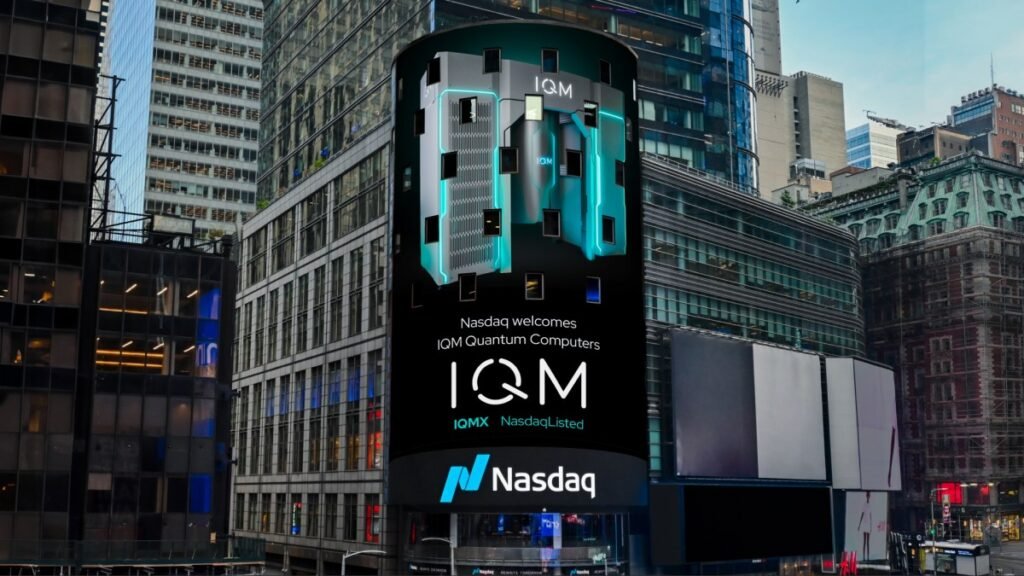
IQM, a full-stack quantum company from Finland, went public on the Nasdaq on Thursday via a SPAC merger at a valuation of around $1.9 billion. But stock prices did not rise. They spent most of the day below the IPO price – a lukewarm welcome. SPAC mergers don’t tend to be immediately popular with retail
IQM, a full-stack quantum company from Finland, went public on the Nasdaq on Thursday via a SPAC merger at a valuation of around $1.9 billion. But stock prices did not rise. They spent most of the day below the IPO price – a lukewarm welcome.
SPAC mergers don’t tend to be immediately popular with retail investors these days. But this failure was arguably driven by IQM’s own admission in its prospectus that “large-scale commercial traction of quantum computing technology may never occur.”
To be fair, this warning applies to all quantum companies. However, that hasn’t stopped the industry, including IQM, from acquiring customers who use the technology just as it does today for tasks like simulations and optimizations. IQM, which sells real physical computers as well as a cloud service, has clients such as the VTT Technical Research Center in Finland and the Leibniz Supercomputing Center in Germany.
“We sell computers in supercomputing centers and advanced data centers, and we sell computing time through the cloud,” CEO and co-founder Jan Goetz told TechCrunch.
Having gone from eight clients in 2024 to 22 in 2025 is a just cause for celebration in the IQM environment, especially when two recent clients are from the private sector. But it also suggests that demand will not increase until the “quantum advantage,” when quantum chips begin to outperform classical computers in a broader range of complex and time-consuming tasks, unlocking use cases from biotech to fintech, while potentially disrupting encryption.
But no one, not even a company that makes quantum computers, can say when that might happen.
This hasn’t stopped investors from doubling down on public and private quantum companies, further encouraged by President Trump’s recent executive orders to accelerate the timeline for quantum technology. In response, the US Department of Energy (DOE) has committed to deploying “the world’s first fault-tolerant, scientifically relevant quantum computer” by 2028.
While this follows similar announcements from France, Germany and the United Kingdom, Trump’s orders carry additional weight for IQM, which recently established a quantum technology center in Maryland and deployed a computer at Oak Ridge National Laboratory, which is part of the DOE. “We can directly benefit from it,” Goetz said.
However, unlike other European unicorns, IQM is not moving its center of gravity to the other side of the Atlantic. In parallel with its IQMX ticker in the US, where most of its quant peers are listed, it will debut tomorrow on Nasdaq Helsinki, where it expects continued support from companies like Tesi, Finland’s sovereign wealth fund.
The history of IQM is inseparable from Finland. It was founded there in 2018 as a subsidiary of Aalto University in Espoo, a technology and quantum hub near Helsinki where two-thirds of its staff still work. But another hundred of its 420-person team are based in Munich, with the rest split across multiple locations to help the company on its global rollout roadmap.
In its prospectus, IQM noted that this duality attracted RAAQ, the blank check company that helped IQM go public through a SPAC. “As evidenced by more than €200 million in public support for IQM, sovereign states and European companies have supported IQM’s emergence as a leading quantum computing company in Europe. IQM has also demonstrated its ability to operate outside of Europe,” according to RAAQ’s board of directors.
Despite global ambitions, Goetz expressed pride that IQM became the first European quantum company to list in the US, by a hair, as French competitor Pasqal also announced plans to go public via a SPAC. “It always feels good to be first and be a pioneer, but ultimately it’s about long-term success,” Goetz said.
The operation will generate new liquidity for IQM: approximately 198 million euros after costs, or 226 million dollars. But the company had already raised $300 million last September. “It’s a great success to grow shortly after Serie B,” said Goetz. This also reflects that IQM’s main objective was to position itself more prominently in a race still full of unknowns.
When you buy through links in our articles, we may earn a small commission. This does not affect our editorial independence.
Keep following us for the latest insights.