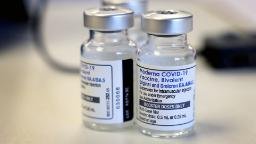
The U.S. Food and Drug Administration on Tuesday amended the terms of its emergency use authorizations for the bivalent vaccines from Pfizer and Moderna, allowing people 65 and older and certain people with weakened immunity to receive additional doses ahead of vaccination campaigns this fall. The bivalent vaccines manufactured by Pfizer and Moderna carry instructions
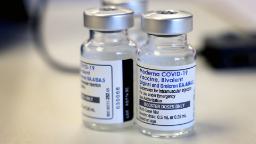
The U.S. Food and Drug Administration on Tuesday amended the terms of its emergency use authorizations for the bivalent vaccines from Pfizer and Moderna, allowing people 65 and older and certain people with weakened immunity to receive additional doses ahead of vaccination campaigns this fall.
The bivalent vaccines manufactured by Pfizer and Moderna carry instructions to combat both the original strain of the Covid-19 virus and Omicron and its derivatives.
They have been available in the United States since September under emergency use authorizations, or EUAs, which strictly restrict how the vaccines can be administered.
On Tuesday, the FDA changed the terms of the authorizations for those vaccines so that certain people could receive an additional dose before most others.
That is, adults age 65 and older who have received a single dose of a bivalent vaccine can receive an additional dose at least four months after their first dose.
Most people with some degrees of immunosuppression who have received a first dose of a bivalent vaccine can receive a second dose at least 2 months later. Additional doses may be given at the discretion of your healthcare provider.
Dr. Peter Hotez, co-director of the Center for Vaccine Development at Texas Children’s Hospital, has been calling on the FDA to increase access to bivalent boosters for those who want them. He says, for the most part, the agency’s current guidance makes sense.
“My only question is why the age limit of 65? What was it based on? Normally I would have preferred it to be lowered to 60 or even 50,” Hotez said in an email to CNN.
“For those Americans who understand its importance, we should make second bivalent boosters available. Finally, we will soon need guidance on another annual booster in the fall. Presumably, that information will come sometime this summer,” he added.
For immunocompromised children ages 6 months to 4 years, eligibility to receive additional bivalent doses will depend on the vaccine previously received, the FDA said in a news release.
Another big change is that most unvaccinated people can now receive a single dose of a bivalent vaccine, rather than multiple doses of the original single-strain vaccines, the agency said. The FDA simplified its recommendation for unvaccinated people after acknowledging that most Americans now have some immunity against Covid-19, even if it is only due to past infections.
“There is now available evidence that the majority of the US population aged 5 years and older has antibodies to SARS-CoV-2, the virus that causes COVID-19, either from vaccination or infection, which may serve as a basis for the protection provided by bivalent vaccines. COVID-19 remains a very real risk for many people, and we encourage people to consider staying up to date with vaccinations, including a bivalent COVID-19 vaccine. Available data continue to show that vaccines prevent the most serious outcomes of COVID-19, which are severe illness, hospitalization, and death,” Dr. Peter Marks, head of the FDA’s Center for Biologics Evaluation and Research, said in a news release.
Children ages 6 months to 5 years who have not yet been vaccinated can now receive a two-dose series of the Moderna bivalent vaccine as the primary series, or a three-dose series of the Pfizer-BioNTech bivalent vaccine if they are between 6 months and 4 years of age. Children 5 years old can receive two doses of the bivalent Moderna vaccine or a single dose of the bivalent Pfizer-BioNTech vaccine.
Children ages 6 months to 5 years who started receiving monovalent vaccines can now receive one dose of a bivalent vaccine, but the number of doses they qualify for will depend on the number of doses they have already received and the type of vaccine they received.
The agency noted that most people who have received one dose of the bivalent vaccine are not currently eligible for a second dose.
And they encouraged everyone who has not yet received their first dose of a bivalent vaccine to do so, and many Americans are still in that group.
Only about 17% of those eligible, less than 1 in 5 Americans, have received the recommended dose.
Over time, adults with reduced immune function due to age or an underlying health problem have been asking doctors if they need another dose of bivalent vaccines.
The US Centers for Disease Control and Prevention has reported preliminary data showing that the effectiveness of bivalent vaccines, including against emergency room visits and hospitalizations, has already begun to decline.
But the agency has not been free to make what is known as a “permissive use” recommendation on boosters, which would allow doctors to offer additional doses to vulnerable patients due to the terms of the EUA.
The updated terms give the CDC and its Advisory Committee on Immunization Practices (ACIP) greater freedom to recommend additional doses of bivalent vaccines. The ACIP will hold a meeting on Covid-19 vaccines on Wednesday and is expected to endorse the FDA changes.
For everyone not covered by today’s changes, the FDA says it intends to make decisions on future vaccines after receiving recommendations on the makeup of the fall strains from its advisory committee in June.
Both Canada and the United Kingdom have offered another round of bivalent boosters to those most at risk of contracting Covid-19 this spring.
Keep following us for the latest insights.