Monday’s national blackout was the third this year and comes on top of state-imposed power cuts to conserve what little fuel remains. Some rural areas are plunged into darkness for up to 70 hours at a time, while planned blackouts of up to 30 hours have occurred in urban areas. The state power company did
Monday’s national blackout was the third this year and comes on top of state-imposed power cuts to conserve what little fuel remains.
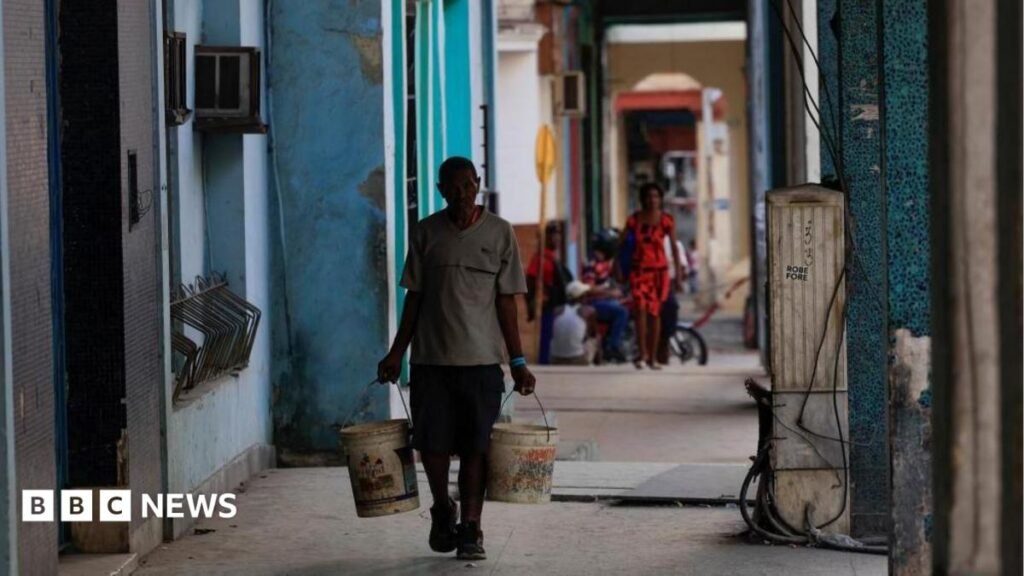
Some rural areas are plunged into darkness for up to 70 hours at a time, while planned blackouts of up to 30 hours have occurred in urban areas.
The state power company did not say what had caused this latest unplanned incident.
The country’s second-largest city, Santiago de Cuba, was among places where power had yet to be restored as of Tuesday afternoon local time.
Cuban President Miguel Díaz-Canel has recognized the growing discontent among Cubans.
“There is a shortage of transportation, food, medicine, there are long power outages that last more than 20 hours, that causes dissatisfaction, no one can be happy, people are suffering,” he told reporters from Claridad, a Spanish-language weekly based in San Juan, Puerto Rico.
But he urged Cubans to direct their anger toward the U.S. government instead of him, adding: “People are banging pots and pans, some angrier than others. I say: direct your pots at our northern neighbors, who are the ones behind these power outages.”
However, the US ambassador to the United Nations, Michael Waltz, placed the blame squarely on the Cuban government.
At a UN General Assembly meeting on Tuesday, he urged her to “change your ways and turn the lights back on for your people.”
He added that “there always seems to be enough power for the Cuban dictatorship.”
But Cuban Foreign Minister Bruno Rodríguez accused the United States of waging a “multidimensional and unconventional war” against Cuba, which he said had “become increasingly cruel” in the past seven months.
Relations between the United States and Cuba, which have been tense for decades, have deteriorated rapidly since the beginning of the year, when US President Donald Trump accused the island’s government of posing a threat to US national security.
Shortly after US forces captured former Venezuelan President Nicolás Maduro – a close ally of the Cuban government – in January, Trump also openly reflected that Cuba was “ready to fall.”
The Trump administration has since imposed new sanctions on Cuba, as well as an effective blockade on oil shipments to Cuba, threatening to impose tariffs on countries that supply it with fuel.
The United States has also brought murder charges against former Cuban President Raúl Castro, who remains an influential figure on the island despite being 95 years old.
Despite trading barbs publicly, the two countries have been holding talks privately in recent weeks.
The Cuban Minister of Foreign Affairs affirmed this Tuesday that these talks “do not show progress,” but left the door open “to dialogue based on mutual respect and non-interference in Cuba’s internal affairs.”
For more tech updates, stay tuned to our blog.