To do what the PFIPC did, an agency in Nigeria must pass through some of the most powerful offices in government: the secretary to the government of the federation; in fact, the chief administrator of the government, the head of the civil service, the accountant general who controls the public accounts, the budget office and,
To do what the PFIPC did, an agency in Nigeria must pass through some of the most powerful offices in government: the secretary to the government of the federation; in fact, the chief administrator of the government, the head of the civil service, the accountant general who controls the public accounts, the budget office and, finally, the parliament, which must turn spending into law.
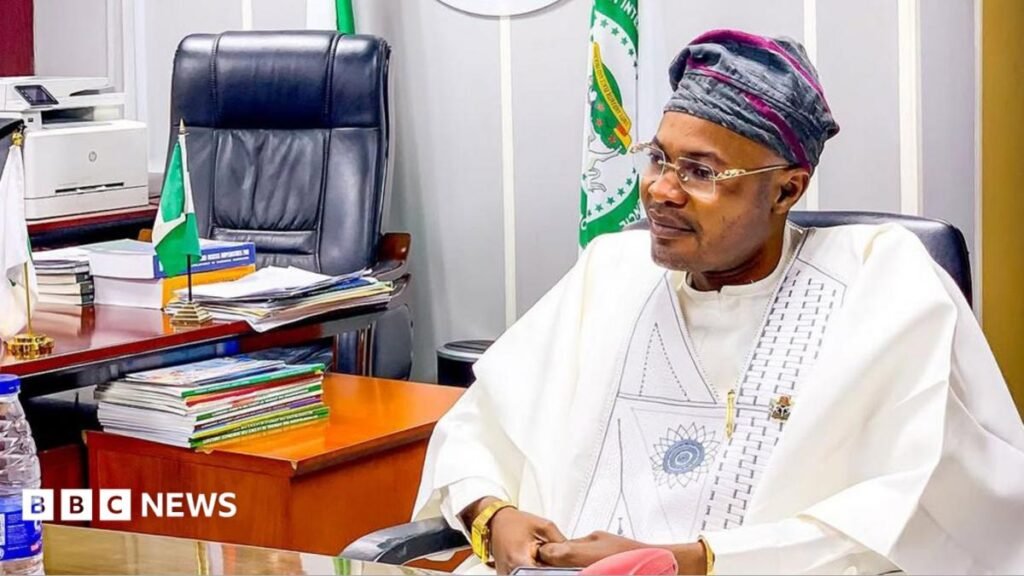
Babachir Lawal is at the top of that chain.
He served as secretary to the government of the federation, the office that assigns agencies their space and status, under Tinubu’s predecessor Muhammadu Buhari.
“There is no way [that office] “In a normal system we wouldn’t know that the agency is fake,” he told the BBC. “You can’t create a budget code yourself without the budget office knowing about it.” “There must be collusion with internal officials.”
His conclusion was forceful: “You must have officials within the system who validate your corrupt behavior.”
Oluseun Onigbinde arrives at a similar vision through a different route.
He co-founded BudgIT, a Nigerian transparency group that first brought attention to the council’s funding. He notes that the PFIPC does not appear in the budgets for 2023, 2024 or 2025, but then emerges, fully formed and with its own budget code, in 2026.
“This agency actually emanated from and was found in the budget of the executive,” he said, meaning it came from the president’s own side of the government, not from parliament. “The functional head of the agency cannot do it alone. It has to come from the House of Representatives. [the president’s office]”he told the BBC.
Onigbinde listed the checks that a genuine agency must pass: an office in the federal secretariat, public administration approval, a budget code and a multi-step approval to open a bank account. He said the “lone imposter” explanation didn’t add up.
“I don’t know how you go through all these leads and end up finding out that this agency is fake,” he said. “It has support. The government just has to be honest about who exactly the people involved are.”
The government’s own account has changed. His spokesman first said Adeyemi had “fraudulently opened” an account at the Central Bank of Nigeria. The accountant general’s office later said no such account was ever activated and no public money was released.
The distinction matters.
Even if no money came out of the treasury, the affair has shown how easily the appearance of a true government institution can be created in Nigeria, a country that actively courts foreign investors, whom this council was apparently created to attract.
The BBC asked the presidency how the agency obtained its office, its staff and its budget line, and why it prefers an internal investigation to an independent one. Presidential spokesperson Bayo Onanuga did not respond to the BBC’s request for comment.
Gbajabiamila’s lawyers said his position was set out in a legal letter and that he would not grant interviews. In that letter, seen by the BBC, they describe Adeyemi’s allegations as false and defamatory, say the two men have never met and demand that he recant or face criminal and civil proceedings, including a claim for N10 billion in damages.
President Tinubu has ordered the country’s anti-corruption commission to investigate and report within 30 days, including “the role of any public officials” who may have helped. Critics point out that he did so while publicly declaring “100% confidence” in Gbajabiamila, who is listed as a witness in Adeyemi’s legal case. Opposition parties, senior lawyers and activists are demanding an independent judicial investigation instead.
Nigeria is no stranger to large-scale corruption, but past scandals have tended to share a common ending: many names mentioned, few convictions.
Tinubu took office in 2023 promising reforms and targeting over 7,000 convictions and over N500 billion recovered in two years. Critics say those figures are dominated by low-level Internet scammers, while politically connected figures are rarely touched.
What sets PFIPC apart is not the amount of money, which is modest compared to some previous scandals, but the method. This was not money stolen from a contract. It was, supposedly, an entire arm of government created from nothing.
Onigbinde describes it as “a symptom of the dysfunctional budget process.” He links it to the rapid growth in the number of government bodies: a 2012 official review recommended cutting Nigeria’s agencies, but their number has roughly doubled, to more than 1,200.
“It is a costly waste of public resources,” he said, in a highly indebted country. As the investigation expanded, its most acute effects were felt far from Abuja. Police searching for Adeyemi, who had gone into hiding, went to his family home in Ogbomoso, southwestern Oyo State, and arrested his elderly father, Chief Adetunji Adeniyi.
Keep following us for the latest insights.