
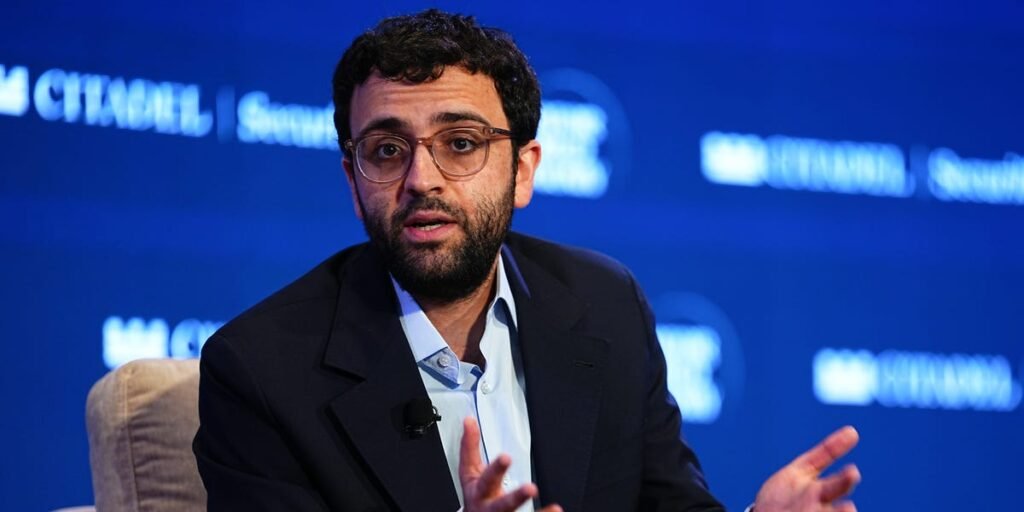
At Kalshi, most employees report directly to both founders of the largest US prediction market in what CEO Tarek Mansour described as a deliberately “unusual” management structure. Speaking on a recent episode of Sequoia Capital’s “Long Strange Trip,” Mansour said he and his co-founder Luana Lopes Lara have about 150 direct reports with little traditional
At Kalshi, most employees report directly to both founders of the largest US prediction market in what CEO Tarek Mansour described as a deliberately “unusual” management structure.
Speaking on a recent episode of Sequoia Capital’s “Long Strange Trip,” Mansour said he and his co-founder Luana Lopes Lara have about 150 direct reports with little traditional hierarchy in between.
“There are some roles that we allow them to do what they do,” Mansour said, “but pretty much the majority of the company depends on the two of us.”
Mansour and Lara founded Kalshi in 2018 after meeting when they were students at the Massachusetts Institute of Technology.
The CEO acknowledged the management style is “quite unusual” but said compensation is a company that can adapt quickly, even if it is “a little chaotic.”
“I think you could build an organization that sort of agrees with that, because what you get out of chaos is continuous, constant adaptability,” Mansour said. “It is very easy for a company to adapt, very easy.”
His goal, Mansour said, is to keep the company flexible enough to “constantly reorient and rally around the biggest challenges or the biggest opportunities.”
“You want to be able to do that without friction; that’s inherently chaotic,” he said, adding, “your structure needs to be as adaptive as possible.”
During the podcast, Mansour told host and Sequoia Capital partner Brian Halligan that he doesn’t follow any leadership manuals and described his approach as “making it up as you go.”
Mansour called him and his co-founder, Lara, “probably kind of business illiterate.”
“We haven’t read all the books, we haven’t watched all the podcasts,” he said.
Mansour said he is focused on Kalshi’s overall strategy, while Lara focuses on the company’s day-to-day operations.
“In fact, I think in some ways we disagree by design,” Mansour said. “We have this thing, this dynamic over time, it’s become something where we will essentially always take the opposite side of the argument.”