
Kirk McKinney was riding his bike near his home in Massachusetts about six years ago when he came across a gold mine: a dumpster full of trash, sure, but also speakers and electronics. “Someone had thrown away this perfectly good pair of speakers,” he told Business Insider. “I asked the guy at the landfill if
Kirk McKinney was riding his bike near his home in Massachusetts about six years ago when he came across a gold mine: a dumpster full of trash, sure, but also speakers and electronics.
“Someone had thrown away this perfectly good pair of speakers,” he told Business Insider. “I asked the guy at the landfill if I could take them and he said yes. I just couldn’t believe it.”
McKinney, a high school student at the time, returned to the dump again and again looking for more speakers for his collection. Eventually, he built a sound system in his bedroom that “rocked the whole house,” he said.
“My mom wasn’t happy about it at all.”
When his mother told him he needed to get rid of the speakers, he decided to try reselling them.
“I sold my first radio on Facebook Marketplace for $50,” he said. It was the most money he had ever earned for an hour of work. “That’s when I discovered what entrepreneurship was.”
From selling garbage to eliminating it
The more time McKinney spent at the landfill, the more he got to know the people who did junk removal work. Finally, he started working for them. After learning to drive, he thought he could do the same himself.
“I was basically doing all the work for them,” he said. “The guy was paying me pretty well and still took money at the end of the job. I finally realized that I’m already hauling junk items from the landfill back and forth. Why not offer this service to people on my own?”

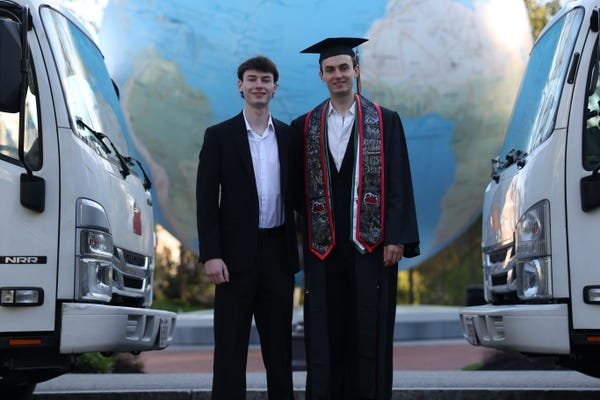
The McKinney brothers attended Babson College in Wellesley, Massachusetts. Kirk graduated in 2026, while Jacob enters his third year. Courtesy of Kirk and Jacob McKinney.
To start, he needed two things: another pair of hands and a vehicle. He recruited his younger brother, Jacob, who had his own small business splitting firewood, and the brothers pooled their savings to buy a $4,000 Ford F-150. That was in 2021.
His first job, which came through a recommendation from the garbage collection workers Kirk had helped, was small but encouraging.
“We were hired to move a couch for about $100,” Kirk said. “It took us 15 minutes. It was pretty good.”
His first customers came mainly by word of mouth. They also posted on Nextdoor, in local Facebook groups, and leaned on family and friends to help spread the word.
Not all jobs went as well as the first. They said an early cleanup of the house took them about nine days, a job they estimate would now take the company about half a day. They had to rent a U-Haul and a dumpster because their truck couldn’t handle the volume.
“In the beginning, we were literally doing everything we could to make it work,” Kirk said. “We were just a couple of kids in a van with couches hanging, like three feet above the top of our van, tied up with straps.”
They learned through trial and error and by asking questions. They called other junk removal companies, explained that they were young and trying to learn the business, and asked how they rated the jobs. Over time, they got better at estimating, loading, and sorting.
“We started to become masters at stacking, breaking down and sorting things,” Kirk said. “It was almost like Tetris, where you just had to fit everything perfectly into the right place.”
Growing into a seven-figure business operating in multiple markets
The first big turning point came in early 2022, when the brothers reinvested most of what they had earned into a dump truck. It costs just over $80,000.
The purchase changed the business immediately. They said the dump truck could hold about eight times as much as the van, which would allow them to take on more jobs, reduce trips to the landfill, set more efficient schedules and start hiring friends to help.

The McKinney brothers have built a team of young employees. Her first hire was a friend from high school. Courtesy of Kirk and Jacob McKinney
By the end of 2022, with the pickup truck, the dump truck, a few employees, and a small amount of paid marketing, they made just over $200,000 in sales, according to a profit and loss statement seen by Business Insider.
In 2023, they bought another dump truck and rented a warehouse after they outgrew their parents’ driveway. The warehouse gave them a place to park trucks and store items they could donate, resell or reuse. That year, they raised almost seven figures.
In 2025, they reached $3 million in revenue. They are on track to raise more than $5 million in 2026.
Garbage removal is relatively easy to get started, but the low barrier to entry also makes the industry competitive. One way Junk Teens stands out, the brothers said, is through speed and communication. Most customers want their trash removed the same day or next day, so responding quickly can determine whether they win the job.

The brothers started the business with a $4,000 Ford F-150 before upgrading to a dump truck. Courtesy of Kirk and Jacob McKinney
They also leaned on what made them different: their age. Initially, the company was called K&J Removal, but Kirk said he realized that clients hired them because they were hard-working, hustling teenagers. That became the basis of the Junk Teens brand.
“I just took what made us stand out, our competitive advantage, and built a brand around that,” he said.
Today, Junk Teens has expanded beyond its main location in Norwood to Cape Cod, the North Shore, and Rhode Island. The company has about 25 employees and five dump trucks, and the brothers said they eventually want to expand nationally.
Kirk said the brand has also helped them build an online audience. Junk Teens has more than 500,000 followers on social media platforms, which the brothers say has helped with visibility and hiring of young workers.
His advice: start small and be good to people.
Jacob said one of the most important skills for young entrepreneurs is learning “the people game”: how to communicate, ask for help, find mentors and build relationships.
“At the end of the day, business is business, but the whole world is made of people,” he said. “If you want to go into business, I think you have to get into that whole person game first.”

Junk Teens originated when Kirk stumbled upon a dumpster near his house and began collecting speakers. Courtesy of Kirk and Jacob McKinney
Kirk’s advice is to simplify the first step. He said many people overcomplicate entrepreneurship by waiting for the perfect idea, the perfect plan or the right amount of money. Junk Teens didn’t start with a national vision. It all started with a sale, then a truck, then a job, then a reinvestment decision.
“You need to hit one realistic goal at a time over and over again, slowly and steadily, and it compounds,” Kirk said. “That’s how the greatest things are created.”