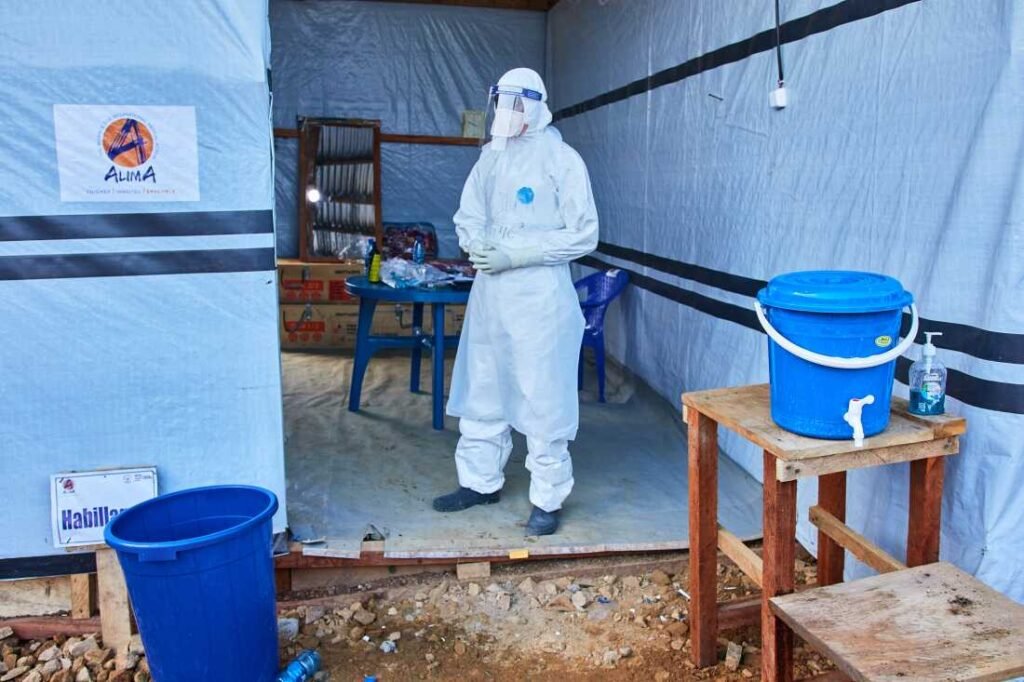
A health worker at the Evangelical Medical Center, in Bunia, eastern Congo, on Friday, July 3, 2026, where Ebola clinical trials are scheduled. Dirole Lotsima Dieudonne/AP hide title toggle title Dirole Lotsima Dieudonne/AP Eighty percent of new Ebola cases in eastern Congo arise from unknown chains of transmission, the World Health Organization said Tuesday, a
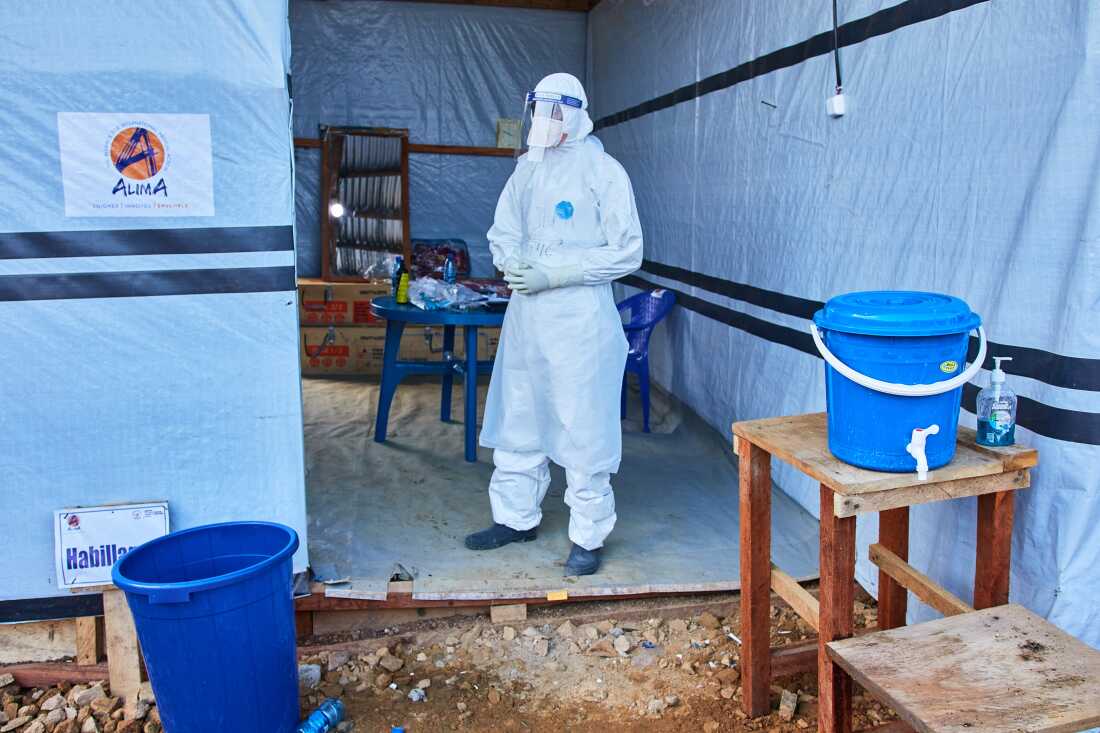
A health worker at the Evangelical Medical Center, in Bunia, eastern Congo, on Friday, July 3, 2026, where Ebola clinical trials are scheduled.
Dirole Lotsima Dieudonne/AP
hide title
toggle title
Dirole Lotsima Dieudonne/AP
Eighty percent of new Ebola cases in eastern Congo arise from unknown chains of transmission, the World Health Organization said Tuesday, a sign that the outbreak is spreading faster than health officials can track despite a growing response.

Congo has been battling an outbreak of a rare type of Ebola since May, with no approved treatment or vaccine. The Africa Centers for Disease Control says it is the fastest-growing Ebola outbreak on the continent.
“Perhaps the most alarming finding is that many of the newly reported deaths are people who died in their communities without even reaching a health center and without receiving care,” Chikwe Ihekweazu said after returning from Bunia, in Ituri province, one of the worst-affected cities. “And today, 80% of new cases are outside our contact lists and, therefore, reach us from unknown transmission chains.”
People who die outside the health system cannot be isolated, treated or traced promptly, increasing the risk of further transmission.
The outbreak, Ihekweazu said, “continues to outpace response efforts.”
As of Monday, at least 1,926 people have been infected, of whom 702 have died, in three Congo provinces from the rare Bundibugyo virus, Congolese authorities said. Cases have also been confirmed in neighboring Uganda.
Ihekweazu told reporters in Geneva that his visit to Bunia had been “quite encouraging on many fronts, but also deeply worrying.”
Treatment capacity in Bunia is now close to 800 beds, with capacity increasing every week, and laboratory capacity has increased from 1 to 14 laboratories, an effort that the emergency chief praised.
However, Ihekweazu said that despite “our best efforts… we have not managed to catch up in the race.”
Lack of funding, attacks on health facilities, an ongoing conflict in eastern Congo and mistrust among local communities have hampered the response.
Dozens of health workers at an Ebola virus treatment center in northeastern Congo went on strike Monday over unpaid salaries and bonuses. On Tuesday they agreed to resume work on the condition that the government pays them within 72 hours.
“A single day of strike has already caused damage. Patients have not been able to access the center,” the striking health workers said in a statement. “We hold the government solely responsible for any loss of life if the site closes after this ultimatum.”
Congolese authorities declared a new Ebola outbreak on May 15 after the disease had been transmitted for weeks without official detection, according to the WHO. Clinical trials for the treatment began last week after researchers launched a long-awaited study in hopes of combating the virus.
The U.S. Centers for Disease Control and Prevention said on July 11 that a U.S. citizen working for a humanitarian organization in the Congo tested positive for the Ebola virus, without providing further details.
{For more tech updates, stay tuned to our blog.|Keep following us for the latest insights.|Check back often for more exciting news!}