
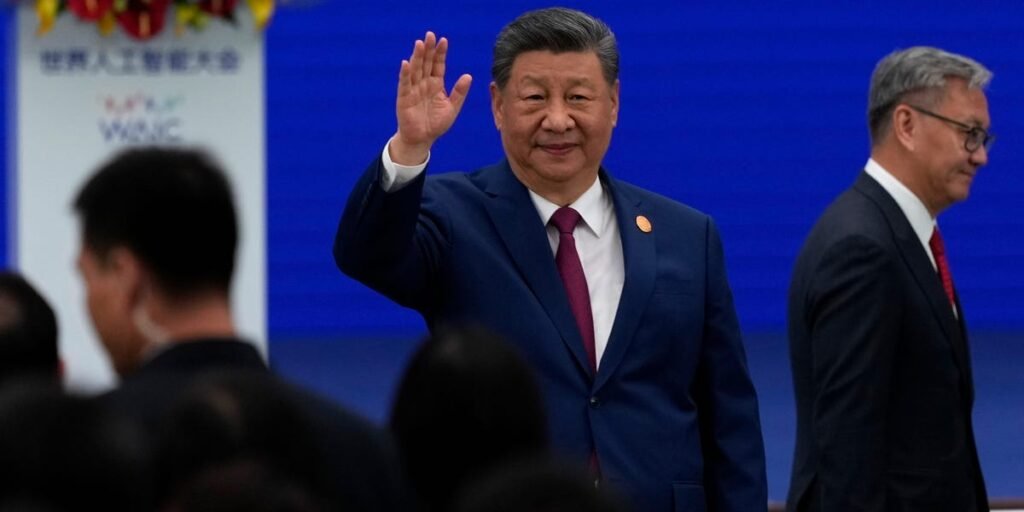
The world’s AI superpowers differ on one key strategy: openness. Chinese leader Xi Jinping shared his philosophy on AI at the World Artificial Intelligence Conference in Shanghai on Friday. He called for both greater regulation of the technology and its open access. In a list of four remarks, Xi first called for a “principle of
The world’s AI superpowers differ on one key strategy: openness.
Chinese leader Xi Jinping shared his philosophy on AI at the World Artificial Intelligence Conference in Shanghai on Friday. He called for both greater regulation of the technology and its open access.
In a list of four remarks, Xi first called for a “principle of openness.”
“We must seize this rare and historic opportunity to foster open source, openness, collaboration and sharing,” Xi said.
Many of the most important Chinese models are open source, including DeepSeek, the company that surprised Silicon Valley last year. Newer competitors, such as Z.ai’s Kimi K3 and GLM 5.2, are also open source.
Meanwhile, American labs mostly operate private, closed-source models. Meta opened its general Llama models, but not its proprietary Muse Spark model. Although its name says “open,” OpenAI models are, in fact, closed.
Anthropic models are also closed source. CEO Dario Amodei said in 2023 that open source models were going down a “dangerous path” because companies can’t moderate usage or revoke access.
Xi, however, had a different opinion. “China is willing to be more open, take more practical measures and take a more visionary perspective,” he said in his speech.
His second observation called for global regulation of AI, ranging from “technological monitoring” to “early response systems.” He was also quick to criticize the United States for its AI protectionism.
“We must jointly oppose exaggerating the concept of national security in the AI dispute or putting the security of one country before that of others,” Xi said.
Indeed, American leaders have long been wary of China’s advances. President Donald Trump delayed one of his executive orders because he believed it could diminish the advantage of American companies over China in the AI race.
China has not always been so happy to share. The Chinese government, for example, ordered Meta to unwind its acquisition of Manus, a Chinese company. AI agent startup that had moved to Singapore.
Xi also said we should use AI to “increase understanding, tolerance, exchanges and sharing.”
At the beginning of his speech, Xi raised a number of big questions that needed answers. One question: How can we “realize AI for all when the gap continues to widen?”
He seemed to respond to that in his fourth observation: that the world should “advocate for solidarity and improve global governance.”
“We should carry out extensive international cooperation and help countries in the Global South with capacity development to close digital and artificial intelligence gaps,” Xi said.
He promised to provide 5,000 AI seminar and training opportunities to countries with less advanced AI technology.