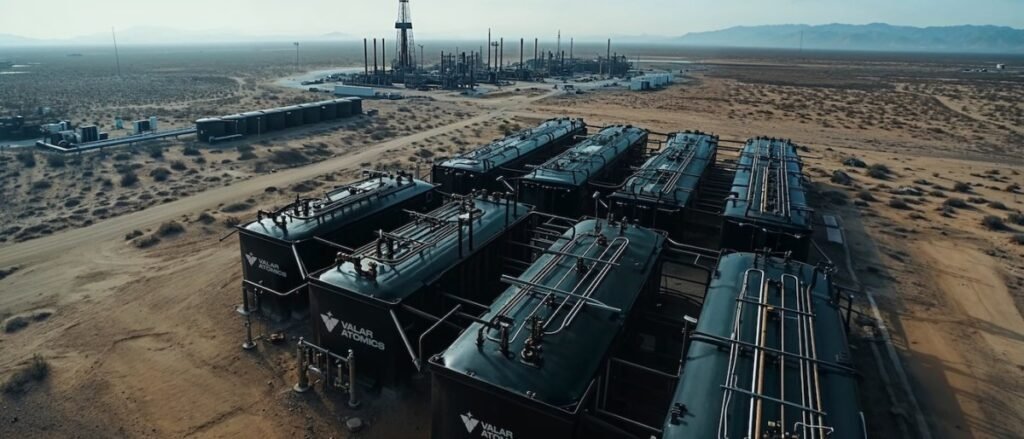
Valar Atomics, a startup that builds small modular nuclear reactors (SMRs) — essentially factory-built miniaturized power plants designed to be cheaper and faster to deploy than traditional reactors — is in talks to raise a new round of capital, according to three sources familiar with the company. The company, founded three years ago, is seeking
Valar Atomics, a startup that builds small modular nuclear reactors (SMRs) — essentially factory-built miniaturized power plants designed to be cheaper and faster to deploy than traditional reactors — is in talks to raise a new round of capital, according to three sources familiar with the company. The company, founded three years ago, is seeking a valuation of about $6 billion and Sequoia is expected to lead the deal, the people said.
The Information was first to report on the funding discussions, including that the El Segundo, California, startup is raising a $1 billion round.
Some of that capital was previously raised at a lower valuation, the people told TechCrunch. Specifically, Valar has raised $450 million, including $340 million in equity and $110 million in debt, at a valuation of $2 billion, according to a Bloomberg report from March.
Deals structured into multiple installments with different valuations, occasionally executed at different times, are becoming increasingly common in today’s AI-driven fundraising environment. These arrangements can create the perception that capital was invested at a single, uniform valuation. In reality, investors in the same round may end up paying different prices for the same company, a distinction that matters more than ever as outsiders try to compare hot startups against each other.
Sequoia and Valar Atomics declined to comment.
Earlier this month, the company demonstrated that its nuclear reactor provided a small amount of power to an Nvidia AI chip. Concurrent with that proof-of-concept demonstration, Valar and Nvidia announced a partnership to explore the development of nuclear power to power future AI data centers.
Valar’s rise plays against a broader demand crisis. Data center electricity needs are expected to grow sharply in the coming years, and utilities in many regions are years away from adding enough new capacity. That void has made nuclear power, long plagued by cost overruns and regulatory bottlenecks, one of the most closely watched corners of the AI infrastructure boom.
Valar counts Palmer Luckey, the founder of Anduril, and Shyam Sankar, CTO of Palantir, among its backers. Others pursuing the opportunity include Kairos Power and TerraPower (backed by Bill Gates), which are building next-generation reactors aimed at industrial and technology customers, and NuScale Power, the only SMR developer with US regulatory design approval (it won approval for an improved, higher-performance reactor design last year).
Valar’s technology is based on a high-temperature gas reactor cooled by helium. The company says it eventually plans to build hundreds of SMRs to power data centers. But while SMRs are theoretically cheaper to manufacture than traditional reactors, the technology is still nascent and it is not entirely clear how long it will take to implement it on an industrial scale.
At its core, Valar has taken an aggressive legal stance toward its regulator. Last year, it joined several states and rival startups in suing the Nuclear Regulatory Commission, arguing that the agency wrongly applies the same lengthy licensing process to small test reactors that it uses for full-size commercial plants. (The case has not remained unresolved, and both sides repeatedly suspended litigation, suggesting some sort of settlement is in the works.)
The company was founded by Isaiah Taylor, who dropped out of high school when he was 16 years old. The 27-year-old said he launched two startups before Valar and proudly shared that his great-grandfather worked as a nuclear physicist on the Manhattan Project.
When you buy through links in our articles, we may earn a small commission. This does not affect our editorial independence.
For more tech updates, stay tuned to our blog.