One of the most important things happening on Earth today is the increase in solar energy. Around the world, companies and countries are rushing to deploy solar power and batteries to achieve energy independence and limit the effects of climate change. However, that construction runs into a challenge in the labor market, with a limited
One of the most important things happening on Earth today is the increase in solar energy. Around the world, companies and countries are rushing to deploy solar power and batteries to achieve energy independence and limit the effects of climate change.
However, that construction runs into a challenge in the labor market, with a limited supply of workers to meet growing installation demand. Robots could be one answer, but industrial robots have historically struggled in unstructured environments, at least until now. The latest generation of AI models may have changed that equation.
That’s the driving idea behind Gritt, a startup founded by two Carnegie Mellon-trained roboticists, CEO Puneet Puri and CTO Vishal Dugar. The company quietly emerged Tuesday morning with a $26 million Series A funding round led by Obvious Ventures with participation from Union Square Ventures and Active Impact Investment. That brings its total funding to $34 million, following a previous seed round backed by First Round Capital, Climactic, Congruent Ventures and VSC Ventures. The startup is building a smart system to “help civilization build infrastructure faster,” in Puri’s words.
“Our thesis is that if we really want to accelerate construction,” Puri tells TechCrunch, “we need intelligence that can work in the chaotic outdoor environments of these construction sites, and it has to be generalizable enough that it can work in these varied environments.”
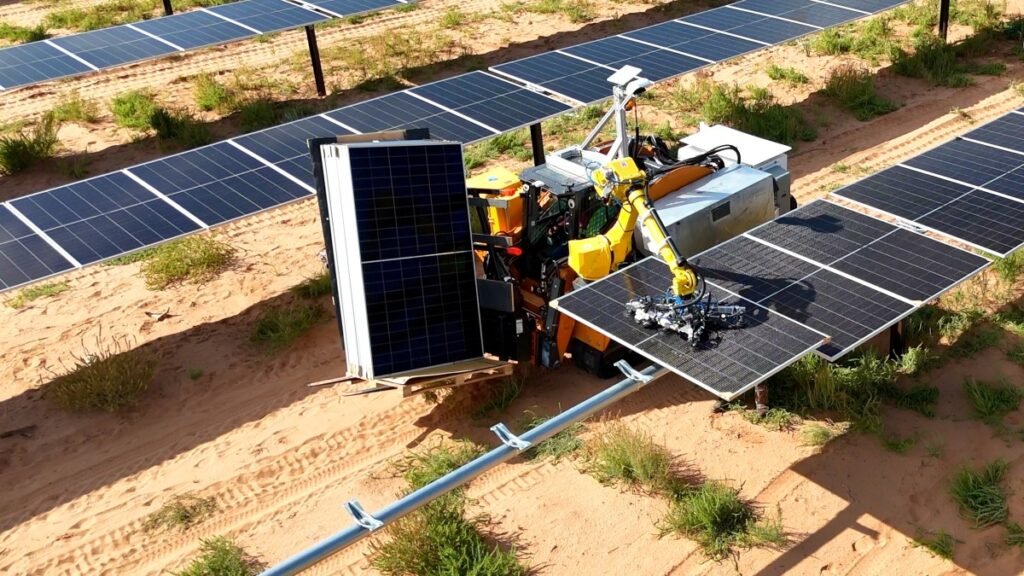
Instead of building its own robots from scratch, Gritt uses off-the-shelf hardware (so far, rented skidders and robotic arms built by companies like Kawasaki) to build platforms controlled by its AI models. The first job their systems do is to unload large glass solar panels, transport them to the metal frames where they need to be installed, and place them on the frames with submillimeter precision so workers can secure them.
“There are people who used to build rockets that went to space and had an infinite budget for the smallest part, and then there are people who know what it means to take dirty, boring, dangerous jobs and scale them like crazy,” said Andrew Beebe, the Obvious Ventures partner who led Gritt’s Series A round. “These guys are in the second camp, and it’s a special kind of entrepreneur who has the technical skills, the artificial intelligence and the computer vision skills to make it work.”
Gritt currently has two systems deployed in the field and uses the data they collect to improve their behavior. Puri says a typical team of eight people can install 800 panels per day, but the same team working on Gritt’s systems can install 3,000 to 4,000 panels per day.
Now, the company says it has a contract to help install 2.8 gigawatts of solar panels over the next 18 months and that its clients include three of the top 10 U.S. energy construction companies. The company expects to operate 48 of its systems in the next six months.
TechCrunch spoke with a Gritt customer who did not want to be identified for competitive reasons, but who was excited about the system’s ability to improve their work. He hopes it will be easier to work in remote sites where it is difficult to attract workers and anticipates a reduction in injuries since workers will not have to repeatedly lift 100-pound panels above their heads.
Gritt is competing against companies with their own panel installation robots such as Luminous Robotics, Cosmic and China’s Trinabot. Those companies are building their own hardware, rather than focusing on off-the-shelf vehicles and weapons like the Gritt, a difference that could determine who grows faster and with a tighter cost structure as demand grows.
Gritt wants to add new handling tasks to his system so he can hold solar panels, drill poles, and even build the frames they sit on. Longer term, he also wants to move on to other common, labor-intensive construction tasks, such as tying up rebar before pouring concrete over it.
What enabled the startup to pursue this vision? Mainly, the emergence of new AI models, the founders say.
“Making a system for a solution was still possible to some extent five years ago, right?” Puri said, but AI is now making that work generalizable: the same underlying process can be reused and improved across tasks. As an example, he noted that training the system to stack concrete blocks took weeks, while a similar demonstration with rebar tying took just one day using the same software.
But training new tasks is just the beginning of Gritt’s vision. The founders believe that the suite of sensors and intelligence their systems bring to workplaces can do more than install panels; can drive management and decision making. For example, imagine that your system detects that a trench is open as a storm approaches, allowing you to alert workers to cover it before the rain damages components or flags missing inventory.
“Gritt now becomes this physical AI layer, which performs this skillful and laborious task, and can also help you make decisions on site,” Puri said.
When you buy through links in our articles, we may earn a small commission. This does not affect our editorial independence.
For more tech updates, stay tuned to our blog.