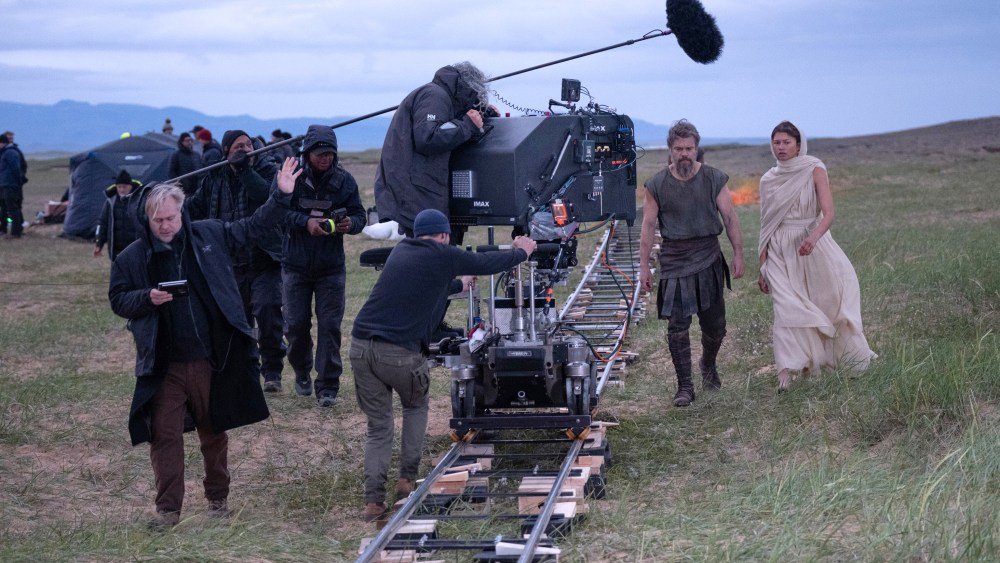
Across five countries and 91 days, Christopher Nolan and the cast and crew of “The Odyssey” were pushed to their limits as they worked to bring Homer’s epic to the screen. They filmed in the ocean, on steep mountain passes, through dense forests and sandy beaches, battling wind, rain and scorching sun in an act
Across five countries and 91 days, Christopher Nolan and the cast and crew of “The Odyssey” were pushed to their limits as they worked to bring Homer’s epic to the screen. They filmed in the ocean, on steep mountain passes, through dense forests and sandy beaches, battling wind, rain and scorching sun in an act of daring cinematography almost as punishing as Odysseus’s long journey home.
“I don’t think I’ve ever felt as exhausted as I did at the end of this shoot,” says a heavy-lidded Nolan the day after the film’s New York City premiere. “It was the hardest thing I’ve ever done. It was a test of endurance for all of us.”
Some locations were so remote, so unforgiving, that no one had dared to film there before. Many days began with crew members climbing over rocky terrain just to get to the location where they would film.
“It felt more like an expedition than a movie,” says Matt Damon, who plays Odysseus. “The running joke while we were filming was, ‘Wow, Greece was tough; I’m sure Italy will be easier,’ and then we’d get to Italy and it would be just as intense. So you’d think Iceland would be a breeze, and then we got to Iceland, and it was raining sideways and we were filming all night.”
It helped that Nolan braved the elements along with everyone else. “I was always next to the camera,” Damon says. “When we were cold and wet, he was cold and wet. If you were climbing a mountain, he was climbing a mountain.”
Filming was supposed to last even longer. “We could have filmed another nine days,” Nolan says. “But the reality is that we were made. We couldn’t have been on those ships any longer than we were, we couldn’t stand it. So, yes, we finished early, but we also stumbled over the finish line.”
It’s 24 hours until “The Odyssey” opens on July 17, and I’m sitting with Nolan in his publicist’s office in SoHo. The $250 million R-rated epic is expected to be one of the biggest hits of the year, and the reviews for the film are just in: They’re glowing. Nolan is calm, if tired, dressed in a blue jacket and sipping a cup of tea despite the 95-degree heat. A lot depends on him. The film features celebrities like Damon, Anne Hathaway and Tom Holland, but Nolan, who became a household name with the “Dark Knight” franchise, and then a draw in his own right with “Inception,” “Dunkirk” and “Oppenheimer,” is the star attraction. In those films, Nolan maintained his auteur fire while creating big, bold populist extravaganzas.
“They broke the mold with him,” says Samantha Morton, who plays the witch Circe. “Somehow he manages to communicate with anyone who just wants to be entertained. and with movie fans. “I don’t know anyone else who has done it like him.”
“The Odyssey” may be set in an ancient world, but Nolan saw it as an opportunity to test the limits of modern technology by shooting the film entirely with Imax cameras. It’s the first film to do so, and the result is a film of truly monumental scope: not only does the sack of Troy and the battle with the Cyclops fill the huge Imax screens, but the palace intrigue that awaits Odysseus when he finally returns to Ithaca also plays out on a grand scale. But achieving it was a tough test. Imax cameras are heavy tools, weighing 300 pounds each and roaring like Cuisinart blenders. Initially, cast members struggled to figure out how to act around something they compared to a van.
“It was an exercise in blind trust in Chris,” admits Hathaway, who plays Penelope, Odysseus’s wife. “Chris has a loyal group around him, and many of them had used Imax cameras to film action sequences. But they had never done intimate scenes like the ones I was in. They were all beginners in some ways.”
Additionally, the cameras only hold less than three minutes of film, so they need to be constantly recharged, often in the middle of a scene. After some trial and error, Nolan opted not to yell “Cut!” when a camera ran out. Instead, he would gently ask the cast to take a break, quietly get more film, and ask them to pick up where they left off.
“When I say ‘cut,’ a bell rings and everyone grabs a cigarette or scratches their butts,” Nolan says. “It’s a word you don’t want to use if you want to maintain some tension. There’s a sacred space between ‘Action’ and ‘Cut’ in a movie. You want everyone to come together instinctively, free their conscious minds, and do great work at the same time instead of peaking at different points. The harmony you need is like a performance on stage.”
“The Odyssey” is being positioned as a big old-fashioned swords-and-sandals adventure, the kind of blockbuster that made blockbusters their name. But most of those films were escapist adventures, and while “The Odyssey” is exciting and full of spectacular settings, it contains much more important themes. In some ways, it is a spiritual sequel to “Oppenheimer,” Nolan’s most recent film, which explores J. Robert Oppenheimer’s guilt in unleashing the atomic age. When Damon, who appears in both films, read the script for “The Odyssey,” he saw parallels between Oppenheimer’s role in building the bomb and Odysseus’s role in developing the Trojan Horse, an ingenious ruse that allows his army to raze the city of Troy. Both innovations lead to carnage on a massive scale.
“You see echoes of Odysseus’s genius in Oppenheimer’s and the tragic consequences of his discoveries,” says Damon. “Both men are tortured by what they have done.”
Part of what Nolan hoped to uncover in his latest film was the Greek concept of xenia, or the law of Zeus, according to which hospitality should be extended to strangers, essentially because you never know if someone is really a deity in disguise. In “The Odyssey,” this civic duty is frequently ignored with disastrous consequences. “It’s supposed to keep people on the right path,” Nolan says. “I was interested in the idea that the interdependence of people is the basis and possibly the definition of civilization. And both ‘Oppenheimer’ and ‘The Odyssey’ show us how often that is ignored and therefore how fragile civilization is and how it can easily be undone.”
Like Homer’s poem, the film adaptation of “The Odyssey” takes place in a mystical world, in which men fight monsters, walk among gods and witness miracles. But Nolan wanted to root the film in reality. That meant using practical effects as much as possible instead of CGI, so that the mythical elements of the story never seemed too fantastical.
“The word Chris kept using was ‘grounded,’” Damon says. “I wanted things that were real and tactile. I wanted layers of dirt in the closet. I wanted the sets to look like real places where people lived and worked, so that it seemed relatable and not a distant world.”
The details of “The Odyssey” remain the same. After defeating Troy and setting sail for home, Odysseus, the ruler of a small kingdom, and his men are blown off course. At the edge of civilization, they fight to stay alive, harassed by giant cannibals, mermaids whose songs drive sailors mad, and a sorceress who transforms men into pigs. But it is also a human story about the costs of war and the innocent people who are swept away by the rubble. Morton, who plays a sorcerer who gains the upper hand over Odysseus’s crew when they arrive at his home island in search of food, plays her role as a battle-hardened woman just trying to stay safe, rather than the temptress of legend.
“My family is a military family,” Morton says. “War is complicated. Men are complicated. Our relationships with men as wives and sisters and daughters are complicated. I built on that. And there are people in my family who have been sexually assaulted and raped, and I thought about that too.”
Perhaps the most subversive thing about “The Odyssey” is the way it repositions its female characters and puts them in the foreground. Penelope, for example, is depicted in the poem as always patient and virtuous as she waits for her husband’s return. In Nolan and Hathaway’s interpretation, Penelope is a more calculating power player, keeping at bay the wolfish suitors who appear hoping to take Odysseus’s place and working the angles to preserve the possibility of her son assuming the throne.
“I always accepted the narrative about Penelope that focused on her friendliness, her goodness, and her morality,” Hathaway says. “Chris created a character who doesn’t deny those things, but instead faces a restrictive and challenging set of circumstances. This model of patience looks toward an uncertain future and is wearing thin. The costs of playing the game are becoming clear.”
Hathaway says one of her friends went to see “The Odyssey” despite her reservations about Homer’s work and came away transformed. “It always felt like it was a war story that blamed women for everything bad in the world,” Hathaway says. “And she came out sobbing. She told me it was the first time she felt welcomed by history. This version of ‘The Odyssey’ reached out to her.”
Most people emerge from “The Odyssey” talking about its battle scenes, from the fall of Troy to Odysseus’s battle with hulking man-eating soldiers dressed in shining armor. And they are exciting. But there is also real darkness. In Troy, for example, we are swept away by soldiers who escape from the Trojan Horse and take the city by surprise. But our excitement fades when Nolan’s camera captures men raping women, ransacking homes, and reveling in violence.
When I spoke to Nolan during the “Oppenheimer” press tour, I was struck by how nervous he seemed about the state of the world. Russia had invaded Ukraine and was openly concerned about nuclear Armageddon. Since that movie, things have become even more dire, and there are also wars in Gaza and Iran. That must have seeped into how he chose to interpret “The Odyssey.”
“That’s my job,” Nolan says. “And if I’ve done it right, there will always be a correspondence between what’s happening in the world and what’s happening on the screen. I don’t like to be too timid or didactic about it. I really want to entertain people. That’s still the most valuable thing about movies.”
Check back often for more exciting news!