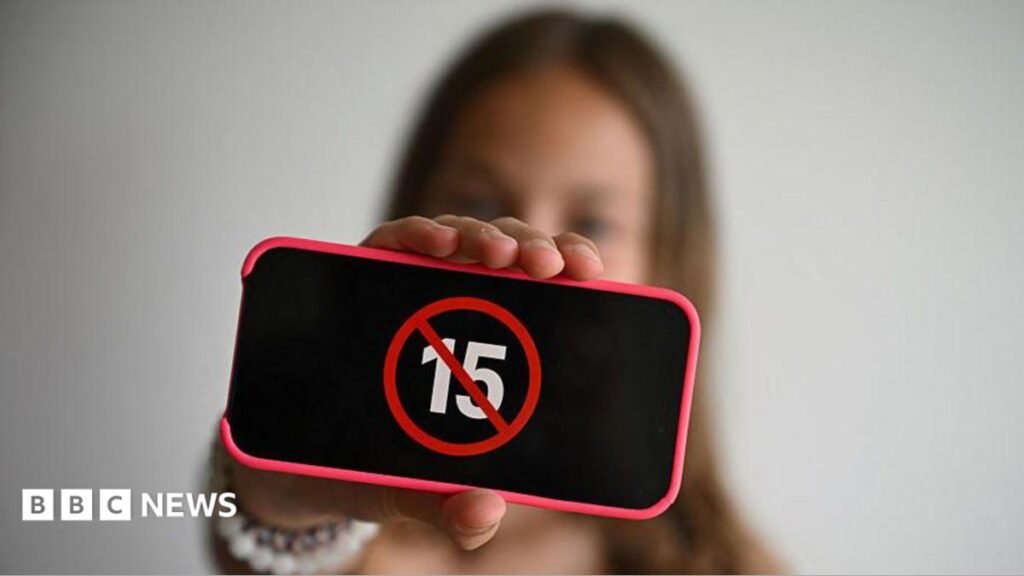
France’s parliament passed a law to ban social media for under-15s from January 2027, making it the first European country to block young people from the platforms. The law will mean everyone in France will have to verify their age to access social media and comes at a time when the UK and EU are
France’s parliament passed a law to ban social media for under-15s from January 2027, making it the first European country to block young people from the platforms.
The law will mean everyone in France will have to verify their age to access social media and comes at a time when the UK and EU are developing their own limits in response to concerns about children’s mental health.
French President Emmanuel Macron welcomed the measure, which he had promised to introduce to mark the end of his decade in office.
While skeptics have questioned the viability of the law, the government has insisted that online tools for implementing age checks are effective and safe.
Both the French Senate and the National Assembly adopted the ban on Tuesday, despite criticism from some sectors of the left.
It will be implemented in two stages:
Starting in September, people under the age of 15 will not be able to open accounts and age verification will be required on all new accounts.
In January 2027, this rule will apply to all existing accounts, meaning that everyone in France will have to prove that they are over 15 years old to use social networks.
Once the ban takes effect, social media platforms would have to use age verification tools approved by the French privacy regulator, according to the Reuters news agency.
But concerns have been raised about privacy, the effectiveness of age verification tools, the risks of young people circumventing them and the speed with which the ban has been designed and implemented, Agence France Presse reports.
French digital minister Anne Le Hénanff defended the speed of implementation of the law before the vote “because age verification tools already exist,” the agency added.
France is the second country to introduce a ban, after Australia.
Despite Australia banning the use of social media by those under 16 in December, it is widely acknowledged that many continue to use the platforms.
In March, the Australian eSafety Commission announced that seven in 10 children under 16 who had a social media account before the ban still had “some access.”
Given this, Tama Leaver, professor of Internet Studies at Western Australia’s Curtin University, told the BBC that the ban has “failed” in its technical objectives.
But, he says, he has successfully demonstrated that a ban “can be done,” although he classifies it as “kind of an experiment.”
One lesson other countries can learn from this example is that “young people need to be part of this conversation” so that the ban is “done with them” and not “for them.”
Leaver said France’s ban may have a better chance of success because of the requirement that each person verify their age, but that this will also increase privacy risks.
Additional risks of the ban include pushing young people into less regulated online spaces, reducing their news consumption and political empowerment, he added.
In recent months, legislation restricting young people’s access to social networks has intensified throughout Europe.
In June, former British Prime Minister Sir Keir Starmer announced that under-16s in the UK will be banned from social media from January 2027. An optional midnight curfew was also announced for UK teenagers aged 16 and 17.
In May, Commission President Ursula von der Leyen proposed a “social media delay” for children in Europe and said new legislation could be introduced within months.
For more tech updates, stay tuned to our blog.