In 2004, Amy Proal got an infection that changed her life. “I was in my pre-med, last year of college, and totally tanked,” she says. “No one could tell me what it was, everybody said my blood work was fine — sent to a psychiatrist, the usual story.” She started reading papers from her sickbed
In 2004, Amy Proal got an infection that changed her life. “I was in my pre-med, last year of college, and totally tanked,” she says. “No one could tell me what it was, everybody said my blood work was fine — sent to a psychiatrist, the usual story.” She started reading papers from her sickbed and soon realized that she wasn’t the only one with unexplained symptoms that lingered after an infection.
A year later, she was diagnosed with ME/CFS (myalgic encephalomyelitis/chronic fatigue syndrome). She managed to improve her symptoms with antivirals and other drugs, and went on to do a PhD in microbiology, studying the lasting consequences of pathogens. In 2018, she co-founded PolyBio, a foundation in Medford, Massachusetts, that advances research on infection-associated chronic illnesses. “Then,” Proal says, “COVID hit.”
COVID-19 killed millions of people, and left millions of others with lingering health problems caused by the SARS-CoV-2 virus. The chronic condition became known as long COVID. A 2024 study estimated that 400 million people around the world have long COVID1, with an annual economic burden of around US$1 trillion.
What causes long COVID? Case builds for rogue antibodies
The condition’s existence prompted a surge of interest in post-acute infection syndromes. Over the past six years, thousands of studies have explored the mechanisms underlying long COVID, its similarities to other post-infection conditions and potential treatments. In December 2020, the US government allocated $1.15 billion to study the chronic consequences of SARS-CoV-2 and, last year, Germany announced €500 million ($580 million) in funding for research into post-infectious diseases. “The COVID pandemic has shone a light on this family of post-acute infection conditions,” says David Putrino, a neuroscientist at Icahn School of Medicine at Mount Sinai in New York City.
Nonetheless, the conditions’ health and financial burden still strongly outweighs the funding. “It’s not a priority, despite having a major destructive influence on our society,” says Chris Ponting, a geneticist at the University of Edinburgh, UK.
The community is working to understand the basic biology underlying these conditions and find reliable disease markers, the lack of which is the main obstacle to developing treatments. How acute infections trigger chronic illnesses remains unclear, but many researchers think the field is closing in on explanations. “We certainly don’t have the answer,” says Michael Peluso, an infectious-disease clinician at the University of California, San Francisco. “But we have a lot of leads.”
Chronic shadows
In 1894, a few years after an epidemic of respiratory disease swept the world, English physician Thomas Dowse described a cluster of symptoms that lingered long after infection. He called the condition ‘post-influenza exhaustion’. Numerous other chronic illnesses, including post-polio syndrome, post-Ebola syndrome and post-treatment Lyme disease syndrome, have since been linked to pathogens. Symptoms vary, but fatigue and neurological features are common. “Almost every infection, viral, bacterial, parasite, is associated with chronic symptoms where a subset of people don’t recover,” Proal says.
Can long COVID be prevented? Two drugs finally show promise
These people were often dismissed by physicians, but the COVID-19 pandemic forced the world to take notice. Data collected in 2023–24 by the US Centers for Disease Control and Prevention (CDC) suggested that around 6% of adults have long COVID (see go.nature.com/4zbjmmh).
In February 2021, the US National Institutes of Health (NIH) launched the RECOVER initiative. The programme focused mainly on assembling large cohorts of people with long COVID, characterizing their symptoms and collecting samples. It has been criticized on a few grounds — for not testing enough treatments, for example — but some researchers say that the large-scale infrastructure the initiative built will pay off in the long term.
Scientists interested in post-infection disorders are joining forces. “Many collaborations are happening, starting from long-COVID researchers reaching out to people who’ve been doing ME/CFS research for decades,” says Akiko Iwasaki, an immunobiologist at Yale School of Medicine in New Haven, Connecticut. Iwasaki and Danny Altmann, an immunologist at Imperial College London, helped to organize a symposium in Santa Fe, New Mexico, in August 2025, bringing together specialists in many different post-infection syndromes. “All the talk was about shared pathways and mechanisms,” Altmann says.

Lilly Downs from Colorado has been in and out of hospital with long COVID after having COVID-19 in 2020.Credit: Hyoung Chang/The Denver Post via Getty
The existence of long COVID gave other disorders like it more credibility, helping to dispel the idea that these conditions were psychological. This narrative has dogged people with ME/CFS for decades, but the CDC and the UK National Institute for Health and Care Excellence both now define the condition as a biological illness. Symptoms of ME/CFS include fatigue, cognitive impairment and — a hallmark feature — post-exertional malaise, the worsening of symptoms after physical or mental exertion.
There is a lot of overlap between the various post-infection syndromes and many also have subtypes. Some people with long COVID, for example, have cardiovascular issues, others have severe brain fog and another subset has symptoms associated with an ME/CFS diagnosis. An important difference between long COVID and ME/CFS is that the former is defined by its trigger and the latter by its symptoms regardless of cause (although reports of previous infection are common).
In fact, most post-infection syndromes leave a proportion of people with symptoms that meet ME/CFS criteria. “There’s nothing unusual about SARS-CoV-2 as a trigger,” Ponting says.
Disease drivers
The emerging picture is of overlapping mechanisms and symptoms shared by many such syndromes. “It’s important for us to consider these diseases together,” Iwasaki says.
Researchers have made progress uncovering some important players, including the immune system. Evidence points to dysregulated immune cells, chronic low-level inflammation and autoantibodies — immune cells that attack the body’s own tissues. Scientists focusing on long COVID have found that SARS-CoV-2 persists in some form2. It can also reactivate other dormant viruses3, in particular those in the herpesvirus family.
Long-COVID signatures identified in huge analysis of blood proteins
Studies have also shown that small blood vessels and the endothelial cells that line them are damaged4. The autonomic nervous system, which regulates heart rate and breathing, is frequently affected and the gut microbiota altered. Mitochondria, the cell’s power plants, are often damaged; this could contribute to symptoms of fatigue.
These mechanisms are probably intertwined. For example, “many viruses infect the gut and lead to long-lasting low-level immune activation”, which in turn disturbs the gut microbiota, says Carmen Scheibenbogen, an immunologist at Charité University Medicine Berlin. When the autonomic nervous system is affected, poorly regulated heart rate and blood pressure impair blood flow, which in turn could starve mitochondria, disrupting energy production and damaging tissues, Scheibenbogen says. “So, what would happen to us if we ran a marathon happens to ME patients from climbing two stairs.”
The relative importance of various mechanisms could provide a way to group people into subsets: those with autoantibodies, say, or signs of viral persistence. This means that it’s unlikely that any one treatment will benefit everybody, although some might work for several diseases.
Strong leads
Among the many mechanisms that could drive pathology, some are seen as stronger candidates than others. Researchers are focusing in particular on immune dysfunction — including autoantibodies — and viral persistence. “The spotlight is on those two areas,” Altmann says.
Autoantibodies are a defining feature of autoimmune diseases, which are more common in women than in men, as are long COVID and ME/CFS. One explanation for how these autoantibodies develop is that the immune system mistakes viral proteins for similar human ones and attacks both.
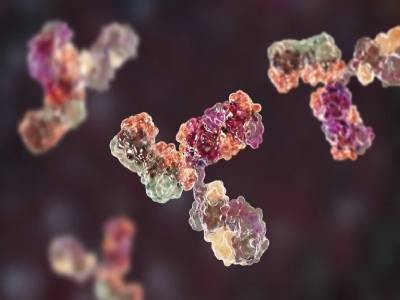
Several groups have shown that antibodies from people with long COVID make mice ill, providing what many consider the strongest evidence so far that autoimmunity causes symptoms. In a study published in May, an antibody called immunoglobulin G (IgG) taken from people with long COVID conferred hypersensitivity to pain when injected into mice5.
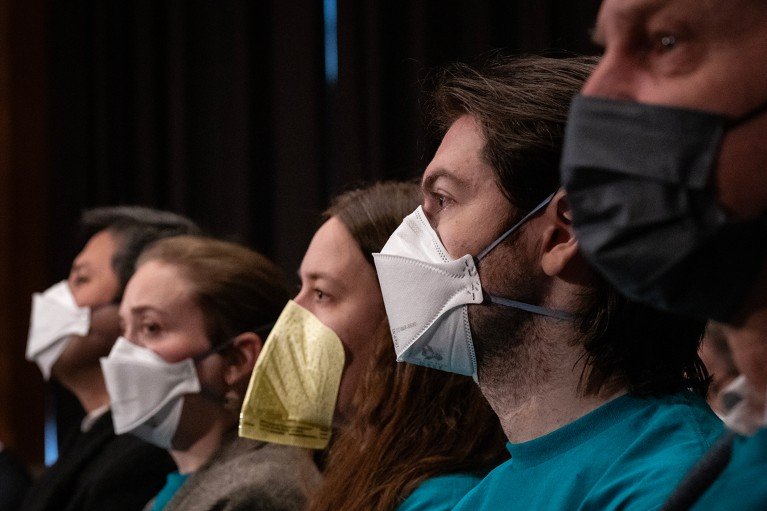
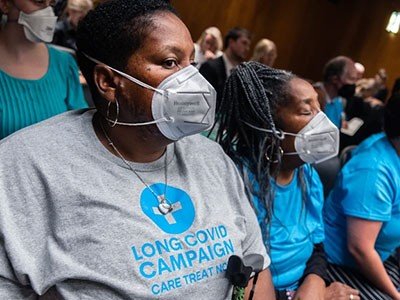
People with symptoms of long COVID listen to a 2024 US Senate Committee hearing in Washington DC on research and health care for the condition.Credit: Drew Angerer/Getty
Scheibenbogen’s group has tried filtering autoantibodies from the blood using a procedure called immunoadsorption. The researchers recruited people diagnosed with ME/CFS after having COVID-19. The procedure reduced both autoantibody levels and symptom severity in most people6. There was no placebo group, so firm conclusions can’t be drawn. Moreover, immunoadsorption is too complex to scale up to large numbers of people, so the team is planning to do placebo-controlled trials of drugs that deplete antibody-producing cells called B cells and plasmablasts.
A team in Norway has already done a small study using this strategy, with promising results. Øystein Fluge, a physician at the University of Bergen, and his colleagues treated ten people with ME/CFS with daratumumab, an antibody that targets plasmablasts. They saw strong benefits in some participants that remained for up to two years7. Those who responded also had larger drops in immunoglobulin levels midway through the trial than did those who did not. A larger, placebo-controlled trial of daratumumab, called ResetME, launched in June 2025 and results are expected between 2028 and 2030.
Meanwhile, numerous trials are targeting long-COVID symptoms by trying to clear lingering viral particles or fragments. Mounting evidence indicates that the virus can hang around for years and this has led some researchers to change their views on the basic biology of infection. “I wasn’t a believer in viral persistence when I started in this field,” says Peluso. “But if nothing else, we have fundamentally started to rework how we think about pathogens that should be transient.”
It’s not clear whether viruses persist as genetic fragments or as whole particles in organs such as the brain and eyes, which are partially separated from the immune system. But something seems to remain. A 2024 study found that participants who had long COVID after a SARS-CoV-2 infection were more than twice as likely to have viral proteins in their blood as were people who recovered — up to 14 months after infection8.
Long-COVID research just got a big funding boost: will it find new treatments?
If viral persistence is causing symptoms, then antivirals could improve things. But evidence for this is inconclusive. A trial run by RECOVER tested paxlovid, a SARS-CoV-2 antiviral, but preliminary analyses failed to find a benefit. The trial’s design could have contributed, says Proal: evidence of viral persistence wasn’t required for enrolment, for instance, and the 25-day treatment was too short.
Many researchers advocate for smaller, faster trials, which are not designed to produce clinically significant results, so much as to help scientists quickly test theories and move promising therapies into larger trials. They call this approach “experimental medicine”.
Inspiration often comes from people who have been thinking about these conditions for a long time, says Putrino. One such individual, William Pridgen, a physician in Tuscaloosa, Alabama, has for years been offering people with ME/CFS and fibromyalgia (a condition characterized by muscle pain and fatigue) a combination of herpes antivirals. The theory is that an infection or other source of stress could reactivate dormant herpesviruses, causing a chronic syndrome.
One of his formulations, a combination of two antivirals, is entering phase III trials for fibromyalgia. Pridgen is also testing a trio of drugs — a pair of herpes antivirals plus paxlovid — that simultaneously targets SARS-CoV-2 persistence and herpesvirus reactivation. He and Putrino published a study in January testing this cocktail in 24 people with long COVID9. Half took only the antiviral pair for 120 days; the rest received paxlovid as well. Everybody’s symptoms improved, but the 12 participants who received the three drugs did much better than did those who received two, and the improvements were still seen after two years. In January, the US Food and Drug Administration granted the researchers an Investigational New Drug exemption to run a larger, placebo-controlled trial of the drug trio.
Keep following us for the latest insights.