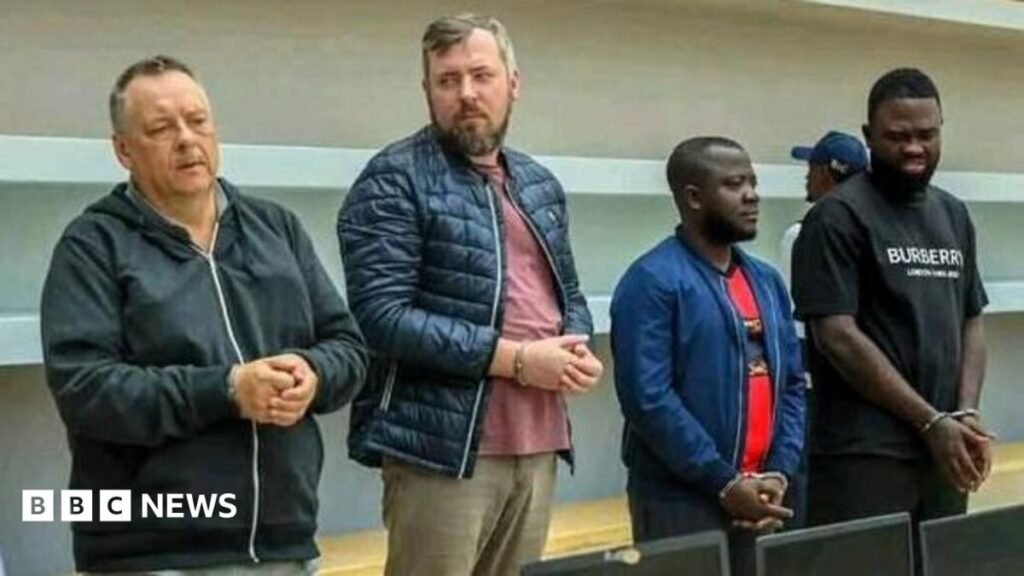
Two Angolans, sports journalist Amor Carlos Tomé and political activist Francisco Oliveira, were also tried on similar charges for their alleged involvement in the influence operation linked to Russia, which they both denied. Tomé received a two-year suspended sentence and Oliveira was acquitted. Prosecutors appealed immediately after the sentence, which was read just after 11:00
Two Angolans, sports journalist Amor Carlos Tomé and political activist Francisco Oliveira, were also tried on similar charges for their alleged involvement in the influence operation linked to Russia, which they both denied.
Tomé received a two-year suspended sentence and Oliveira was acquitted.
Prosecutors appealed immediately after the sentence, which was read just after 11:00 p.m. local time on Tuesday.
Tomé is expected to remain in custody pending the outcome of the appeal.
The BBC contacted the Russian embassy in Angola for comment but had not received a response at the time of publication.
Elizeu Nguiniti, the lawyer representing Ratchin and Lakshtanov, told the BBC he would not comment on the decision.
After the sentence was read, he told the court that he did not agree with the verdict, which found his clients guilty of four of the 11 charges (criminal conspiracy, espionage, terrorism and illegal retention of currency), but said he accepted the court’s decision.
According to Angola’s private news site Novo Jornal, the Russians told the court during previous hearings that they had held private meetings with political figures from both the ruling MPLA party and the opposition Unita, but denied that the meetings were related to any illegal activity.
He reported that the court had rejected a defense request to call several of those politicians as witnesses, considering that their testimony “was not necessary” to establish the facts of the case.
Prosecutors alleged that the defendants played a role in organizing deadly riots in Angola in 2025.
They claimed the Russians paid local journalists and experts more than $24,000 (£18,000) to spread pro-Russian and anti-government content aimed at bringing about political change in Angola.
They also cited publications linked to the operation, notes and photographs related to the 2025 protests found on the defendants’ devices, as well as alleged contacts with senior Angolan political figures.
Many Angolan activists strongly disagree with the prosecution’s argument that the protests did not happen organically.
Novo Jornal previously reported that Lakshtanov told the court during one of the hearings that he had lived and worked in Angola for almost four decades and that his long academic career was incompatible with participation in terrorist organizations.
Previously, Ratchin had explained in court that he was a businessman who had come to Angola to establish a Russian cultural center and that the payments he made to various people were compensation for services rendered, Novo Jornal reported.
He reportedly said he was surprised by his arrest in August 2025 and subsequent charges.
The first proceedings of the trial, which began in March, were marked by controversy.
During one of the initial hearings, the prosecutor refused to read the indictment aloud in court. He maintained that the defendants were already aware of the allegations against them and therefore a formal reading was not necessary.
The defense disagreed. They argued that since the trial was public, those who attended the proceedings, including journalists, should be able to hear and understand the accusations.
However, the prosecutor maintained that the reading of the accusation was optional and refused to do so.
The accusation itself had been criticized even before the trial began.
Since then, the defense has consistently questioned its content, arguing that it was often based on assumptions rather than concrete evidence.
The BBC had previously identified a number of spelling errors and apparent factual errors in the document, but did not receive any clarification from the prosecution on these.
Additional reporting from Ilya Barabanov and the Russian BBC investigations team
Keep following us for the latest insights.