
I’m a summer Grinch. I do not thrive in hot climates. I don’t have money for an extravagant vacation. Perhaps my least favorite thing about summer is that my family’s sense of routine is disrupted. My two children, ages 10 and 12, spend several weeks of the summer at day camp, but we also have
I’m a summer Grinch. I do not thrive in hot climates. I don’t have money for an extravagant vacation. Perhaps my least favorite thing about summer is that my family’s sense of routine is disrupted.
My two children, ages 10 and 12, spend several weeks of the summer at day camp, but we also have periods when we have no commitments. I work from home as a freelance journalist and also have a summer job at a new works festival.
A babysitter watches the kids while I’m at the theater, which motivates me to keep the house at least somewhat tidy. But I was still struggling to find a system to keep my house and my sanity intact while the kids are home.
Turning to a business system gave me some help, and some hope, during a summer we could all survive.
I came across a new-to-me method of organizing our lives.
I was researching ways to organize online workflow and came across the Kanban method. I was intrigued. I learned that kanban means “sign” in Japanese and is a business system used by companies like Toyota (where it was developed). Helps manage workflow between multiple people on multi-step projects.
My teaching experience influenced my decision to use this method, as it involves “breaking” a project into smaller parts. Instead of the task of “keeping the house clean,” there are smaller actions like “cleaning the countertops” that are more specific and manageable.
Chunking is an especially good strategy for students with ADHD or other barriers to learning, and my kids fall into that category. I took out the Post-It notes and got to work.
Configuring the system
After learning how kanban can help people maximize their productivity, I made the unpopular family decision to implement the method this summer.
I had some trial and error while building my board. The first version was just putting sticky notes on the wall, but they kept falling off, so I pinned a shiny square of paper to the wall. The sticky notes stuck better to the paper than to the wall.
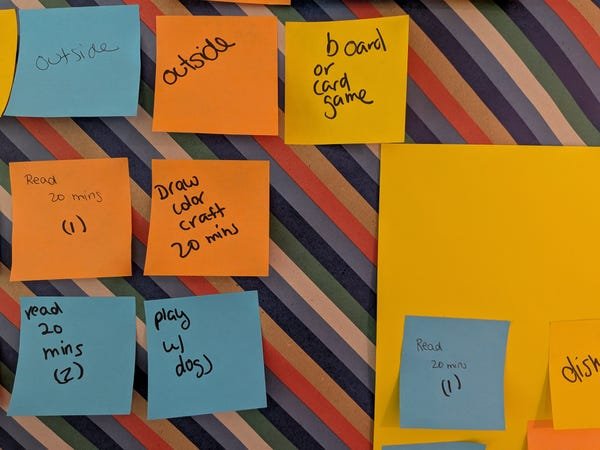
I put a solid sheet of paper on one side to indicate the “done” section. Then, I assigned colors to each child and designated a third color for activities that anyone could do or that they could do together, like putting away clean dishes or playing a board game.

The author said she added some fun activities to help balance her children’s days. Courtesy of Laura Wheatman Hill.
it’s working
I have a very independent and artistic high school student and an extremely energetic and very sociable elementary student, so I gave them very different tasks to suit their own abilities and interests.
My oldest son is writing a novel, so I made a sticky note for that activity. My youngest son likes playing with dogs the most, so I assigned it to him as a chore. I also gave each child two 20-minute reading spaces. I would like my children to see free reading as leisure time, but that is not who they are right now.
While there are some fun tasks on the board, screen time is not. I’m not strict about screens, we all regulate with them, and I think part of the secret to my limited successes as a parent over the years is that I allow a certain amount of screen time no matter what. However, once the allotted screen time in the morning is gone, I expect the kids to work from the whiteboard. We all take a little screen time in the afternoon, whether it’s playing solo or watching a family movie, to decompress and escape the heat.
I considered assigning myself a color. I thought that having a visual representation of all the tasks I do might give the kids some empathy for me and might inspire them to do their own part, but I decided against it for now. If I start to feel repulsed as summer reaches its second half, I’ll reconsider. Who knows, maybe I’ll find it helps with productivity too.
While the children were reluctant to this system at first, they joined in when they saw that each task took relatively little time compared to their expectations and that they still had plenty of time for their precious tablets.