We’ve all experienced that frustration or that motorcycle with an incredibly loud exhaust, a V8 that’s missing a jack, pissing off all the dogs in the neighborhood. While residents will file complaints with police, catching such excessively loud vehicles has been a notoriously difficult task for authorities. Unless the police are lucky and witness the
We’ve all experienced that frustration or that motorcycle with an incredibly loud exhaust, a V8 that’s missing a jack, pissing off all the dogs in the neighborhood. While residents will file complaints with police, catching such excessively loud vehicles has been a notoriously difficult task for authorities.
Unless the police are lucky and witness the vehicle pass by at high volume, or stop it for another problem and then initiate a sound check with specialized equipment, they are often left unaddressed. Repeated complaints may prompt officers to visit the registered address of a vehicle in question, but that is a fairly insufficient way to address the challenge and does not escalate.
That dynamic is about to change dramatically in Melbourne’s suburbs as automated roadside monitoring technology steps in to take on the heavy lifting.
Two-year trial of acoustic cameras on Victorian roads
A new state government initiative is officially rolling out automated noise cameras designed to detect, identify and penalize vehicles that exceed legal noise limits on public roads.
The trial is led by the Victorian Environment Protection Authority, which acts as the state’s main environmental regulator. Originally established in 1971 under the Environmental Protection Act of 1970, EPA operates as an independent statutory authority charged with preventing pollution and protecting local habitability.
Funded by the Victorian Government, this new two-year technology trial will initially focus on known hotspots of vehicle noise in four key municipal areas: Port Phillip, Casey, Knox and Stonnington.
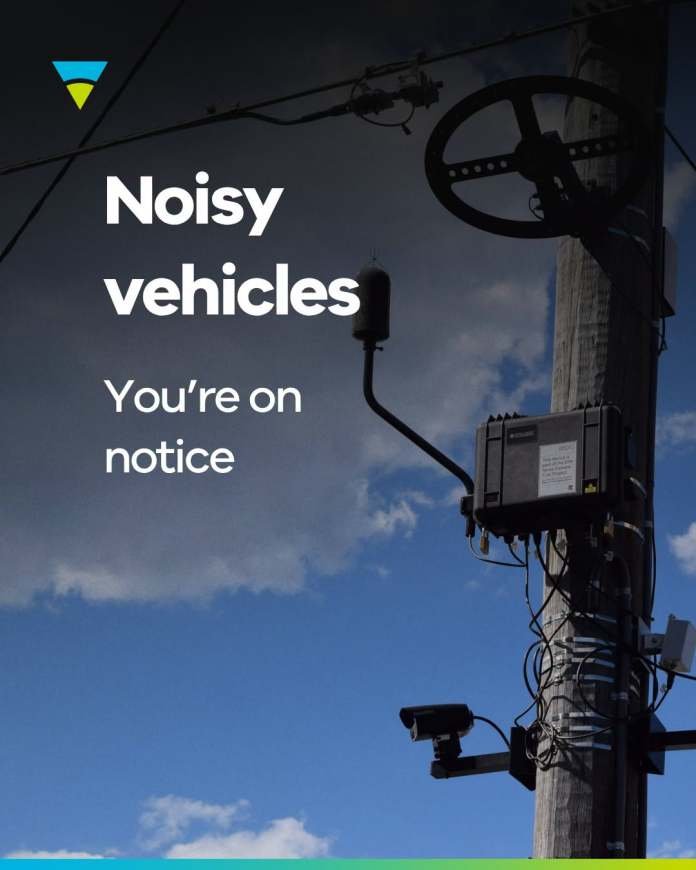
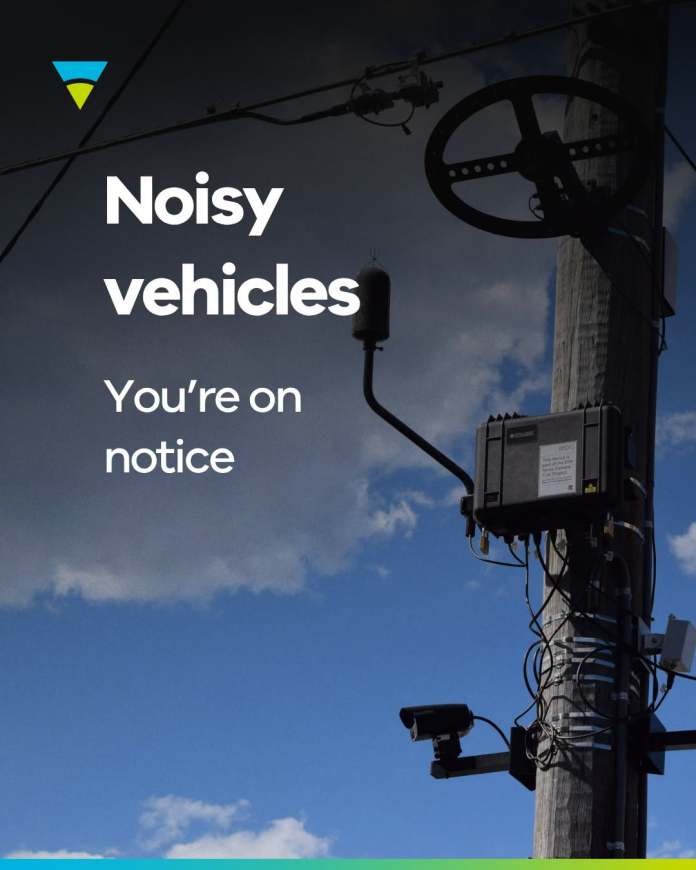
How Acoustic Road Camera Hardware Actually Detects Loud Exhausts
The technology behind these new acoustic road cameras is an intelligent fusion of directional audio engineering, high-resolution imaging and automatic license plate recognition.
Unlike a traditional speed camera that relies on radar or laser reflection, an acoustic camera focuses exclusively on the sound signature produced by passing traffic. Instead of relying on a single microphone, each camera box on the road features an array of microelectromechanical system microphones arranged in a precise geometric pattern.
Using a technical process known as acoustic beamforming, the system calculates the smallest differences in the time it takes for a sound wave to hit each individual microphone in the array. This precise time difference allows the on-board computer to generate a spatial audio heat map in real time. The system then overlays that heat map directly onto a live video feed of passing traffic.
When a vehicle exceeds predetermined noise thresholds, the system identifies the exact physical source of the sound, even when multiple vehicles are driving side by side in heavy traffic.
The camera instantly takes a clear, high-definition photograph of the offending vehicle’s license plate, securely recording decibel readings, audio frequency data, and visual evidence in a single encrypted package.
The enforcement process and serious penalties for vehicle owners
Passing one of these acoustic camera units while making excessive noise will not result in an immediate automatic ticket in your mailbox like a standard speed camera. Instead, all captured audio recordings, visual heat maps, and vehicle registration details are sent directly to the EPA for expert review.
If EPA officers determine that the vehicle likely violated Victorian noise regulations, an official vehicle test notice is sent to the registered owner. The owner is then legally required to present their car or motorcycle at an accredited testing center to undergo a formal stationary noise test.
Ignoring the mandatory test notice or continuing to drive an excessively noisy vehicle on public roads carries serious financial consequences. Individual drivers who fail to comply face fines of A$1,221, while owners of corporate vehicles and commercial fleets face massive fines of up to A$6,105.
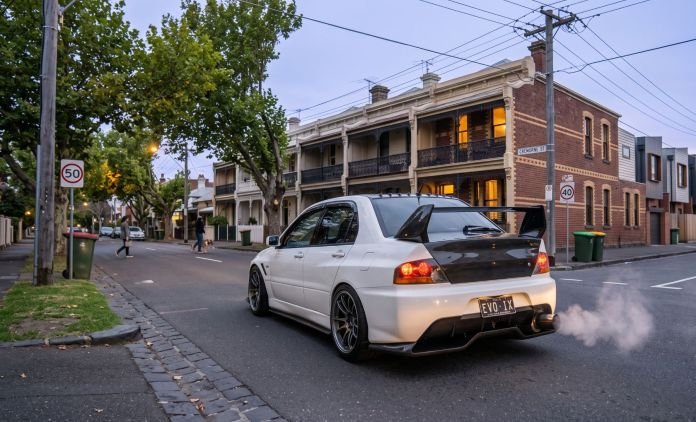
Why Victoria is cracking down on vehicle noise now
The decision to fund and implement roadside listening technology comes in response to a sharp increase in community complaints about anti-social vehicle noise. State statistics show that exhaust noise has become one of the most persistent environmental complaints raised by suburban residents in recent years.
The EPA received more than 9,100 reports of vehicle noise last year alone, which is nearly double the volume of complaints recorded just five years ago. Law enforcement and environmental officials have already stepped up traditional law enforcement actions across the state to address the surge.
During 2025 alone, authorities issued more than 1,200 fines to owners who drove excessively noisy vehicles on Victoria’s roads.
These new automated cameras will allow authorities to dramatically increase surveillance and capture persistent offenders in locations where police officers cannot maintain a constant physical presence.
Intelligent signal processing filters out urban background noise
Deploying acoustic monitoring hardware in busy suburban highway environments presents significant digital signal processing challenges.
Modern streets are inherently noisy spaces, filled with the sirens of emergency vehicles, construction equipment, heavy industrial transportation, and atmospheric wind. To avoid false positives, these acoustic camera systems run custom, cutting-edge computer processors trained on extensive real-world sound data sets.
The software analyzes the full frequency spectrum, peak amplitude and harmonic profile of any detected noise event in real time.
This allows the hardware to clearly distinguish between a brief ambient sound, such as the release of an air brake, and the sustained low-frequency roar of an illegal exhaust system when accelerating. If bad weather, strong winds, or loud ambient background noise compromise the accuracy of the audio measurement, the edge computer automatically overrides the event.
What this means for everyday drivers and car enthusiasts
For the vast majority of drivers driving modern production cars, daily hatchbacks or electric vehicles, these new cameras will have no impact on daily driving.
Factory exhaust systems are designed to operate comfortably below legal noise limits, even when accelerating hard on the highway. Car enthusiasts who maintain legal and certified aftermarket exhausts or vehicles equipped with factory valved exhaust systems also have little to worry about. As long as a high-performance vehicle meets the standard legal sound levels during official testing, driving past an acoustic chamber at normal speeds will not lead to enforcement action.
The primary focus of this tech test is explicitly illegal modifications, including removed mufflers, straight pipes, bypassed catalytic converters, and aggressive ECU crackling tunes. Drivers who deliberately modify their vehicles to generate maximum noise in residential areas are the ones who should pay attention.
Interstate and global evidence shows that acoustic cameras work
Victoria relies on valuable data collected from similar automated noise monitoring trials conducted in Australia and around the world. New South Wales previously tested the acoustic camera technology in high-complaint areas in Sydney and Wollongong to assess the system’s accuracy.
Data from interstate trials revealed that a surprisingly small fraction of motorists are responsible for the vast majority of suburban noise complaints. In fact, interstate test data indicated that more than half of all high-decibel noise events were caused by the exact same vehicles repeatedly passing camera locations.
Similar implementations in international cities such as Paris, London and New York have shown that automated acoustic monitoring leads to rapid behavior change. Once drivers realize that an area is actively monitored by intelligent audio hardware, antisocial accelerations and noisy street driving decrease significantly.
The future of smart road surveillance technology in Australia
The introduction of roadside acoustic monitoring reflects a larger shift towards multi-sensor monitoring platforms across Australian infrastructure networks.
Road infrastructure is rapidly evolving beyond basic speed radars towards integrated detection platforms capable of monitoring multiple road safety factors simultaneously. Modern camera gantries and mobile trailers are now capable of tracking vehicle speed, mobile phone use, seat belt use and ambient noise emissions in real time.
As this two-year trial progresses through Port Phillip, Casey, Knox and Stonnington, EPA and local councils will closely monitor operational data.
If the technology proves effective in reducing neighborhood noise pollution and improving compliance, these listening posts are expected to expand across the state. For suburbanites looking for a quiet night’s sleep, the technology is a welcome arrival, while those with loud exhausts may want to replace their mufflers before the warnings start coming.
For more information, please contact EPA Victoria.
Check back often for more exciting news!