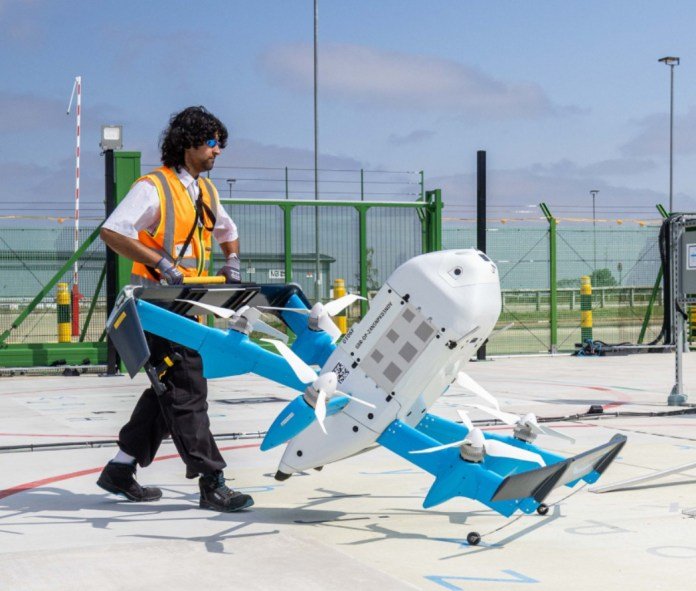
Amazon has just signalled a major step-up in its drone delivery ambitions. Prime Air will expand to nearly 500 cities and towns across the United States by the end of 2026, a 6x increase from its current footprint. The goal is simple, get millions of everyday items to customers in as little as 30 minutes.
Amazon has just signalled a major step-up in its drone delivery ambitions. Prime Air will expand to nearly 500 cities and towns across the United States by the end of 2026, a 6x increase from its current footprint. The goal is simple, get millions of everyday items to customers in as little as 30 minutes.
What Amazon is actually rolling out
The company says its Prime Air drones currently operate from sites serving about a dozen metro areas across seven states:
- Tolleson, Arizona (Phoenix metro area)
- Ruskin, Florida (Tampa metro area)
- Kansas City, Kansas
- Papillion, Nebraska (Omaha metro area)
- Baton Rouge, Louisiana
- Hazel Park, Michigan (Detroit metro area)
- Pontiac, Michigan (Detroit metro area)
- Richmond, Texas (Houston metro area)
- San Antonio, Texas
- Richardson, Texas (Dallas metro area)
- Waco, Texas
Specific hubs sit in places like the Phoenix, Tampa, Detroit, Houston, Dallas and Omaha regions. Each site covers roughly 175 square miles.
By year’s end the network is expected to reach nearly 500 cities and towns, putting the service in front of tens of millions of US customers. New launches are already lined up for the:
- Chicago
- Syracuse
- Cleveland
- Atlanta
- Boise metro areas
- more to follow.
Eligible packages must weigh 5 pounds (about 2.3 kg) or less and fit inside a large shoebox. Amazon claims this covers more than 60% of the items customers buy most often. That includes groceries, cosmetics, medications, household staples and electronics such as phones, AirPods, AirTags and Ring devices.
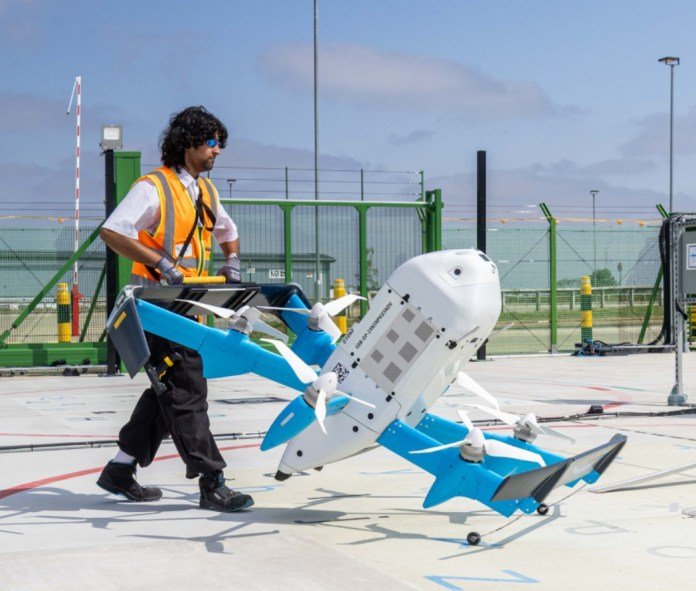
Most deliveries land around the 60 minute mark. Some arrive in 30 minutes. The drones are fully electric, can operate in light rain, and use a Detect-and-Avoid system that continuously scans the airspace. Amazon holds FAA Part 135 certification, the same standard applied to commercial air carriers.
In terms of price, Prime members get the service free on orders of US$50 or more. Under that threshold the fee is US$2.99. Non-members pay US$4.99. The experience sits inside the normal Amazon app: same checkout, same returns process, same A-to-z Guarantee.
David Carbon, Vice President of Amazon Prime Air, put it this way:
“Customers already turn to Amazon for fast Same- and Next-Day Delivery, and Prime Air provides them an even speedier option when they need it, with deliveries in as fast as 30 minutes.
We’ve already delivered hundreds of thousands of packages to customers by drone this year, and by the end of 2026 we plan to reach customers in nearly 500 cities and towns.”
David Carbon, vice president of Amazon Prime Air.
The company has also begun operations at a site in Darlington, England, its first outside the United States.
The Australian connection
Carbon is Australian. He grew up in Melbourne and has previously said he wants to see Prime Air flying in his home country before he retires. In a 2025 interview he was clear that there was “no immediate plan in the next 12 months” but added he would “certainly like to think we’ll bring it here – with my accent.”
That remains the public position. Amazon has not announced any Australian trials, regulatory filings with CASA, or launch timelines. The focus is still on scaling the US network and bedding down the UK and Italian sites.
Meanwhile the local ground network keeps expanding. Amazon Australia now runs multiple fulfilment centres and logistics sites. Recent moves include faster same-day and overnight windows in Sydney and Melbourne, with hundreds of thousands of products eligible.
Prime members in those cities can order late and still receive items overnight or the same afternoon. The company continues to invest hundreds of millions of dollars in new facilities, including robotics-equipped centres.
Why drones still matter here
Australia already has real-world drone delivery experience. Alphabet’s Wing operated commercial services for years in Canberra, Logan and parts of Melbourne before quietly shutting local operations in early 2026 to concentrate on the US market. That exit leaves a gap, but it also leaves behind regulatory experience and public familiarity with the concept.
CASA has been relatively progressive on Beyond Visual Line of Sight operations and commercial RPAS approvals compared with many jurisdictions. The technical and safety systems Amazon is refining in the US: sense-and-avoid, quiet electric flight, automated delivery-point selection, would map reasonably well onto Australian suburban conditions if the company decides to move.
The practical upside for Australians is obvious. Same-day ground delivery is already strong in the big capitals, yet many regional and outer-suburban customers still wait longer. A drone capable of carrying common small items in under an hour would change the equation for medications, essentials and impulse purchases, particularly where road distances or traffic add friction.
The limits are equally clear. Australian urban sprawl, variable weather, lower population density outside the major cities, and the need for dense enough fulfilment nodes all raise the cost and complexity of a national rollout.
Noise, privacy and local council attitudes will also matter. Amazon’s own safety language stresses that drones do not track people or stream live video, but public acceptance still has to be earned suburb by suburb.
Provide a caption (optional)
Realistic expectations
The US expansion shows Amazon is finally treating drone delivery as a scalable product rather than a long-running experiment. Hundreds of thousands of packages have already been delivered this year. The company is projecting continued growth and has the regulatory clearances to support longer-range operations.
For Australia the picture is different. Ground delivery speed is improving steadily through conventional means. Drone technology is maturing. An Australian is running the global program and has openly stated a desire to bring it home. Yet the company has not committed capital, regulatory applications or a public timeline.
Until that changes, Australian customers will continue to rely on the expanding network of vans, bikes and warehouses. The 30-minute drone drop remains a US (and soon UK) story. Whether and when it becomes an Australian one depends on the next set of commercial and regulatory decisions Amazon makes – decisions that will be watched closely from both sides of the Pacific.
For more information, head to
Amazon
.
For more tech updates, stay tuned to our blog.