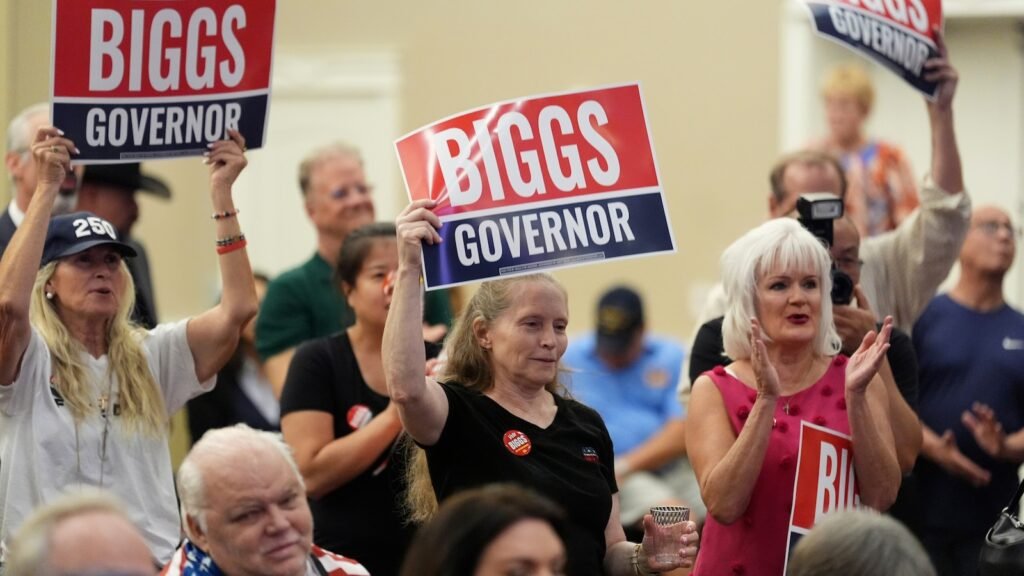
PHOENIX — As head of the conservative Freedom Caucus in the U.S. House of Representatives, Rep. Andy Biggs was one of the Republican Party’s toughest fighters in Washington, defending President Donald Trump’s agenda while frustrating establishment leaders. U.S. Rep. David Schweikert says such uncompromising tactics are a losing recipe in Arizona, where Republicans have seen
PHOENIX — As head of the conservative Freedom Caucus in the U.S. House of Representatives, Rep. Andy Biggs was one of the Republican Party’s toughest fighters in Washington, defending President Donald Trump’s agenda while frustrating establishment leaders.
U.S. Rep. David Schweikert says such uncompromising tactics are a losing recipe in Arizona, where Republicans have seen their power erode as voters rejected candidates deemed too extreme.
After decades of coexistence in Arizona’s fractious Republican Party, Biggs and Schweikert are on a collision course in Tuesday’s gubernatorial primary. The race has become a clash of competing visions to revive the once-dominant Republican Party to take on Katie Hobbs, the country’s most vulnerable Democratic governor.
Biggs, backed by Trump and backed by Turning Point Action, built his political career as a skilled Republican insider, but he never faced a tough campaign against a Democrat. Schweikert, meanwhile, is trying to resurrect a version of the party that is becoming increasingly anachronistic.
“Biggs lives in a district where if he were a turtle running as a Republican, you would win him,” said Kathleen Dunbar, 75, a former Tucson City Council member who plans to vote for Schweikert on Election Day. “Schweikert lives in a district that’s a lot like the state of Arizona, where he has to win independents. And he’s done it eight times in the last 16 years.”
Biggs’ greatest asset is his alliance with Trump. But Trump’s endorsement is a double-edged sword in Arizona.
No Republican has lost a state primary here with Trump’s endorsement. But since 2018, only one of them, former Gov. Doug Ducey, has managed to win a state general election. As a result, in a state where registered Democrats are outnumbered by both Republicans and independents, the Democratic Party holds both Senate seats and the top three state offices.
In 2022, a slate of Trump-backed Republicans, led by former local news anchor Kari Lake as the party’s gubernatorial candidate, refused to moderate their message in the general election, convinced that an enthusiastic MAGA base would propel them to victory. They lost.
Biggs rejects comparisons to Lake and has been polishing the edges of his uncompromising personality.
After backing Trump’s effort to block certification of the 2020 election, Biggs now refuses to say whether Biden’s victory was legitimate. He’s also talking about examples of work across the aisle.
Biggs voter Kathy Babits, 71, a retired occupational therapist from Scottsdale, said she wasn’t swayed by Schweikert’s warning that Biggs is too toxic for a general electorate.
“As long as people support it and things don’t change too much, I’m for it,” Babits said.
Biggs and Schweikert are both fiscal conservatives from neighboring districts in the Phoenix suburb of East Valley, the two whitest and wealthiest districts in Arizona.
However, style-wise, they are completely different.
Biggs boasts of having a direct line to Trump. He built a national profile in the House as a bulwark against compromise with Democrats, playing a key role in toppling Republican Speaker Kevin McCarthy and joining a failed rebellion against his successor, Mike Johnson.
He has taken hard-line, sometimes solitary, stances against public spending. He was one of the few House members to vote against economic stimulus at the beginning of the COVID-19 pandemic and, as a state lawmaker, even proposed eliminating the state’s Medicaid program.
It has thrived in the younger, fast-growing, family-oriented suburbs on the sprawling fringes of the Phoenix metropolitan area.
“I like his style, his policies and his mannerisms,” said Don Dobie, a Biggs supporter from Scottsdale. “And he seems like a trustworthy guy.”
Schweikert, meanwhile, has not been photographed with Trump. Although he has been a reliable supporter of Trump’s priorities and avoids publicly criticizing him, he has worked to cultivate a public image as a budget expert obsessed with the federal deficit.
He has persevered at the posh country club located in one of the most educated congressional districts in the country. He managed to retain his House seat even as many of his district’s wealthy and highly educated Republicans left the party under Trump.
Schweikert needs voters like Jeff Clark, a retired telecommunications engineer from Scottsdale who is dismayed by his party’s embrace of Trump.
“Once they say they’re sponsored by Trump and all that, I’m sorry, it’s just not going to work,” Clark said.
But Clark sat out the gubernatorial race and refused to vote for anyone because he is convinced Biggs is locked in the nomination and hasn’t seen Schweikert “do much for anyone” in Congress.
Republicans are struggling in Arizona because they are not aggressive enough in pushing Trump’s priorities, such as the SAVE America election bill, said Michael LoBello, a 79-year-old retiree from Scottsdale. Voted for Biggs.
“Defend the people,” LoBello said. “Just defend us. They’re forgetting who they represent, and that’s the people.”
Both parties have hotly contested primaries for Schweikert’s House district, which is a major battleground in the fight for a majority in Congress.
The Democratic Congressional Campaign Committee has controversially thrown its support behind Marlene Galán-Woods, a former television news anchor who used to be a Republican. Her late husband, Grant Woods, was a Republican attorney general in the 1990s and later became an outspoken critic of Trump.
Woods’ primary opponent, Amish Shah, is an emergency room doctor and former state lawmaker who was the party’s candidate in 2024 but narrowly lost to Schweikert.
“I like his background in medicine,” said Jeff Cohen of Cave Creek, 69, an attorney who voted for Shah. “And he came to my door and I met him. He made a difference. Old style politics.”
On the Republican side, former Arizona Cardinals kicker Jay Feely has Trump’s endorsement. He has been criticized for living outside the district: He lives in Biggs’ district and originally ran there until Trump endorsed a rival.
Feely faces Joseph Chaplik, a former state lawmaker popular with many of the party’s grassroots activists, and businessman John Trobough.
Check back often for more exciting news!