Bond yields are spiking after the latest consumer inflation report, further hobbling Donald Trump’s goal to make life more affordable ahead of a pivotal midterm vote. The yield on the 10-year US Treasury, which influences everything from mortgages to car loans to business loans, saw a sharp spike on Wednesday as investors take in a
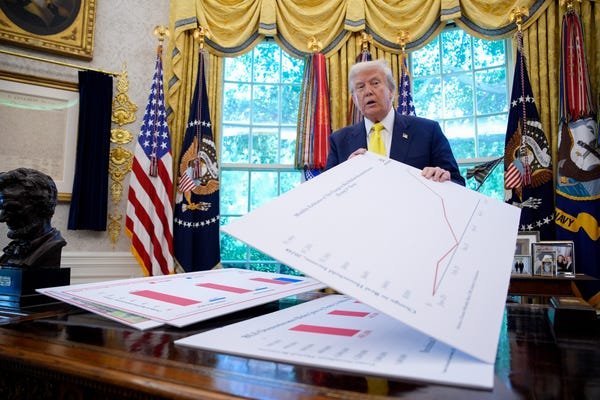
Bond yields are spiking after the latest consumer inflation report, further hobbling Donald Trump’s goal to make life more affordable ahead of a pivotal midterm vote.
The yield on the 10-year US Treasury, which influences everything from mortgages to car loans to business loans, saw a sharp spike on Wednesday as investors take in a hotter-than-expected inflation report.
Stocks also fell after the latest inflation data. Tech stocks in particular took it on the chin, extending their losses from a global sell-off that began in South Korea yesterday.
The tech-heavy Nasdaq 100 fell 2%, while the S&P 500 slid 1%.
Here’s where US indexes stood at the 4 p.m. ET closing bell:
Here were some of the big moves in the tech sector:
Consumer prices rose at a 3.7% annualized pace in September, slightly above the 3.6% growth economists were expecting and hotter than 3.4% in August. The 10-year yield, which had begun to recover slightly after investors dumped government bonds in a frenzy last week, jumped as much as 9 basis points to 5.31%.
The yield gave up its gains in the afternoon, falling back to 5.19%. It still sits near its highest level since 2002.
Concerns have risen this year about the US’s fiscal stability, driving investors to sell Treasurys and push yields up. Inflation expectations have also played a large role, the logic being that the bond market is anticipating the Fed to raise rates to tame price growth.
It’s a big problem for Trump for a few reasons:
- The president has made lower interest rates a mantra. Alongside a yearslong pressure campaign directed toward former Fed Chair Powell to lower rates, he’s also floated a lower 50-year mortgage and mulled capping credit card interest rates in an endeavor to make borrowing costs more affordable for Americans. Treasury Secretary Scott Bessent has also boasted about the strength of the US bond market, but softened his tone as the sell-off continued to push yields to their highest levels in almost a quarter century.
- Higher rates threaten economic growth, another key talking point for Trump. The president has been touting the resilience of the US economy heading into the midterm elections, floating an “economic success for our country the likes of which we have never seen before” at a recent Ohio rally — assuming the Republicans win the midterms.
- The midterm elections just weeks away. The pivotal vote marks the halfway point of Trump’s second term. Hopeful Democrats believe the election will result in a painful rebuke of Republicans’ economic policies and their impact on Americans’ wallets.

Yuri Gripas/Abaca/Bloomberg via Getty Images
As yields have spiked to multi-decade peaks, the Trump administration has repeatedly referenced rates, frequently pointing to how borrowing costs could or should be lower.
Ahead of the Fed’s meeting in September, Trump told reporters the US should have the lowest interest rate out of any country in the world. Shortly after the central bank made the decision to lift rates, he called for rates to be capped at 1% in a post on Truth Social, and later told reporters he believed the Fed was “doing the wrong thing.”
He doubled-down on his view in a late September interview with TIME, adding he didn’t think the Fed should raise interest rates again before the end of the year.
“We’re blowing through the interest rates. But if we didn’t have to, it would be great,” he said, possibly referring to how the bond sell-off accelerated in late September.
Higher for longer
Lower rates look out of the question for markets for the time-being. Investors are now pricing in a 96% chance the Fed will hike rates at least one more time before the end of the year, and a 50% chance it will hike rates twice, per the CME FedWatch tool.
“We believe that the Fed has its work cut out for them and one hike, while giving the Fed temporary bona fides as inflation fighters, will not be enough to satiate this unruly bond market,” John Kerschner, a portfolio manager at Janus Henderson, wrote in a note.
“We think bond yields have much more room to rise before investors start pulling money out of stocks and into bonds to lock-in elevated yields. The next key threshold for the 10-year Treasury is 6%,” Skyler Weinand, the chief investment officer of Regan Capital, said.
The Trump administration began to show a fixation with the 10-year yield in early 2025, when Bessent framed the 10-year as a gauge for interest rate expectations when speaking to the media.
“He and I are focused on the 10-year Treasury, and what is the yield of that,” Bessent told Fox Business in early 2025. “He wants lower rates. He is not calling for the Fed to lower rates.”
The president also suggested he was watching the sudden surge in bond yields last year, when investors sold Treasurys aggressively as he unveiled his sweeping slate of Liberation Day tariffs. Trump later said the surge in yields was not a factor in his decision to issue a 90-day pause on tariffs, though he noted that investors in the bond market were getting “yippy.”
The Trump administration has also taken measures to cool the 10-year yield, with the US Treasury announcing a $6 billion bond buyback plan in September. The move was expected to add more liquidity to the bond market and help calm yields on the long end, though investors had the opposite reaction, with yields climbing higher shortly after the announcement.
The White House did not immediately respond to a request for comment sent by Business Insider.
{For more tech updates, stay tuned to our blog.|Keep following us for the latest insights.|Check back often for more exciting news!}