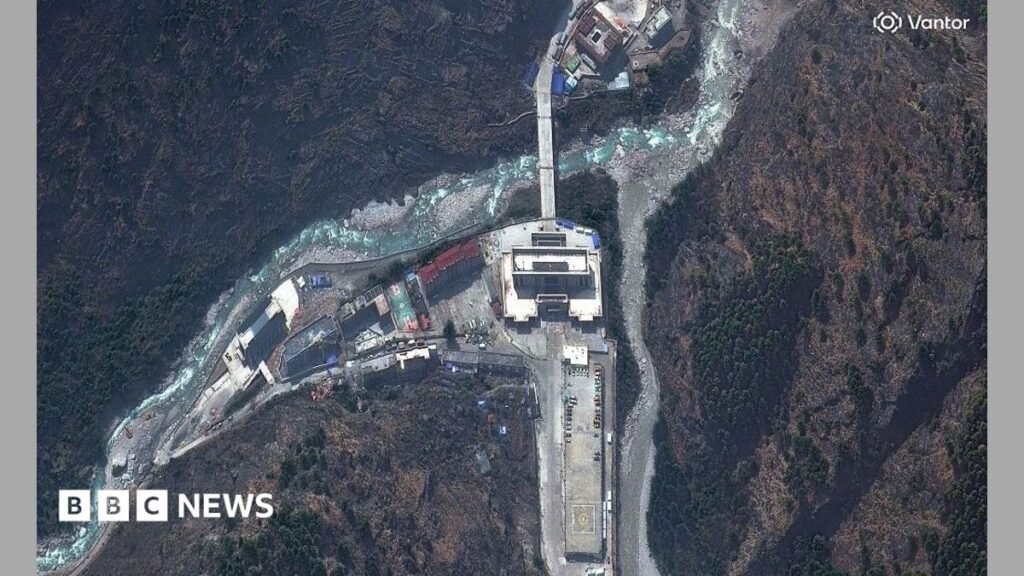
When a 21-member Chinese rescue team reached Gyirong on 28 August, one rescuer told Reuters: “As far as the eye could see, there was nothing but ruins.” The crossing had only recently recovered from another major flood. In July 2025, flooding shut Rasuwagadhi for nearly six months. It reopened on 1 January after China built
When a 21-member Chinese rescue team reached Gyirong on 28 August, one rescuer told Reuters: “As far as the eye could see, there was nothing but ruins.”
The crossing had only recently recovered from another major flood. In July 2025, flooding shut Rasuwagadhi for nearly six months. It reopened on 1 January after China built a temporary bridge.
Traffic had since returned. Chinese border authorities say more than 100,000 people had passed through Gyirong by June, while Nepali immigration records show 53,742 arrivals and departures at Rasuwagadhi in the year to mid-July. The two figures are based on different reporting periods and counting systems, making a direct comparison difficult.
Indians were the largest group recorded at the Nepali immigration point, followed by Nepalis and Chinese.
Gyirong had also become one of the main arteries linking Nepal and China.
Posh Raj Pandey, chairman emeritus of the Kathmandu-based South Asia Watch on Trade, Economics and Environment, says Rasuwagadhi is one of Nepal’s two main trading points with China, alongside Tatopani, and accounts for about a third of Nepal’s $2.95bn trade with its northern neighbour.
Around 60 to 70 trucks passed through the gorge each day, carrying electronics, machinery, vehicles, fruit, clothing and other goods towards Kathmandu. Pandey says the route also handled about 80% of Nepal’s electric-vehicle imports from China.
Its closure has left Nepal increasingly dependent on Tatopani – which Chinese authorities have also temporarily closed, external because of landslide risks on the Nepali side, the Kathmandu Post reports.
The crossing also lies along the proposed route of the railway connecting the region to Kathmandu, part of plans by Nepal and China to develop a trans-Himalayan rail network.
“Nepal should develop an alternative China trade route and reconsider its wider development strategy, including its heavy concentration of hydropower projects along the same river system,” Pandey says.
“We have put all eggs here. We need to develop an alternative border port.”
Across the border, Pokharel was left thinking about conversations he had with the colleagues who were now missing.
The previous year’s flood had made staff at the Rasuwagadhi immigration office acutely aware of the danger. At night, he says, they sometimes “felt vibrations” and went outside to check the river. They had even discussed among themselves about escaping uphill if another flood struck.
“But my friends could not get that chance,” he said.
For more tech updates, stay tuned to our blog.