The SSPX was founded in 1970 in opposition to the modernizing reforms carried out by the Roman Catholic Church in the 1960s, in what became known as the Second Vatican Council. The Society is believed to have around 600,000 faithful worldwide. Responding to the Vatican decree, Rita Reid, an SSPX worshiper from Jersey in the
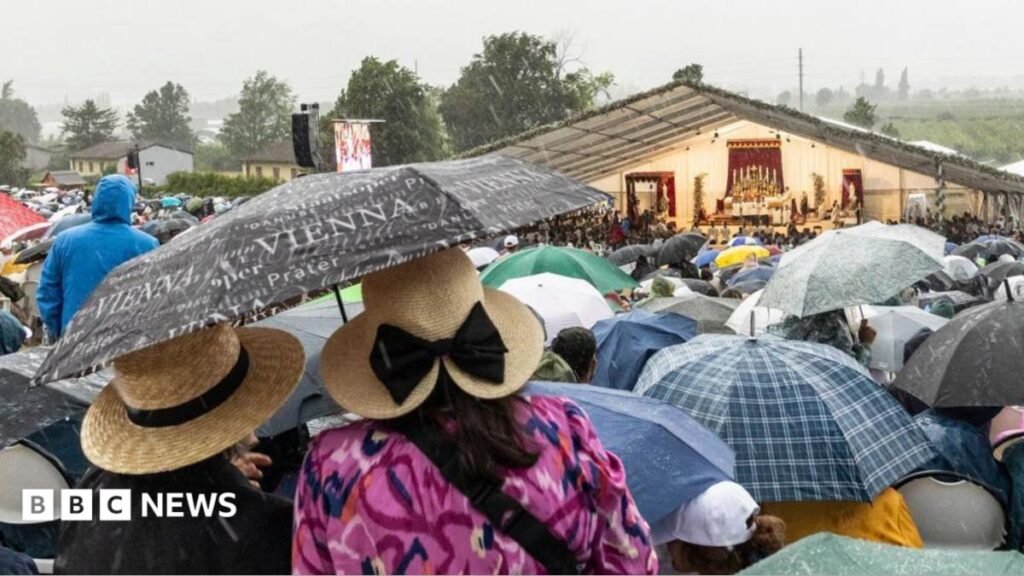
The SSPX was founded in 1970 in opposition to the modernizing reforms carried out by the Roman Catholic Church in the 1960s, in what became known as the Second Vatican Council. The Society is believed to have around 600,000 faithful worldwide.
Responding to the Vatican decree, Rita Reid, an SSPX worshiper from Jersey in the Channel Islands, said: “It actually makes me feel quite strong.
“Yesterday, before the consecrations, I told my husband: ‘You know what? Even if they excommunicate us, go ahead, go ahead, it’s not going to make any difference.'”
The Society rejects the changes made to the way the Mass is celebrated; for example, it still celebrates its services in Latin rather than everyday language, and the priests face the altar rather than the congregation.
At SSPX masses, the priest must give the communion bread directly into the mouths of the kneeling faithful, rather than the parishioners being able to stand and hold it themselves.
Women in the group also tend to cover their heads for services and SSPX followers tend to be more socially conservative overall.
The SSPX also opposes the modern Catholic Church’s stance of greater dialogue with other Christian denominations and other religions.
For Rita, 76, the SSPX ceremonies are much “deeper,” where she feels “the true presence of Jesus.”
She says there is no comparison to the standard Catholic mass, which she describes as “so weak and feeble.”
The retired B&B owner used to attend modern Catholic services, as well as those of the SSPX, but complained that traditional social values, such as not having sex before marriage, were no longer taught at the standard mass.
“I think that now many young people who are going to new order [the standard liturgy] Think ‘well, okay, we can do these things.'”
The Society’s main presence is in the US and France, but it holds masses in 26 locations across the UK, from Lerwick in Shetland to Devon, with its main center in Wimbledon, south London.
At one point in the 1980s, the Society’s bishops were excommunicated for disobeying Rome, but that decision was later reversed.
More recently, efforts had been made to reconcile with the SSPX, but the Vatican’s response to this week’s events was more aggressive than before and more severe than anticipated.
Wednesday’s event in Geneva was widely expected to lead to the excommunication of the bishops involved.
But the excommunication of all those lay people who remain part of the SSPX came as a surprise to many, with the traditionalist group now further from the power center of the Roman Catholic Church than ever.
Excommunication is one of the harshest punishments the Church can impose, effectively expelling the offender from the religion and excluding them from Catholic life.
It means that a baptized follower is “out of communion” with the Church, meaning that they cannot receive the sacraments, such as confession, or marry within the Roman Catholic Church.
The Vatican said Thursday: “The sacred ministers of the Society of Saint Pius X administer the sacraments illicitly, while the sacrament of penance they administer and the marriages they witness are invalid.”
It means that members of the SSPX now have to choose whether they want to remain part of a group that is in “schism” or leave behind the things they believe are right to remain part of the Catholic Church.
However, it is clear that many members of the SSPX believe that it is the Vatican that has strayed from true doctrine, not them.
For more tech updates, stay tuned to our blog.