“Additional analysis of nearby seismic stations, long period seismic waves, and satellite imagery led to the determination that the seismic event was instead a glacial collapse and debris flow, and that no earthquake had occurred,” USGS said on Thursday. Earlier Nepali authorities had also told the BBC that a massive chunk of ice may have
“Additional analysis of nearby seismic stations, long period seismic waves, and satellite imagery led to the determination that the seismic event was instead a glacial collapse and debris flow, and that no earthquake had occurred,” USGS said on Thursday.
Earlier Nepali authorities had also told the BBC that a massive chunk of ice may have collapsed from a mountain, pulling down rocks and other sediments with it.
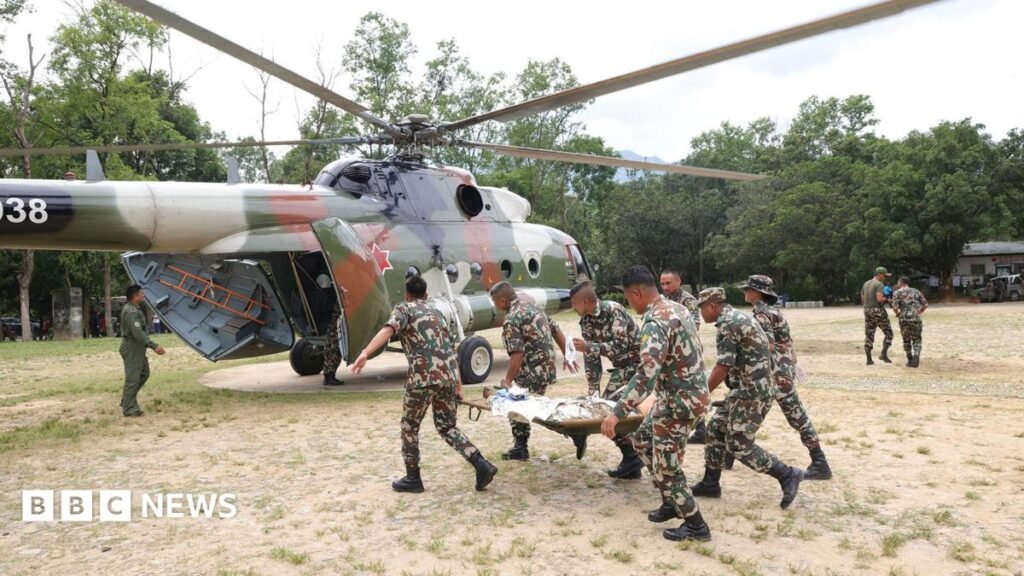
Climate change is known to be driving faster glacier melt in the Hindu Kush Himalaya region and, as rescue efforts continue, scientists are trying to piece together the exact order of events.
Simon Cook, senior lecturer in energy environment and security at the University of Dundee who specialises in glaciology, said “climate change could have an impact”.
Cook said his team had detected that the lower part of a glacier in Nepal near the Langtang Lirung peak – which is approximately 15km (9 miles) west of the site of the floods – had collapsed.
He estimated that the glacier collapsed in a northwesterly direction and then travelled westwards downstream.
He told the BBC “permafrost is partially holding some mountainsides together, this permafrost is warming and thawing and degrading so you are going to get more landslides”.
Mike Searle, professor of Earth sciences at Oxford University, said the glacier could have collapsed “hours or days” before the flooding hit Nepal and Tibet.
He told the BBC: “I think the sheer wave of debris suggests there was a landslide first, the water built up, (which) dammed the river, and then it burst in one huge great flood.”
One possibility is that water from rainfall or melting ice may have destabilised the ground or ice, triggering a chain reaction.
Scientist will be looking at satellite images of exactly where the landslide occurred, whether any glacial lakes suddenly drained, and where the river might have become blocked, as well as data on recent rainfall.
Keep following us for the latest insights.