Somalia is facing a fresh test of its stability as foreign troops begin withdrawing, funding for its security forces comes under pressure and a bitter political dispute threatens to derail plans for the country’s first direct democratic elections in decades. The combination of challenges has raised questions about whether the government can defend itself against
Somalia is facing a fresh test of its stability as foreign troops begin withdrawing, funding for its security forces comes under pressure and a bitter political dispute threatens to derail plans for the country’s first direct democratic elections in decades.
The combination of challenges has raised questions about whether the government can defend itself against Islamist militant group al-Shabab while managing growing divisions among political factions.
Some analysts fear the situation could embolden al-Shabab, which is affiliated with al-Qaeda, and potentially allow it to seize control of the capital, Mogadishu.
The group already controls large parts of the country despite the presence of about 12,000 African Union (AU) troops supporting the government.
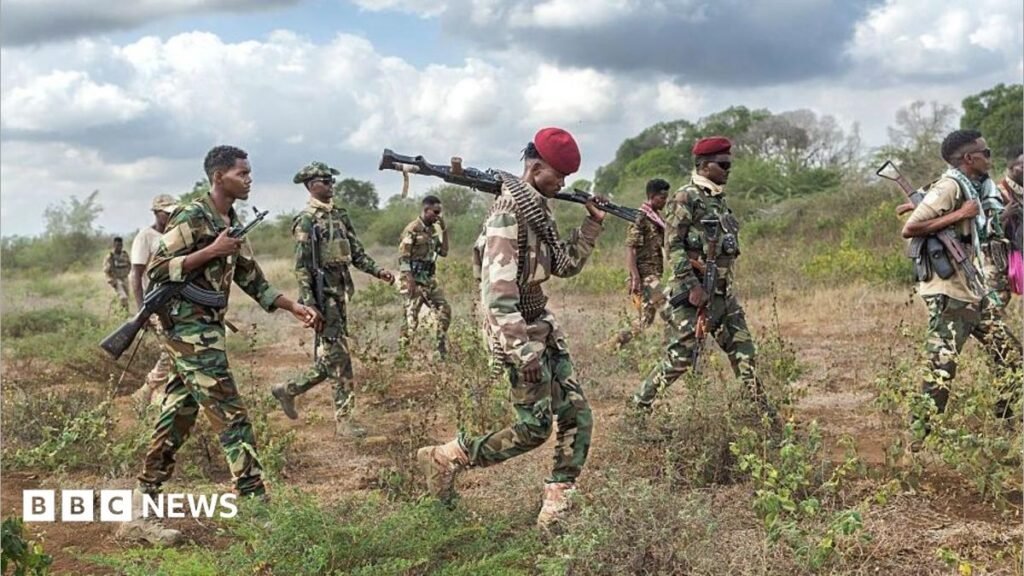
The withdrawal of foreign forces, alongside the activities of clan-based militias aligned with rival political factions, has heightened concerns about the government’s ability to maintain control.
Ugandan troops, who make up the largest contingent of the AU force, began withdrawing last month, with the country expected to complete its withdrawal by next year.
Ethiopia, another major contributor to the AU mission with over 7,000 troops, is also reportedly planning to withdraw about 3,000 troops.
The US, which had earlier announced cuts to funding for the UN Support Office in Somalia (UNSOS) has since said it is extending it for a year. Washington contributes about a quarter of $500m UNSOS’s annual budget, which supports Somali security forces, AU missions and individual troop-contributing nations.
With military support uncertain and the government facing mounting political challenges, analysts question whether Somalia’s security forces are ready to stand on their own.
The concerns were heightened recently when al-Shabab claimed to have killed hundreds of elite Somali soldiers in an attack. The government acknowledged the attack but did not disclose the number of casualties.
Abdisalam Guleid, a former deputy director of Somalia’s National Security Agency, told the BBC the security situation was increasingly precarious.
He warned that the withdrawal of foreign troops could leave Mogadishu vulnerable to a takeover similar to that of Afghanistan by the Taliban in 2021, following the withdrawal of US and Nato forces.
“I don’t think Mogadishu will be able to defend itself. The Taliban style [takeover]… that’s the most likely scenario I can envision now,” he said.
The Taliban took over control of Afghanistan between 6-15 August 2021 in a rapid offensive, following the withdrawal of US and NATO forces.
Such a scenario has played out in Somalia in the past, Guleid explains.
For more tech updates, stay tuned to our blog.