The El Niño weather pattern that is strengthening in the Pacific Ocean is on track to be the largest in at least 150 years, researchers said today during a press conference. If the monstrous forecasts they presented come true, the heat surge that El Niño will unleash from the ocean, combined with warming due to
The El Niño weather pattern that is strengthening in the Pacific Ocean is on track to be the largest in at least 150 years, researchers said today during a press conference. If the monstrous forecasts they presented come true, the heat surge that El Niño will unleash from the ocean, combined with warming due to human-caused climate change, will likely make next year the hottest ever recorded, and lead to extreme weather conditions in many parts of the world.

Asia’s oceans break heat records: what it means for extreme weather
According to projections from a suite of climate models, the El Niño peak will surpass the previous record by “a truly mind-boggling margin,” says Zeke Hausfather, a climate scientist at Berkeley Earth, a nonprofit research organization in California that organized the briefing.
“It is not outside the realm of possibility” that the event could combine with climate change to raise global average temperatures in 2027 by up to 1.7°C above the pre-industrial average, he said at the briefing. This would bring the planet to the brink of exceeding the 1.5°C threshold that governments committed to avoid under the Paris Agreement.
The fact that El Niño is occurring now is not surprising. El Niño-Southern Oscillation (ENSO) is a natural fluctuation in sea surface temperature and winds in the tropical Pacific Ocean. Historically, it has oscillated between warm El Niño and cold La Niña every two to seven years. The last El Niño occurred in 2023-24 and, after meteorologists warned that a major event was imminent, this year’s event emerged in June.
But the latest predictions suggest that this El Niño could become even stronger than expected. According to Justin Mankin, a climate researcher at Dartmouth College in Hanover, New Hampshire, they look very similar to what scientists had projected would be amplified by human-caused climate change later this century.
Extreme forecasts
Elevated Pacific sea surface temperatures and wind patterns that are characteristic of El Niño have strengthened rapidly since June. In its latest advisory, the US National Oceanic and Atmospheric Administration (NOAA) gave a four in five chance of a “very strong” event developing by the end of the year, with almost certainty that El Niño conditions will persist until at least April 2027.
“Right now, we are seeing all markers of very vigorous atmosphere-ocean coupling across the equatorial Pacific Ocean, which gives us more confidence that we will eventually see a ‘very strong’ El Niño that would rank among the strongest El Niño in our historical record,” says Michelle L’Heureux, a NOAA meteorologist who leads the agency’s ENSO prediction team in College Park, Maryland.
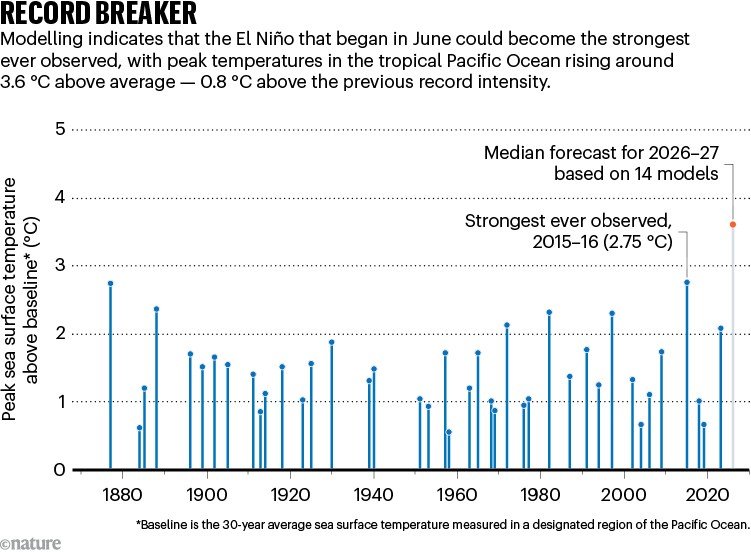
However, NOAA’s forecast could be conservative. In a blog post last week and during today’s briefing, Hausfather compared projections from 14 climate models for this El Niño and showed that the median estimate of maximum sea surface temperature in the Pacific is about 0.8°C higher than the previous record set in 2015-16 (see ‘Breaking Records’). “It’s by no means a foregone conclusion, but the probability has increased month after month,” he said.
Source: Zeke Hausfather/Berkeley Earth
In addition to the El Niño event raising global average temperatures to record levels in 2027, Hausfather says there’s a good chance it will raise temperatures enough in the coming months to make 2026 a record year as well. The pattern of heat waves, droughts, floods and wildfires associated with El Niño will also have consequences for economies. Mankin and his colleagues have estimated1 that changes in climate attributed to a strong El Niño in 1997-98 reduced global economic growth by $5.7 trillion in subsequent years.
If forecasts are even close to correct, the current El Niño could cause “$10 trillion in economic losses by 2032,” Mankin says. Beyond the impacts on human society, this El Niño is likely to stress ecosystems and oceans, causing a decrease in the net amount of carbon they absorb from the atmosphere. Rising ocean temperatures are also bad news for heat-bleached coral reefs.
Check back often for more exciting news!