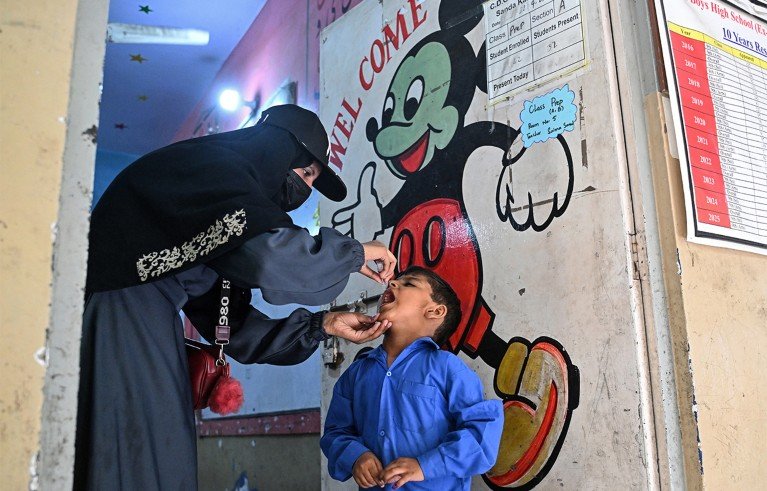
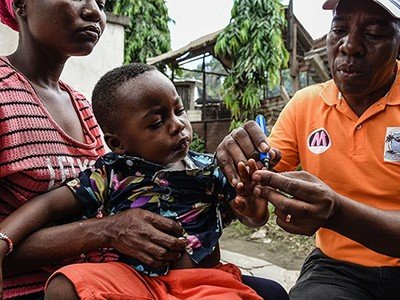
Polio vaccination in Pakistan, where the wild virus continues to circulate.Credit: Arif Ali/AFP/Getty If you are under 60, the global quest to eradicate polio has been with you for most of your adult life. During that time, the natural strain of the virus, also known as wild-type polio, has been eliminated from almost all countries.
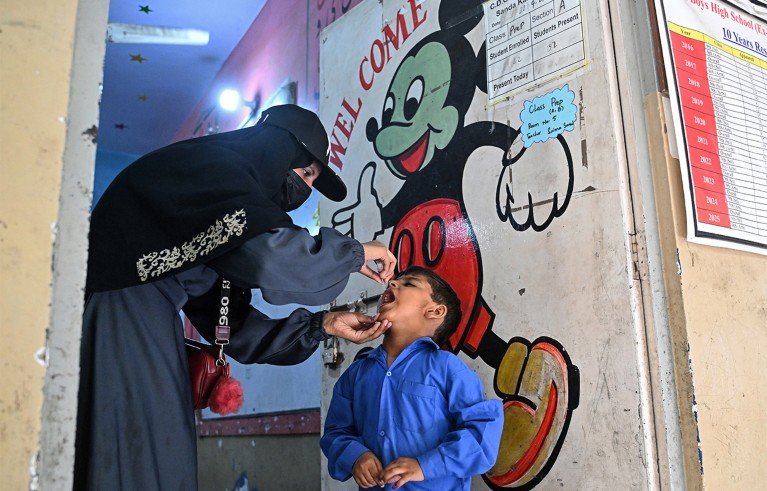
Polio vaccination in Pakistan, where the wild virus continues to circulate.Credit: Arif Ali/AFP/Getty
If you are under 60, the global quest to eradicate polio has been with you for most of your adult life. During that time, the natural strain of the virus, also known as wild-type polio, has been eliminated from almost all countries. In 2023, there were only 12 confirmed cases worldwide: six in Pakistan and six in Afghanistan.
Polio should have been eradicated by now. What is plan B?
But the polio eradication curve is not flattening to zero. The small gap that remains is not closing. Polio should have disappeared long ago, but it remains endemic in Afghanistan and Pakistan, which this year reported a total of 18 confirmed cases, as of July 21. There has to be a renewed urgency to finish the job once and for all. The stakes are high: some disease modelers predict a resurgence of hundreds of thousands of cases a year if the world abandons the cause (KM Thompson et al. Expert Rev. Vaccines 211667–1674; 2022).
In recently polio-free countries, a kind of complacency is setting in, according to an assessment by the Independent Monitoring Board of the Global Polio Eradication Initiative (GPEI). GPEI has worked to eliminate polio since 1988 and does phenomenal work, administering more than one billion doses of polio vaccine to some 400 million children each year. But there are many reasons why the “last mile” is proving difficult. These are articulated in the latest report from its independent monitoring board, published last September (see go.nature.com/4g2evvd), and in a Nature News Feature (Nature 655840–842; 2026).
Last mile
The GPEI faces funding challenges from its international donors. At the same time, vulnerable countries are deprioritizing polio and focusing on more immediate problems, including maintaining public budgets at a time when the conflict between the United States and Iran is worsening inflation.
Nigeria eliminated wild-type polio in 2016. But in the intervening decade, parts of the country have experienced outbreak after outbreak of what is called vaccine-derived polio, the form of polio virus derived from an oral vaccine, which can mutate into a disease-causing form and spread in communities with low immunization rates. In Afghanistan and Pakistan, where more than $3 billion has been spent over the past decade on polio eradication, there is no single notable reason why eradication has not been achieved. Disruption during the COVID-19 pandemic could be involved. Insecurity also persists in the region and vaccinators are the target of attacks. Another factor is that some people refuse vaccines or question the need for polio vaccination when other health needs, such as clean water and sanitation, are not met. These are complex and sensitive issues that governments and donors are trying to address.
New world disorder
Behind these developments lies a larger problem: a turn toward unilateralism, which is threatening the multilateral efforts on which public health initiatives such as polio eradication are based (E. Petersen et al. Int. J. Infect. Dis. 165108472; 2026). When the United States withdrew from the World Health Organization in January, that also ended its funding for WHO’s multilateral polio eradication efforts. For the GPEI, the US withdrawal has meant a 30% budget cut this year, which will likely continue until 2027.
Vaccine-derived polio is undermining the fight to eradicate the virus
The abrupt dismantling of the U.S. Agency for International Development (USAID) last year cut off $85 million in funding for crucial anti-polio activities such as surveillance and health communication. Although much of that money, along with broader funding for global health, was restored by the US Congress in April, these funds now pass through different channels, primarily through the State Department. And there is a key difference between the old and new funding: So far, the United States has insisted on bilateral health agreements with 34 countries. That rules out money for global campaigns like the GPEI.
The consequences for the fight against infectious diseases (not just polio) are profound. That said, polio eradication still has a lot of support, even, it seems, in the United States. As Mike McGovern, who chairs polio activities at the US philanthropic charity Rotary International, points out, there is still support for this work in the US Congress, from both Democrats and Republicans. Congress, for example, continues to protect about $180 million for the Centers for Disease Control and Prevention’s (CDC) polio efforts. This money funds the CDC’s central polio laboratory in Atlanta, Georgia, and a network of polio laboratories around the world.
Polio is on the brink of eradication. Here’s how to prevent it from coming back
Additionally, Rotary International’s 1.2 million members continue to raise $50 million annually for the polio eradication campaign. Some governments are also stepping up: last year, Saudi Arabia pledged $500 million and Pakistan $154 million. The Gates Foundation says it remains deeply committed to the cause and has committed to spending $1.2 billion on the 2026-29 eradication program.
There needs to be better accountability that these funds will make progress toward ending polio once and for all. A source said Nature that “politicians focus on real problems, not on something that basically no longer exists, for all practical purposes.” The campaign’s existing message – “we’re almost there, let’s finish the job” – is only half the story. The other half must be that failure will unleash a new wave of polio transmission, and the world cannot afford to let that happen.
Check back often for more exciting news!