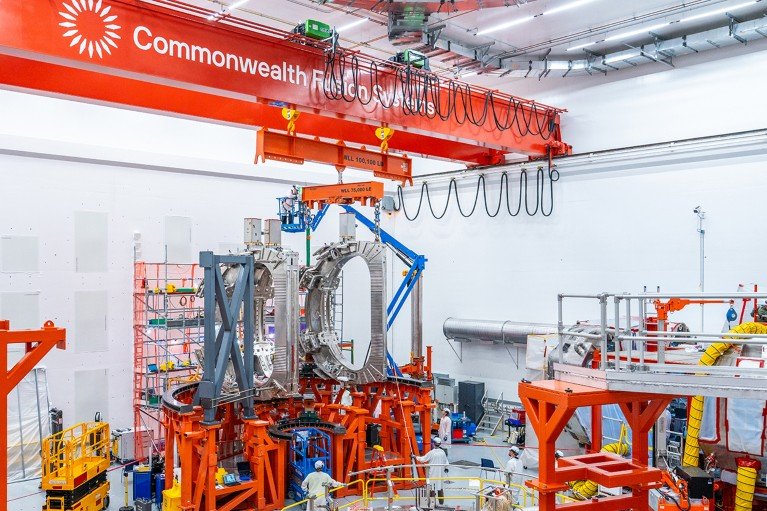
D-shaped magnets form part of a tokamak that is being built for a nuclear-fusion pilot project. Credit: Commonwealth Fusion Systems About a dozen technicians, in hard hats and protective clothing, move around a large, double-height room. Some are checking pipes coming up through the floor into a raised, circular platform. Others work on instruments installed
D-shaped magnets form part of a tokamak that is being built for a nuclear-fusion pilot project. Credit: Commonwealth Fusion Systems
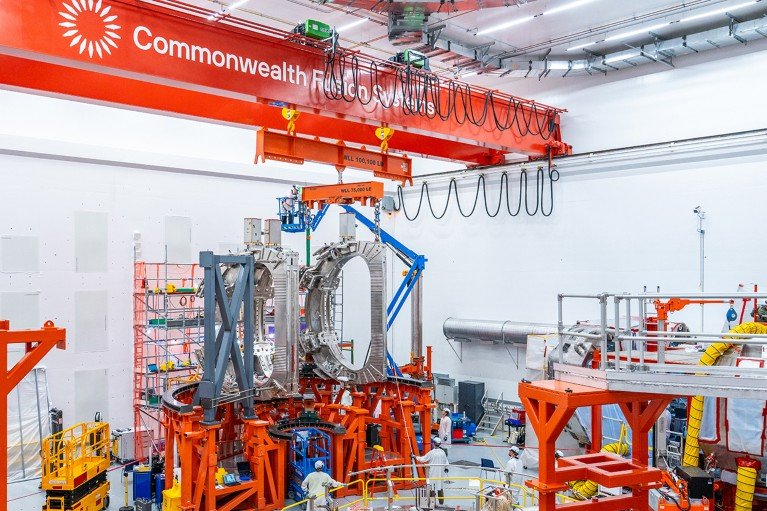
About a dozen technicians, in hard hats and protective clothing, move around a large, double-height room. Some are checking pipes coming up through the floor into a raised, circular platform. Others work on instruments installed in one of two semicircular chambers. Another is focused on a pair of D-shaped objects that are big enough for a person to stand in and are set in an upright frame. With hole-studded rectangular plates jutting out from the arc of the D and horizontal grooves decorating the spine, they look like a 3D steampunk version of an initial letter from a medieval illuminated manuscript.
In fact, each D-shaped object is a toroidal field magnet, developed with scientists at the Massachusetts Institute of Technology in Cambridge. Its makers hope that packing a strong magnet into a compact space will enable their company to be the first to achieve commercially viable nuclear-fusion energy. Because of how fusion power density scales with magnetic strength, doubling the field strength increases the density 16 times. “That is a game-changing technology,” says physicist Alex Creely, chief engineer at the company behind the machine, Commonwealth Fusion Systems in Devens, Massachusetts.
Nature Outlook: Nuclear power
The machine that the firm is building will require 18 magnets, arranged in a circle. Semicircular chambers will be threaded through the magnets to form a single vacuum chamber. The completed device, known as a tokamak, will rest on the platform, in which pipes will carry liquid helium to keep the magnets cold. The company hopes that lessons from building this prototype will help it to achieve commercial fusion by the 2030s.
At the core of each 23-tonne, steel-clad magnet is a coil of thin, superconducting tape, made from rare-earth barium copper oxide. When cooled to about 15 kelvin and fed with an electric current, each magnet produces a 20-tesla field, which is more than strong enough to lift an aircraft carrier. The fusion plasma state created in the machine is held in place by the field as it speeds around in the vacuum chamber, heated to more than 100 million degrees Celsius by radio waves. An electromagnet called a solenoid in the centre of the machine carries an electric current to create another magnetic field that forces the plasma into the right shape.
Commonwealth Fusion Systems is not alone in this quest for commercial fusion. According to the Fusion Industry Association in Washington DC, 46 companies have raised a combined US$14.6 billion to try to turn fusion — long a tantalizing scientific curiosity — into an electricity-generating reality. Although some firms are pursuing tokamaks, others are working on different designs that they hope can create self-sustaining fusion, putting an end to energy scarcity.
Big magnets, big lasers
That’s an ambitious goal. Research into fusion energy started in the 1950s, but it was not until late 2022 that a fusion experiment, at the US Department of Energy’s National Ignition Facility (NIF), produced more energy than was required to ignite it. Instead of a tokamak, the NIF experiment used lasers to trigger the fusion reaction. The lasers delivered a shot of about 2 megajoules of energy — enough to boil 7 litres of water — to ignite the fusion, which produced just over 3 MJ. That’s a small net gain. But it took 300 MJ to power the lasers, so even when the NIF achieved 8.6 MJ in 2025, it was still producing much less energy than was being consumed in total.
The record amount of energy produced by a tokamak-based reactor, set at the Joint European Torus in Culham, UK, in 2024, is 69 MJ. But it took three times that energy to heat the plasma enough for fusion to take place.
“Those are spectacular results, and it shows that we can actually make fusion work,” says Steven Cowley, a theoretical physicist who directs the Princeton Plasma Physics Laboratory in New Jersey. “What it doesn’t show is that we can make a commercial fusion plant that can make electricity at a cost you would pay.”
A 2021 report by the US National Academies of Science, Engineering, and Medicine called for a pilot fusion plant — one that demonstrates feasibility but that does not provide commercial levels of energy — to be operational between 2035 and 2040 (National Academies of Sciences, Engineering, and Medicine Bringing Fusion to the U.S. Grid National Academies Press; 2021). Cowley says that timeline, which is more conservative than what many companies are suggesting, sounds reasonable. In the mid-2040s, he says, commercial fusion could become a reality.
Helion Energy’s Polaris machine uses the hydrogen isotope deuterium and helium-3. Credit: Helion
Nuclear fusion could produce nearly limitless energy with no climate-changing carbon emissions. A typical reaction produces four times as much energy by weight of fuel as a uranium fission reaction does, and nearly four million times as much as burning fossil fuels. Fission derives its energy by splitting atoms apart, whereas fusion forces two atoms to fuse together. Unlike fission, fusion has no chain reaction that can lead to a meltdown; if the plasma becomes unstable, the fusion reactions just stop. At any given time, fusion machines contain only a tiny fraction of the radioactive fuel that is found in fission reactors — grams rather than tonnes — and produce less and shorter-lived radioactive waste.
The fusion reaction usually uses two forms of hydrogen: abundant, non-radioactive deuterium, and radioactive and rare tritium. Fusion happens when the positively charged hydrogen nuclei in the plasma become hot enough to overcome their repulsive forces and slam together to form helium, plus a neutron. These neutrons deposit their energy in a surrounding layer of lithium, creating heat that boils water to turn a turbine and generate electricity.
Alternative paths
In magnetic confinement fusion, which Commonwealth Fusion Systems is using, the fuel must be heated to a plasma that is around ten times hotter than the centre of the Sun. That plasma has to be kept stable enough by the magnetic field to sustain the fusion reaction; if it expands and touches the reactor wall, it will cool and the reaction will stop. The other main approach to fusion energy production, the inertial confinement on which the NIF relies, uses ultra-short, ultra-powerful pulses of laser light to heat and compress deuterium–tritium fuel pellets.
In the United Kingdom, First Light Fusion, a spin-out of the University of Oxford, has its own approach to inertial confinement fusion that separates the compression and heating stages. The company charges a series of capacitors, which then discharge their electricity in a burst. This pulse creates a magnetic field that compresses the fuel target to a density about ten times that of lead. A high-intensity laser pulse ignites the compressed fuel, sparking an energy-yielding fusion reaction. Reactor operators then have 10–25 seconds to get a new fuel target in place. The project is at an early stage, and is at least five years away from showing energy gain, says Jonathan Skidmore, a physicist and principal scientist at First Light Fusion.
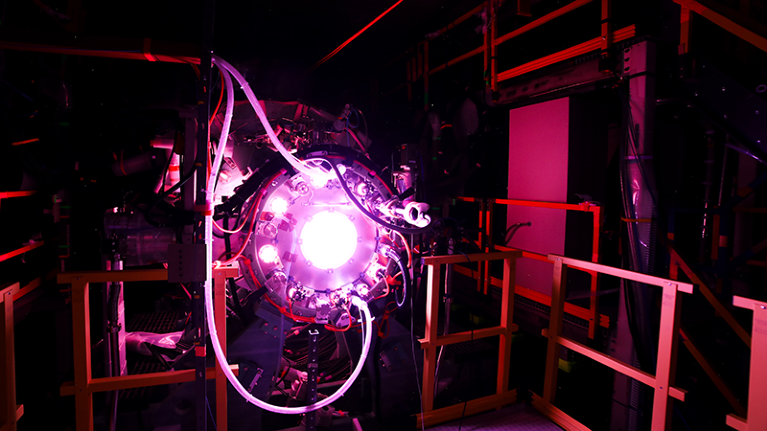
Helion Energy in Everett, Washington, is also designing a pulsed approach to fusion, although it uses magnetic confinement in a process known as field-reversed configuration. Rather than a doughnut-shaped tokamak, Helion creates magnetic ‘bottles’ at each end of a long, straight cavity that narrows at the centre. The system creates rings of hot plasma at each end of the cavity, then uses other magnets to send them racing down it at 1.6 million kilometres per hour. The plasma rings are squeezed by the narrowing cavity before they collide in the centre; there, magnetic fields compress them further and spark fusion reactions.
Instead of tritium, Helion makes its fuel out of deuterium and the isotope helium-3. The advantage of that, explains Anthony Pancotti, an aerospace engineer who co-founded the company, is that when the two nuclei fuse, they release charged particles. These particles push the magnetic fields outwards, which drives electric current back into the magnetic coils and recharges the capacitors. In principle, Pancotti says, that sort of direct energy conversion is more efficient because it skips the steps of creating steam and using it to drive a turbine.
Another magnetic confinement design that might improve on the tokamak is a stellarator. Tokamaks create an electric current in the centre of the plasma that can lead to instabilities that quench the plasma. Stellarators eliminate that current, and, therefore, that source of instability. The concept of a stellarator was devised in 1951. But it remained undeveloped for decades because of difficulties in engineering the device, says physicist Elizabeth Paul, who studies stellarators at Columbia University in New York City.
Instead of using the central solenoid to generate a further magnetic field to shape the flow of the plasma, a stellarator uses magnets twisted into different configurations to shape the field. One experimental stellarator, the Wendelstein 7-X, built by the Max Planck Institute for Plasma Physics in Greifswald, Germany, uses 50 magnetic coils in 5 distinct shapes. Instead of Commonwealth Fusion Systems’ circle of D-shapes, the torus of a stellarator would look like it was wrapped in a spring that had been stepped on. A stellarator’s coils are difficult to manufacture because they involve winding brittle high-temperature semiconductors along twisting paths. But it can lead to fewer instabilities. Type One Energy in Knoxville, Tennessee, and Proxima Fusion in Munich, Germany — a spin-off of the Institute for Plasma Physics — are both building demonstration stellarator projects, but neither company has demonstrated a working machine.
Creely says that scepticism about the pace of fusion-energy development is “totally fair”. Still, he remains optimistic. “We’re making very quick progress,” he says. Reactor models built with high-performance computing have advanced scientists’ understanding of fusion, he says, and several groups, including at Google’s DeepMind, have developed artificial-intelligence models to predict plasma instability — a vexing problem that has stymied many an attempt to control fusion (J. Degrave et al. Nature 602, 414–419; 2022).
Paul grants that advances in superconductors and computer modelling have brought fusion closer to reality, although she thinks that most companies’ timelines are overly optimistic. Still, she says, “fusion really is the energy of the future. I think we will get there someday”.
For more tech updates, stay tuned to our blog.