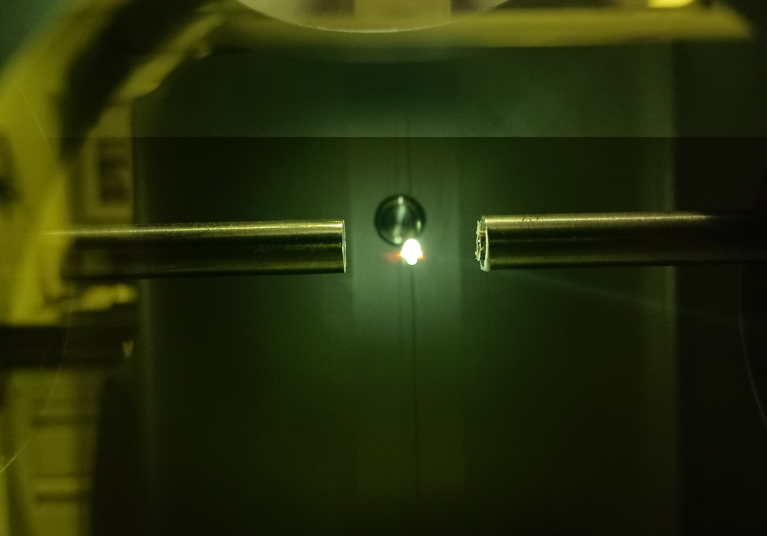
Light emitted by a microplasma could be used to monitor a molten-salt nuclear reactor.Credit: ORNL New insight into an old material Because it can tolerate high temperatures and neutron damage, the carbon material graphite is used in several ways in nuclear reactors. It has a role in structural components and in fuel coatings, and it
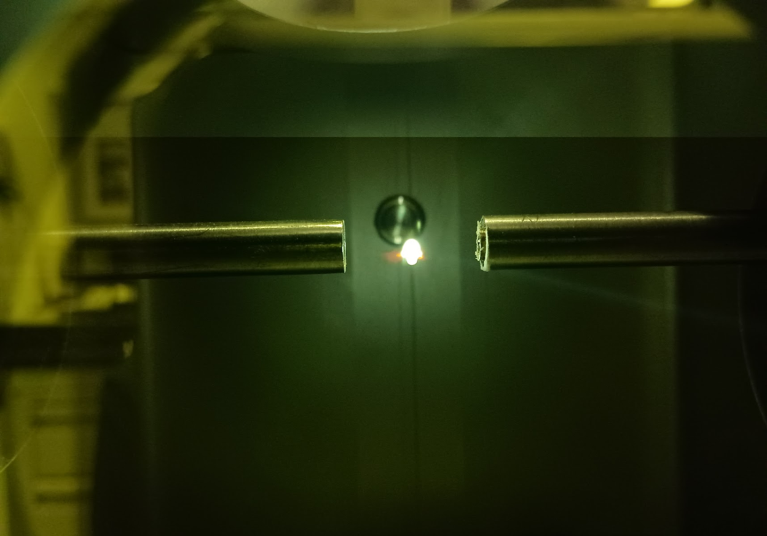
Light emitted by a microplasma could be used to monitor a molten-salt nuclear reactor.Credit: ORNL
New insight into an old material
Because it can tolerate high temperatures and neutron damage, the carbon material graphite is used in several ways in nuclear reactors. It has a role in structural components and in fuel coatings, and it also acts as a ‘moderator’, slowing down neutrons to make fission reactions more likely. But there’s a lot that scientists still don’t know about graphite, and it is difficult to predict precisely how its structure will change in response to radiation. That opens up questions about how to make more-durable, safer graphite parts for reactors.
Nature Outlook: Nuclear power
Researchers led by nuclear physicist Boris Khaykovich at the Massachusetts Institute of Technology in Cambridge used X-ray scattering to study graphite before and after exposure to different levels of radiation at various temperatures, to learn how its initial structure influences its durability. The team found that the size distribution of pores inside the material determines how its volume changes in response to radiation.
When irradiated, graphite at first increases in density. But after further irradiation, the material expands. Exactly how this plays out depends on the temperature, how much stress the material is under and the grade of the graphite. Nuclear graphite is typically a composite, consisting of crystalline regions, in which the carbon atoms are arranged in regular arrays; a ‘binder’ carbon matrix, in which the atoms are less ordered; and a network of pores and cracks. The structural differences determine how stress is distributed through the material, and how much it will shrink and expand inside a working reactor. The researchers hope that these insights into how graphite’s porous structure determines its response to radiation could help scientists to design materials for future reactors.
Interdiscip. Mater. 4, 714–718 (2025)
Monitoring reactor chemistry
Emerging nuclear-reactor designs that use molten salts either as a combined fuel and coolant, or as the coolant only, offer potential safety advantages. But the chemical and isotopic complexity of nuclear fuel dissolved in molten salt, and the corrosiveness of this environment, means that monitoring conditions inside such reactors is difficult. Researchers at Oak Ridge National Laboratory (ORNL) in Tennessee hope to accelerate the development of molten-salt reactors by devising better analytical techniques.
Inside these reactors, the nuclear fuel and its fission products — as well as the molten salt itself — can undergo unwanted chemical reactions, generating toxic gases. Scientists sample and analyse these gases to monitor what’s going on in a reactor. But to get a complete picture of the nuclear and chemical reactions, researchers need tools that can track isotopes while also providing chemical insights. What’s the potential for oxidation inside, and is corrosion occurring? Is water vapour forming? Seeing all of this at once has not so far been possible with any single method.
The team at ORNL, led by Joanna McFarlane, designed a system that zaps the gases with high-energy laser pulses to turn them into plasma. That plasma is then sent to three different spectrometers for simultaneous real-time analysis of its constituent elements and isotopes. They demonstrated the method in a molten salt based on sodium and potassium, saturated with protium and deuterium gases. The researchers sampled the mixture by sweeping these isotopic forms of hydrogen off the top and by blowing an inert gas through it to capture dissolved material. This provided a picture of how much gas the salt could hold and how fast it moved through the liquid.
The team hopes that a similar spectroscopy system will be integrated into future molten-salt reactors to monitor them during operation.
J. Am. Chem. Soc. 147, 910–917 (2025)
Nuclear power and cancer mortality
Radiation is a well-known carcinogen. But although many nuclear plants have been in operation for decades, it’s unclear whether they pose cancer risks to people living in their vicinity. Some studies in Spain and France have reported that residential proximity to nuclear plants increases cancer risk, but other studies have found no consistent associations.
Spurred by the renewed interest in nuclear power, researchers led by Petros Koutrakis, who studies environmental health at the Harvard T.H. Chan School of Public Health in Boston, Massachusetts, performed a large-scale analysis to try to get a clear answer. They focused on the United States, which produces about 30% of the world’s nuclear energy. Previous studies might have yielded mixed results, the authors write, because they tended to look at only one or a few plants. This limits their statistical power, and complicates detection of rare cancers. Many studies also used hard cut-offs when assessing proximity to nuclear reactors, meaning that risks might be underestimated for people living slightly farther away.
Using 2000–18 data from the US Centers for Disease Control and Prevention (CDC), Koutrakis’s team found that adult cancer mortality rates were higher in counties located close to nuclear plants than they were in counties at a greater distance away. The association was largest in older people — probably, the authors say, because cancers caused by environmental exposures take time to develop.
The researchers acknowledge several limitations of their study: it does not include childhood cancers, which were rare in the CDC data; it uses proximity as a proxy for radiation dosage, which might not always be accurate; and it does not account for differences in the type of nuclear plant or other potentially confounding sources of radiation exposure. “Understanding the potential long-term health implications of nuclear power generation is particularly important given the renewed interest in nuclear energy as a low-carbon solution,” they write.
Nature Commun. 17, 1560 (2026)
A look at radiation-resistant alloys
Materials belonging to a class called high-entropy alloys are more resistant to radiation damage than is stainless steel, which is widely used to make parts for nuclear reactors. Researchers have now detailed single-atom-level structural changes inside one of these materials that might explain its greater hardiness.
Conventional steel alloys are made mainly of iron, with small amounts of other elements added to enhance strength or other properties. By contrast, the high-entropy alloys that have emerged over the past 25 years or so combine several metals in similar amounts.
Researchers have previously described what happens in high-entropy alloys when they are bombarded with radiation at room temperature. But how far these findings apply to real systems is uncertain: temperatures in nuclear reactors can reach hundreds of degrees Celsius.
In this study, a team led by materials engineer Yanwen Zhang of Queen’s University in Kingston, Canada, irradiated a high-entropy alloy composed of chromium, iron, manganese and nickel at 400 ºC and 600 ºC, and used X-ray spectrometry and other analytical and imaging techniques to see how the material’s structure changed. The tests showed that the high-entropy alloy sustained less damage under these conditions than steel does.
Depending on the radiation dose and temperature, the type of damage to the material varied. Some conditions were associated with higher numbers of structural imperfection, others with fewer imperfections of larger size. The researchers also observed how radiation displaced atoms within the material, depleting manganese in some regions and enriching others in nickel. To improve a material, scientists want to learn as much as they can about what happens when it fails.
J. Nucl. Mater. 615, 155940 (2025)
Proliferation risks of uranium fuels
Many advanced reactor designs use uranium fuels formulated differently from those used in conventional light-water reactors. There’s some debate about whether these fuels require new safety regulations to ensure that they won’t be a target for terrorists and nation-states that want to make a weapon. A paper by nuclear engineer Charles Forsberg at the Massachusetts Institute of Technology and Florida-based nuclear power consultant Andrew Kadak argues that existing safeguards are likely to be sufficient.
High-temperature gas-cooled reactor fuels are often made up of poppy-seed-size granules of uranium coated in several layers of graphite and silicon carbide. This formulation — called TRISO (tri-structural isotropic) fuel — protects the uranium and makes meltdown very unlikely up to about 1,600 ºC. Because the material contains only a small amount of uranium by volume, the uranium itself needs to be more enriched with the highly reactive uranium-235 isotope than do conventional fuels. Uranium that is more than 20% 235U is considered highly enriched, and has the potential to be further enriched for use in weapons. TRISO fuels typically incorporate high-assay low-enriched uranium (HALEU), which is enriched to between 5% and 20% 235U.
Some specialists have warned that 1,000 kilograms of HALEU could be used directly to make a nuclear weapon. Forsberg argues that it is unlikely that terrorists intent on bomb-making would be able to pull this off by stealing TRISO fuels, because of the complex chemical processes needed to extract the uranium from its coatings. Each chemical step would have associated losses, making it challenging to gather 1,000 kg of HALEU. This process “involves the largest number of sequential chemical processes ever considered for any nuclear material,” he writes. However, he argues, because a nation state might have the capability of extracting the material and enriching it, safeguards already in place for other types of nuclear fuels should also be applied to TRISO fuels.
Nucl. Technol. 211, 2880–2887 (2025)
Keep following us for the latest insights.