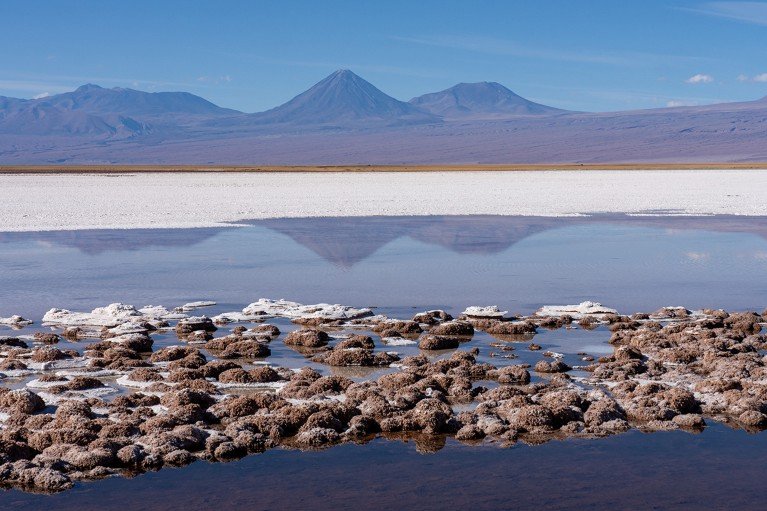
Fossilized microbial mats known as stromalites provide important records of some of Earth’s earliest life.Credit: Jon G. Fuller/VW Pics/UIG via Getty Earth & Life: A Four Billion Year Conversation Andrew H. Knoll Princeton Univ. Press (2026) On 14 February 1990, NASA’s Voyager 1 spacecraft turned around briefly to snap a picture of Earth before heading
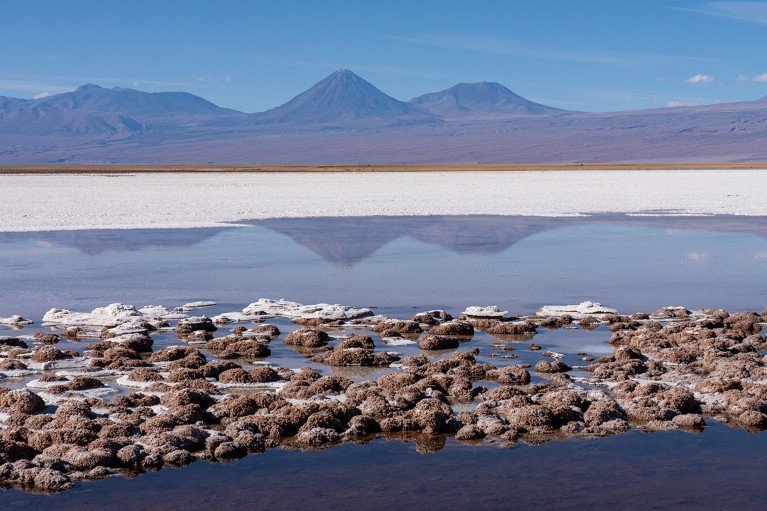
Fossilized microbial mats known as stromalites provide important records of some of Earth’s earliest life.Credit: Jon G. Fuller/VW Pics/UIG via Getty
Earth & Life: A Four Billion Year Conversation Andrew H. Knoll Princeton Univ. Press (2026)
On 14 February 1990, NASA’s Voyager 1 spacecraft turned around briefly to snap a picture of Earth before heading to the fringes of the Solar System. The image it captured — known as the pale blue dot — instantly became a classic.
Carl Sagan, the astronomer who suggested taking the picture, noted in his 1994 book Pale Blue Dot how, from afar, “our planet is a lonely speck in the great enveloping cosmic dark”. Everything we know is on that lump of gas-cloaked rock: “Our posturings, our imagined self-importance, the delusion that we have some privileged position in the Universe, are challenged by this point of pale light.” His subsequent writings about life on Earth were infused with awe and appreciation as well as sober existential reflection.

‘Climate free fall’: why the biggest risk to our economies is yet to be recognized
Over the centuries, many other scientists have wondered how life emerged on our planet. How did it take root? What enabled it to flourish? Does life exist elsewhere in the Universe? Is it common? Will we ever be able to know with certainty?
Such questions motivate Andrew Knoll’s book Earth & Life. A labour of love by one of geobiology’s most respected scholars, it builds on his earlier work, Life on a Young Planet (2003). This latest book, written for a general audience, emphasizes how physical, chemical and biological processes have engaged with each other and evolved together over time — in short, they have struck up a conversation.
Knoll introduces the reader to the field of geobiology, a melting pot of disciplines, through his personal and professional experiences. He relates how he discovered, as an undergraduate student, that life and Earth have influenced each other’s development — a profound intellectual awakening. He then sketches geobiology’s history, paying homage to the field’s key contributors over the past three centuries, from the Age of Enlightenment to the present.

To unravel the origin of life, treat findings as pieces of a bigger puzzle
Knoll catalogues Earth’s great biogeochemical cycles, how the elements that sustain life became available, the origin of life and the evolutionary relationships between organisms. He highlights how microorganisms transformed Earth’s environment at various stages. Microbes, for instance, catalysed the initial build-up of oxygen in the atmosphere during the Great Oxidation Event. Yet, he explains, these changes were possible because physical processes, including plate tectonics, and chemical ones, such as weathering, worked with the biology.
Telling the story of atmospheric oxygen in three acts, he describes how the conversation between physical, chemical and biological processes was written down at distinct periods of Earth’s history, during which atmospheric oxygen levels reached different steady states. The book ends with a thoughtful discussion of how our knowledge of the past informs our perspective of modern climate change, as well as how it influences our search for life on other planets.
How we understand the past
Deciphering the past holds a powerful intellectual allure, but it can be intractable. It is hard enough to make sense of events that transpired decades or centuries ago, let alone millions or billions of years ago. To infer the history of life on Earth, scientists must read the records preserved in ancient rocks. Yet these are fragmentary. Some periods of time have left abundant evidence. But for others, the information remains elusive, because the original rocks have long since been altered by tectonic processes — wiping the record clean.
Even if researchers are lucky enough to find ancient rocks with putative traces of life, it can be difficult to know what they are looking at. Did a potential ‘biosignature’ indeed result from a living organism, or something purely abiotic? We cannot travel back in time to observe what happened. Earth did the experiment once, all we can do is piece together the surviving evidence.
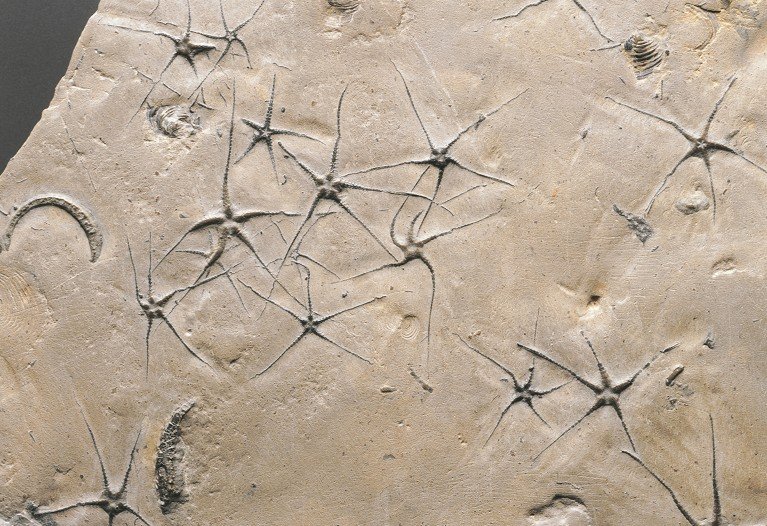
Brittle star fossils dating to the Jurassic period, 200 million to 145 million years ago.Credit: G. Cigolini/De Agostini via Getty
Therefore, composing a coherent narrative about life and Earth’s four-billion-year conversation requires imagination, skill, tenacity and comfort with a lack of certitude. The best historians recognize that they are storytellers, embracing fresh evidence as it becomes available and revising their interpretations accordingly. Knoll is one of them.
He exposes the reader to the drama of the discipline: the intrepid qualities of geobiologists, their differences in opinion, their passionate debates. Knoll humanizes geobiology by explaining how scientific consensus emerged around major topics. For example, we know when the Great Oxidation Event occurred (2.4 billion to 2.2 billion years ago), but debate still rages on as to why it happened then.
How would we know whether there is life on Earth? This bold experiment found out
Best of all, Knoll explains the art of geological deduction. That geologists are essentially detectives dressed in field gear is a revelation. Knoll teaches the reader how learning about the past is a remarkably rigorous, evidence-based endeavour. Contextual clues can help us to favour one interpretation over another.
Coursing through the book are personal anecdotes. We get to know people who Knoll was influenced by and admired; we are taken on a tour around the world to remote sites where he collected samples of geobiological importance. He does an impressive job of summarizing highly distinct topics — from the origin of life to how we understand evolutionary relationships — with clarity and rigour.
Keep following us for the latest insights.