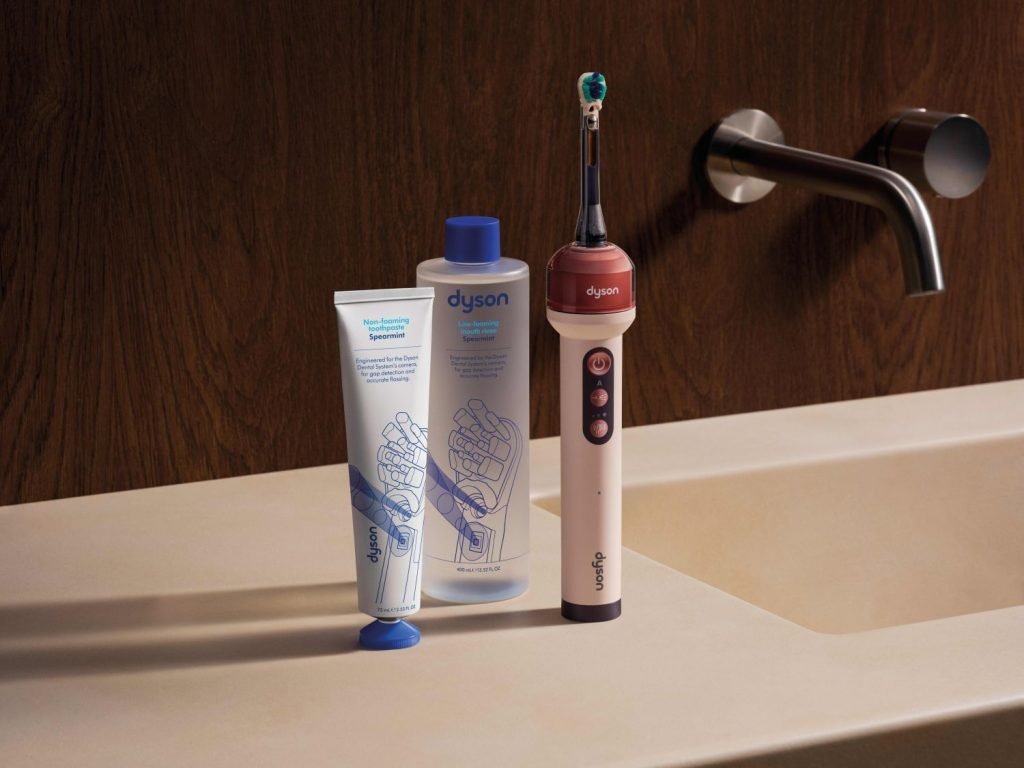
Dyson has spent six years trying to solve a problem most of us already know we have. We brush too quickly, skip the gaps between our teeth, and treat flossing as optional homework. The company’s answer is the Dyson CameraJet, a toothbrush that watches those gaps in real time and fires a burst of mouthrinse
Dyson has spent six years trying to solve a problem most of us already know we have. We brush too quickly, skip the gaps between our teeth, and treat flossing as optional homework.
The company’s answer is the Dyson CameraJet, a toothbrush that watches those gaps in real time and fires a burst of mouthrinse into them while you brush. It goes on sale in Australia from 2 September 2026 at A$799.
That is a lot of money for something that lives next to the tap. It is also the first time Dyson has walked into oral care with the same over-engineered seriousness it applied to vacuums and hair dryers.
The gap most of us miss
Dentists have been saying the same thing for decades. Brush twice a day for two minutes, then clean between the teeth. Dyson’s own research, cited in the launch material, found nine in ten people do not floss as often as they should. The same briefing says the average brush lasts about 45 seconds, well short of the two-minute guideline.
Those missed spaces are where plaque starts. Left alone, it hardens into tartar and can feed the everyday problems that send people to the dentist: bad breath, irritated gums and decay.
The World Health Organization’s 2025 Global Oral Health Status Report estimates nearly 3.7 billion people are living with oral disease. Poor oral health is also increasingly linked, in the medical literature Dyson points to, with wider conditions including heart disease and Alzheimer’s disease.
This explains why Dyson thinks the category is worth 661 engineers, 38 patents and 16 million lines of code.
How the camera is supposed to work
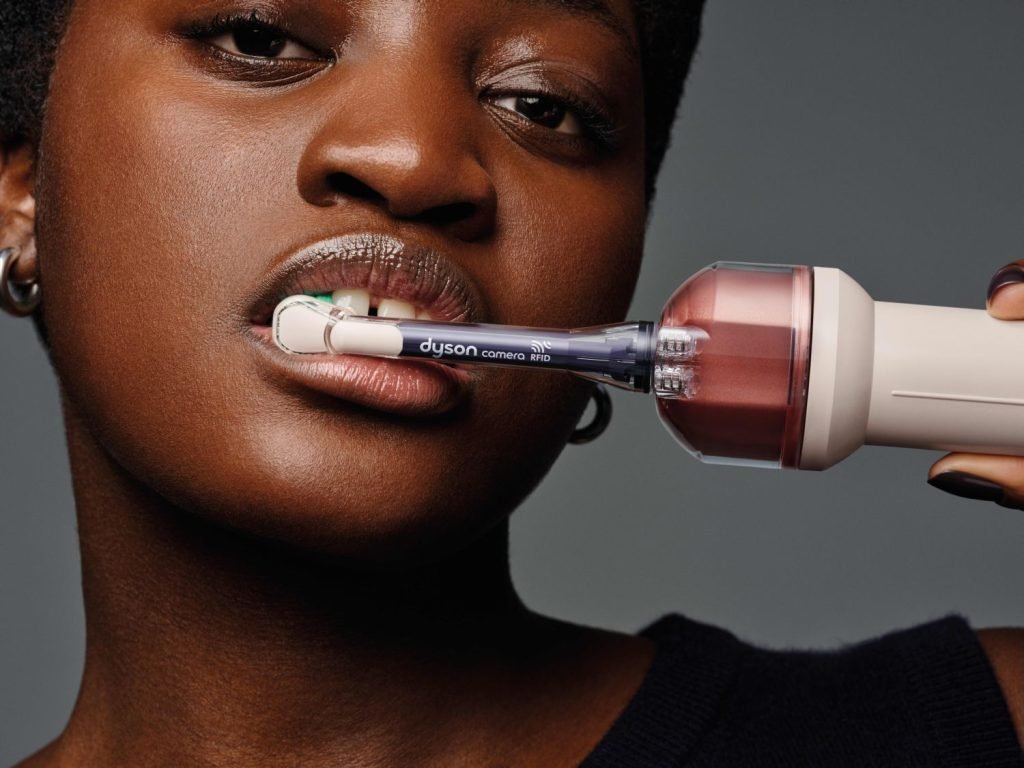
The CameraJet carries a 100,000-pixel macro lens in the brush head. Dyson calls the software behind it Gap Optical Targeting.
The company says the camera scans 28 live images every second, then detects, tracks and predicts the gaps between teeth. Within 100 milliseconds of seeing a gap, the brush is meant to fire a conical burst of mouthrinse at that spot.
Dyson says the machine-learning system was trained on 470,000 dental images collected during development. The camera strobes at 257Hz, slightly out of sequence with the moving bristles, so the software can still see while the head is oscillating.
A target lens on the brush head widens the camera’s field of view so the system can look ahead rather than only reacting to what is already under the bristles.
You can also turn auto-jetting off and trigger the jet yourself. Intensity is adjustable. The company is not claiming the camera diagnoses disease. It is claiming it can find the spaces string floss is meant to reach, then wash them while you keep brushing.
James Dyson on why flossing loses
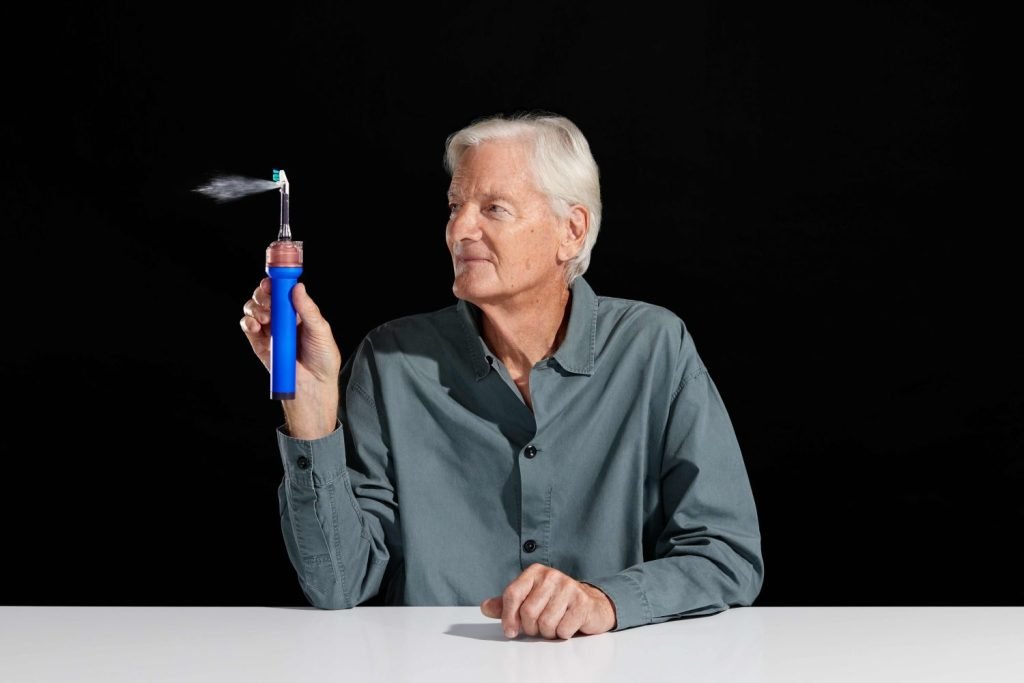
James Dyson, Founder and Chief Engineer at Dyson, frames the product as a response to a habit people already fail at.
“Flossing is an awkward and time-consuming chore. Few of us do it even though we know we should. Dyson engineers and scientists have spent well over a decade understanding oral care regimes and how nasties build up in the mouth. Our research has shown that people consistently miss the areas where plaque forms: the gaps between teeth.
We wanted to solve three fundamental problems: how to see those gaps, remove plaque, how to improve cleaning performance while brushing.
By combining a camera, machine learning, precision fluid dynamics, advanced brushing technologies, connectivity and WiFi, Dyson CameraJet introduces an entirely new way to keep your mouth healthy.”
James Dyson, Founder and Chief Engineer, Dyson.
That is the pitch. The test for Australian buyers is whether the hardware is less awkward than a roll of floss.
A cone of rinse, not a needle of water
Most water flossers use a thin, needle-like stream. Dyson’s fluid team argues that profile punches a hole through plaque without lifting it off the tooth.
The CameraJet uses a broader conical spray. Dyson says the wider pattern sweeps plaque rather than piercing it, and that the jet runs at a lower pressure so it is gentler on gums and enamel.
To iterate without running a clinical trial after every nozzle tweak, Dyson spent five years working with the National University of Singapore’s Faculty of Dentistry on a proxy plaque. Engineers could then test removal in the lab and change the jet geometry quickly.
The company also quotes laboratory results against conventional brushes. In deep-clean mode versus a manual toothbrush, Dyson says the system removes more plaque. Separate external lab testing, according to Dyson, found its variable sonic oscillation removed up to 69 per cent more plaque than market-leading premium electric toothbrushes in hard-to-reach areas.
Those figures are Dyson’s, generated under defined test conditions. They are not a substitute for what your own dentist sees after six months of real use.
A four-week clinical test with 71 people, using Dyson’s own toothpaste and mouthrinse twice a day, is the company’s human evidence against a manual brush. That is a start. It is not a head-to-head published trial against the best Oral-B or Philips models in Australian bathrooms.
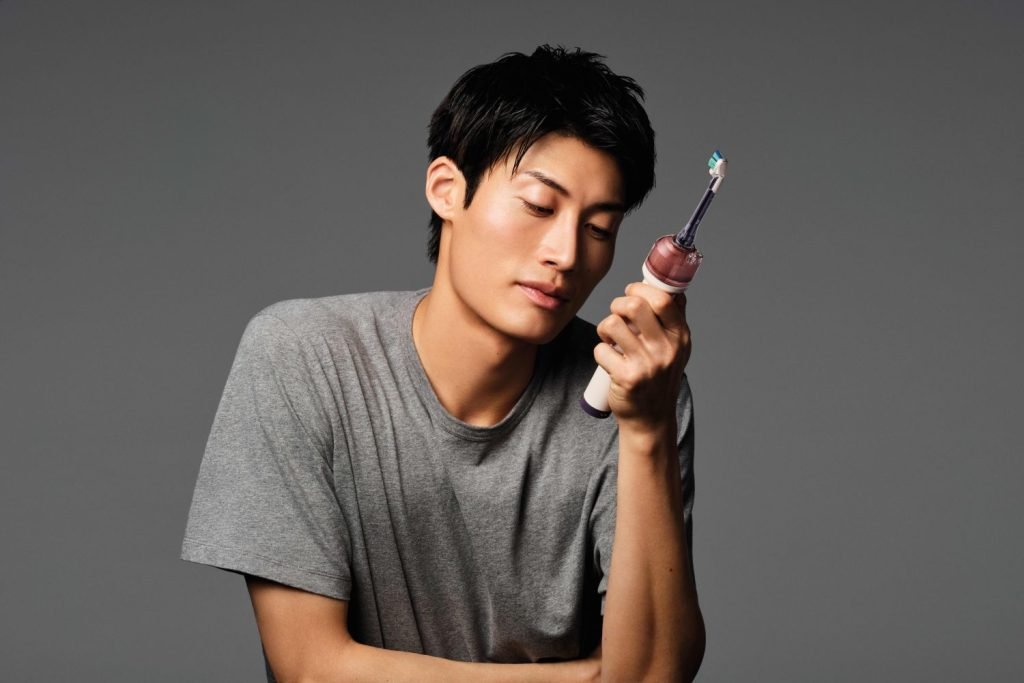
The tank that still works upside down
The rinse lives in a 12.5ml tank. Dyson says that volume is tuned to cover the gaps in one session without flooding your mouth.
A conventional “straw in a cup” reservoir can suck air when you tilt the handle to reach the back teeth. Dyson’s anti-gravity tank uses a diaphragm pump and pressure chamber so the jet is meant to keep firing whether the brush is upright, angled or horizontal.
The charging dock is doing more than holding the handle overnight. Press a button and it refills the tank in three seconds, then stands the brush upright between cleans.
A travel case is in the box, which matters if you actually want the full routine on the road. The dock is the piece that makes daily use less fiddly than filling a separate water flosser.

Bristles that are not a flat lawn
Dyson’s line on the head is simple: teeth are not flat, so the brush should not be either.
The dual-bristle head uses firmer inner bristles to work on surface stains and softer outer bristles along the gumline. Dyson says the contour is designed to cover more of the tooth than a conventional flat head.
Each head has an RFID tag. The handle knows when a head is attached, how many cleans it has done, and when it should be replaced. A sensitive head is also in the range for people who find standard bristles too aggressive.
The motion is the other half of the story. Dyson engineers watched slow-motion footage of leading sonic brushes and found bristles can stall against the tooth even while the motor is running.
Variable sonic oscillation changes the angle of movement as you brush, which Dyson says keeps the filaments moving instead of jamming. The head is also described as moving nearly 1,000 times a second, with a sonic dampener in the head for a quieter, less harsh feel.
Why Dyson wants you on its toothpaste
The camera is useless if the lens is looking at a mouthful of foam.
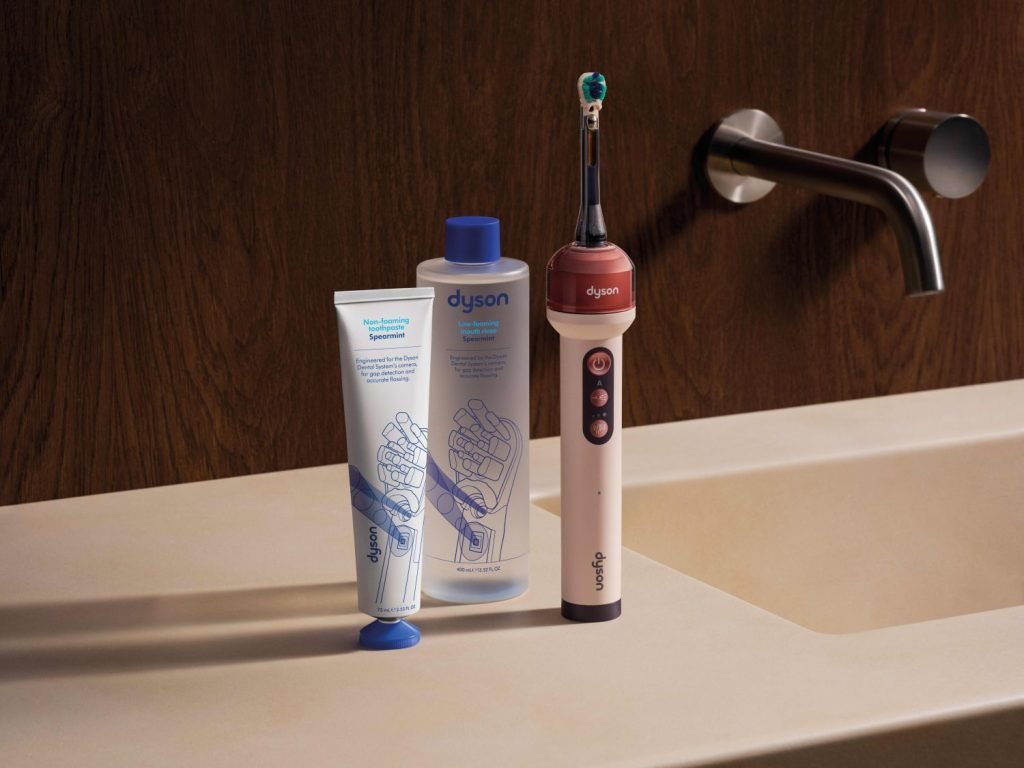
Dyson has therefore made a non-foaming toothpaste without SLS, the surfactant that makes most pastes bubble. The matching mouthrinse is low-foaming and formulated to go through the jet.
Both contain sodium fluoride to help strengthen enamel, plus phosphates and xylitol aimed at the bacteria behind plaque and tartar. The rinse is antibacterial and uses glycerin to reduce that dry, tight feeling some mouthwashes leave behind.
Flavours are Ginger Mint and Spearmint. Dyson says they are tuned to sit together in the mouth rather than fight each other.
You can, in theory, fill the tank with water. You can also try another SLS-free paste. If you stay on a foaming supermarket tube, the camera’s party trick is the first thing to fail.
Consumables will be the long-term cost. Heads, paste and rinse are how a A$799 handle keeps earning after the unboxing.
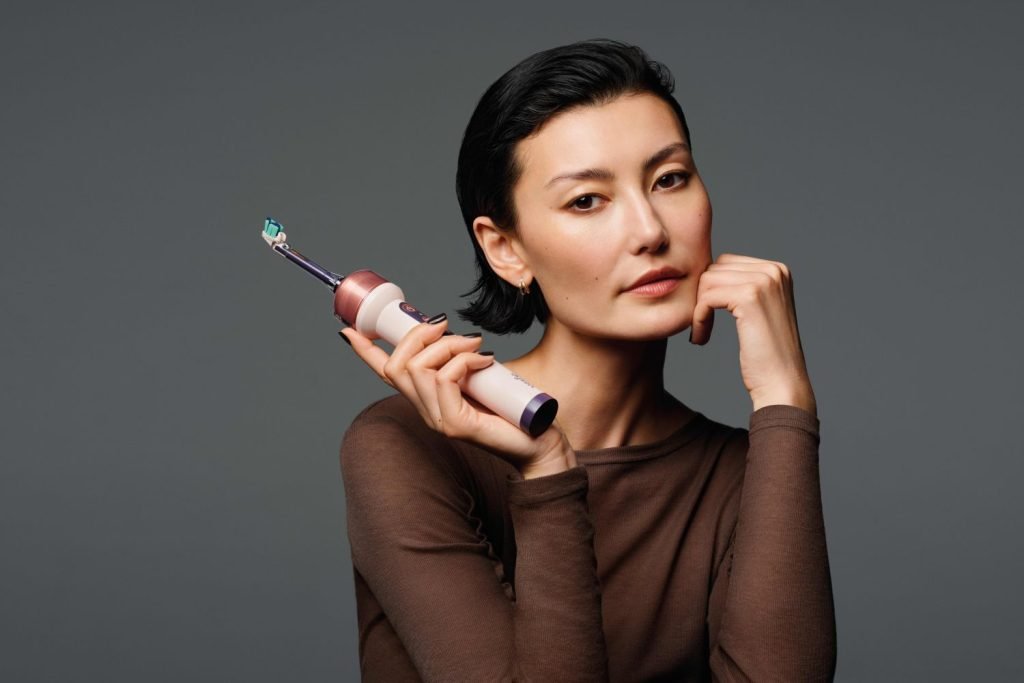
Live view, no cloud album of your molars
The CameraJet connects over 2.4GHz Wi-Fi and Bluetooth. Inside the MyDyson app you can watch a live endoscope view of your own teeth, plus guided cleans, how-to films, coverage maps and technique feedback.
Dyson says the camera only turns on for live viewing or auto-jetting. No images are recorded on the brush or sent to the cloud. If that claim holds, the privacy model is better than a lot of bathroom gadgets that quietly keep a gallery.
You will still need a 2.4GHz network. Plenty of modern Australian mesh systems hide that band or push phones onto 5GHz by default, so expect a bit of router fiddling on day one.
The app can show you where you lingered and where you rushed. Whether that changes behaviour is the same question every smart brush has faced. Some people love a score. Others put the handle back on the charger and never open the phone again.
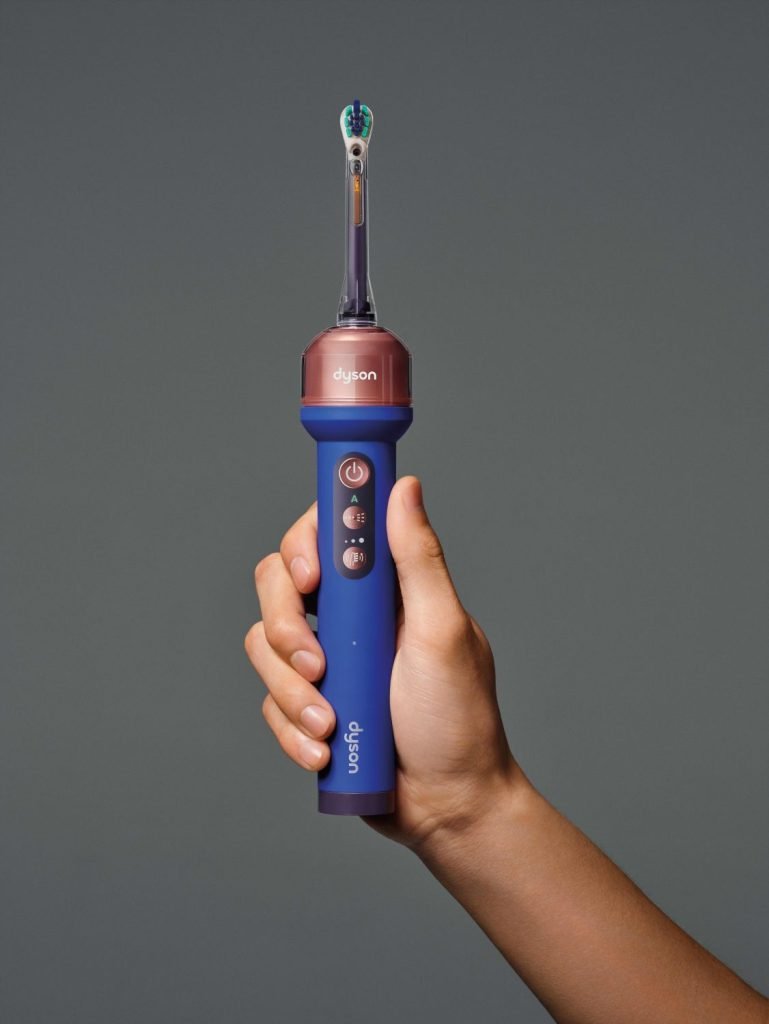
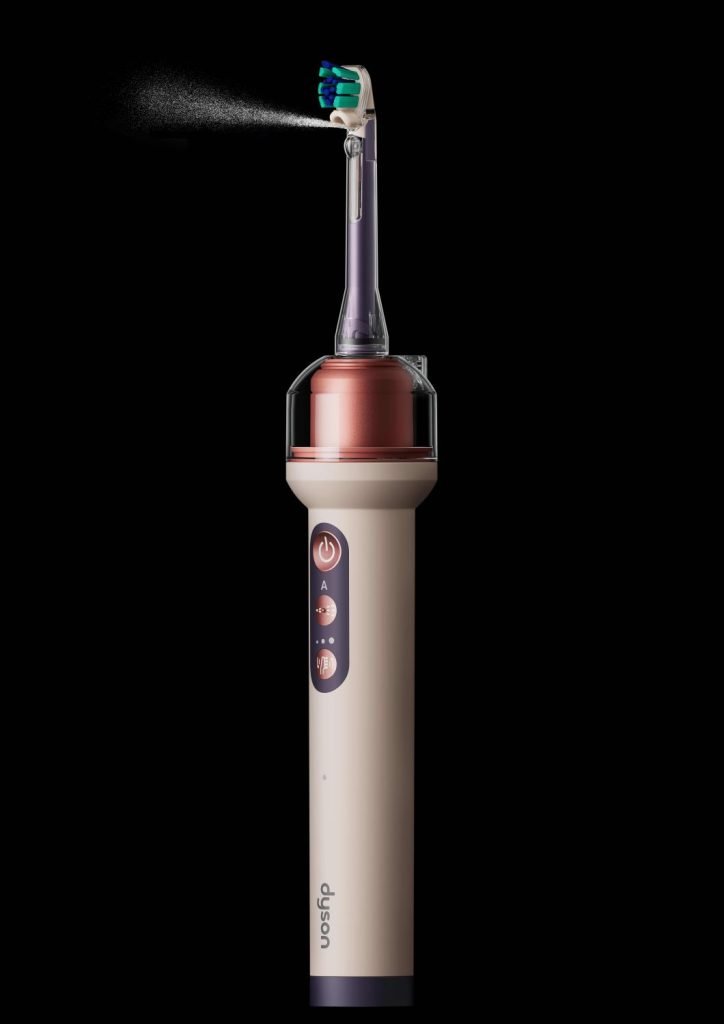
Price, colours and what is in the box
The Dyson Dental System is listed at A$799 from 2 September 2026 at dyson.com.au, Dyson Demo Stores and selected retailers.
In the box you get the CameraJet, the charging and refill dock, a travel case, and a starter kit of Dyson toothpaste and mouthrinse. Colourways are Ceramic Ultra Blue and Ceramic Pink.
A$799 sits in the same neighbourhood as Dyson’s hair tools and well above a typical electric toothbrush. It is not automatically the dearest brush in Australia. Flagship Oral-B iO models have carried RRPs that climb into the same rarefied air, usually without a camera or an onboard flossing jet.
What you are paying for here is a bundled routine: brush, targeted rinse and a dock that refills the tank. What you are not paying for is proof that this replaces string floss for every mouth, every dentist, every day.
If you already water-floss and brush for two minutes, the CameraJet is a very expensive way to combine two habits. If you never floss and your hygienist keeps drawing blood from the same spots, it is a more interesting experiment.
The honest next step is the same as every other Dyson launch. Use it for a few weeks, then ask the person who actually looks at your gums whether the gaps look cleaner.
For more information, head to Dyson.
Keep following us for the latest insights.