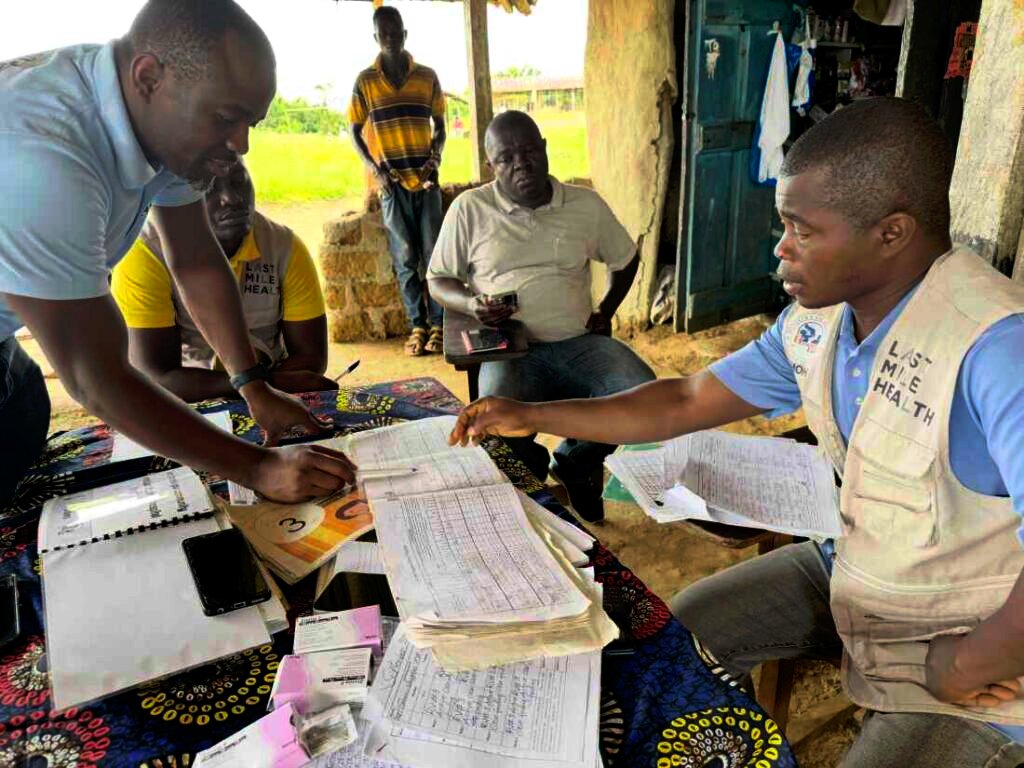
Genesis Whegelee (right, in vest) has been a community health worker for Last Mile Health in Rivercess County, Liberia, since 2018. He visits households to keep an eye on sick children, pregnant moms and anyone with a problem that needs diagnosing. Last Mile Health hide caption toggle caption Last Mile Health In 2007, Dr. Raj
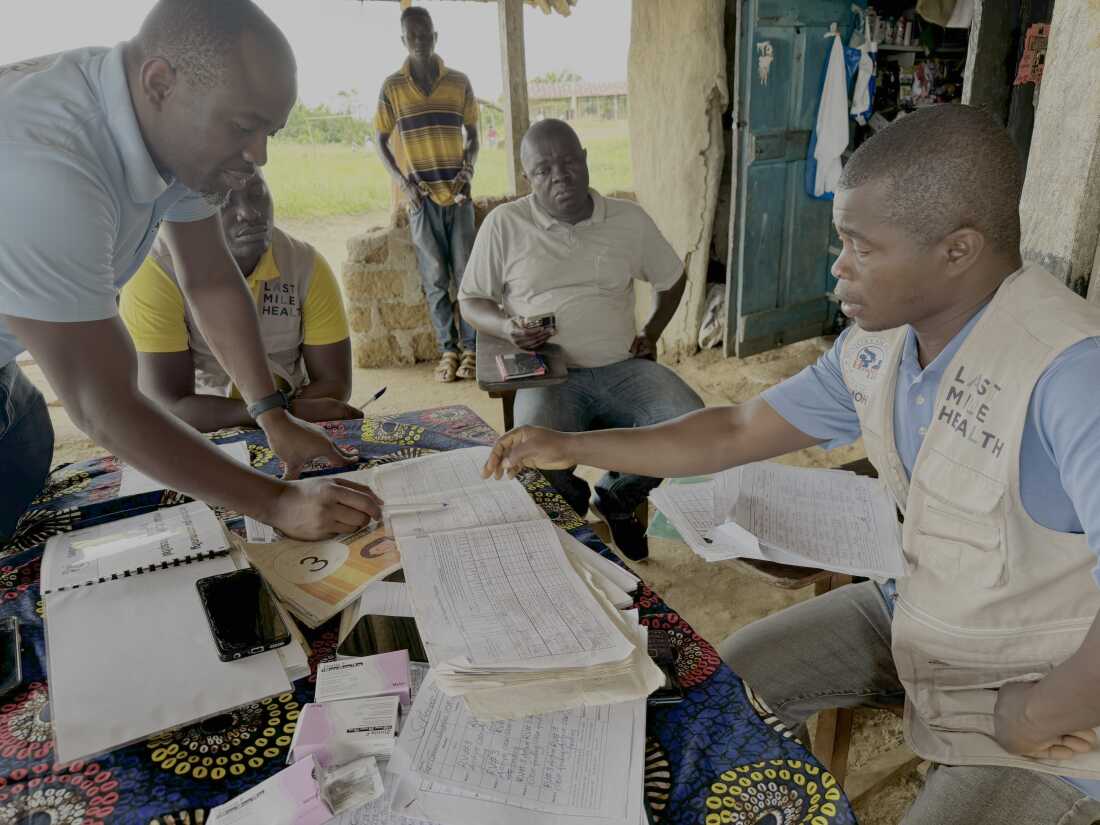
Genesis Whegelee (right, in vest) has been a community health worker for Last Mile Health in Rivercess County, Liberia, since 2018. He visits households to keep an eye on sick children, pregnant moms and anyone with a problem that needs diagnosing.
Last Mile Health
hide caption
toggle caption
Last Mile Health
In 2007, Dr. Raj Panjabi, a physician at Brigham and Women’s Hospital in Boston, traveled to Liberia, where he was born. He had just been married and brought the $6,000 he had raised from wedding guests to help co-found a health initiative to provide care to those who lived in the country’s most remote, inaccessible regions. The organization’s name, Last Mile Health (LMH), reflected its mission: the belief that no one should be beyond the reach of life-saving medical help.
Today, Last Mile Health is receiving an honor that comes with a $3 million gift. It’s the Conrad H. Hilton Humanitarian Prize, the world’s largest humanitarian award to a nonprofit group. It’s a resounding affirmation of how a group that started very small can go on to, according to the Hilton honor announcement, make extraordinary contributions toward alleviating human suffering.
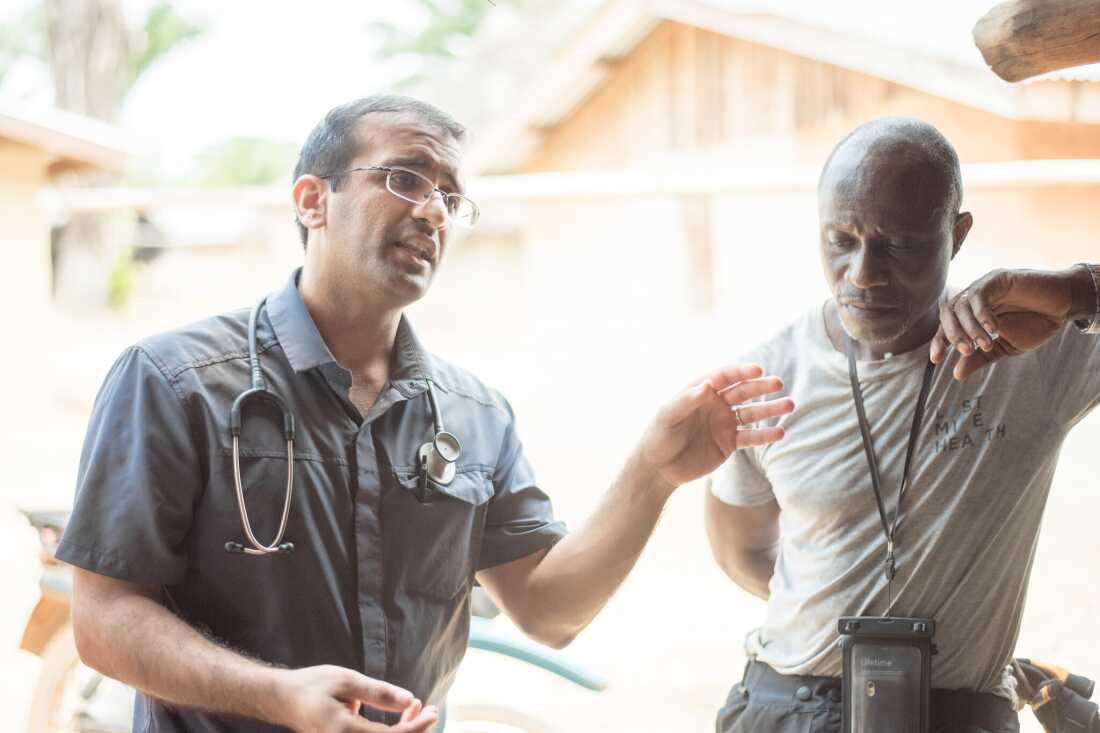
Dr. Raj Panjabi started Last Mile Health with money donated by his wedding guests. His goal was to walk the last mile to bring healthcare to people in remote areas in Liberia, where he grew up.
Last Mile Health
hide caption
toggle caption
Last Mile Health
But how did they reach that last mile, when physicians, nurses and medical supplies were, if available at all, scarce and far away? By using community health workers.
These are individuals who typically have a primary school education. During their eight weeks of training, they learn to diagnose and treat preventable diseases in children, including malaria, pneumonia and diarrhea, as well as help pregnant mothers develop a birth plan to deliver in the clinics. The health workers are also trained to monitor any signs of new diseases or outbreaks.
The initial $6,000 raised to start the organization served to pay the organization’s first 17 workers. Since then, the group has expanded its scope with funding from governments as well as philanthropic and nonprofit institutions. In 2010, LMH began caring for HIV/AIDS patients in 12 of Liberia’s 15 counties, partnering with the Government of Liberia and the Global Fund to Fight Aids, Tuberculosis and Malaria.

During the 2014-16 Ebola epidemic in Liberia, LMH trained more than 1,300 community health workers to help contain the outbreak’s spread. During the COVID-19 pandemic, LMH delivered 6.2 million pieces of personal protective equipment. Going door to door to persuade people to get vaccinated, they helped lead Liberia, one of the poorest countries in the world, to an 81% vaccination rate.
Today, LMH supports 20,000 community health workers helping 32 million people not only in Liberia but in Ethiopia, Malawi and Sierra Leone. The nonprofit group has helped design a digital training program as well.
But many people who live in remote areas struggle to find medical services, points out LMH chief executive officer Lisha McCormick.
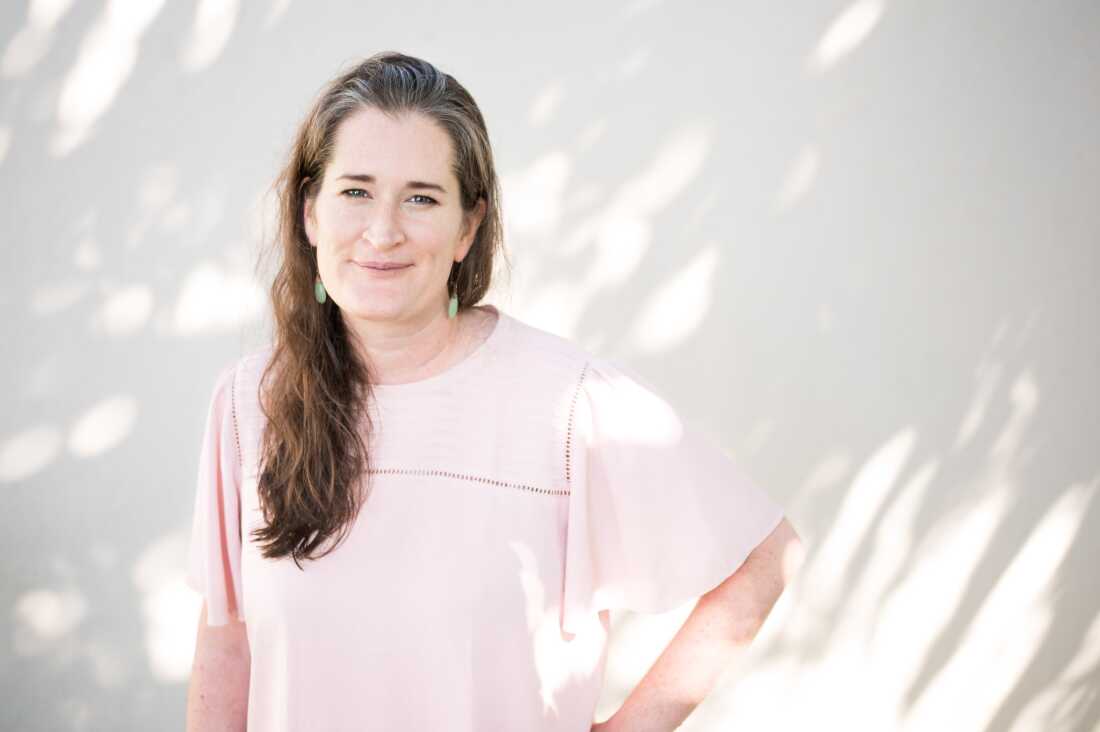
Lisha McCormick is the chief executive officer of Last Mile Health. Approximately two billion people live in remote communities outside the reach of healthcare, she points out. The group’s goal is to bring healthcare to them.
Last Mile Health
hide caption
toggle caption
Last Mile Health
“Last Mile Health’s work feels especially pressing today,” Peter Laugharn, president and CEO of the Hilton Foundation, said in a statement. “Health systems in the hardest-to-reach regions still face enormous strain, and Last Mile Health has met that challenge head-on.”
Panjabi, who is now president emeritus of LMH, agrees.
“We are at an unprecedented moment in global health,” he says, citing projections that there could be millions more deaths by 2030 if current funding trends continue, with major reductions by the United States as well as some European countries. The projections come from a study published in Lancet , which found that U.S. foreign aid cuts in the year 2025 could lead to more than 14 million additional deaths globally by 2030, including more than 4.5 million children under five.
“Everyone wants to cut healthcare costs,” he continues. “We cannot cut funds without cutting care, unless you get ahead of the disease. One of the most effective ways to get ahead of disease is to detect it at the earliest possible time. And community health workers are part of the answer.”
Research exists to back the contention that beyond saving lives, community health workers also save money. A 2025 analysis of 255 studies published in SSRN, a platform for researchers from academia and, in this case, members of leading health groups like the Clinton initiative, found that more than 80% of the time, these professionals delivered care at a median cost of just $0.59 per person per year. “Overall, a decade of data shows that CHWs [community health workers] are a proven, cost-effective platform for primary health care,” the paper’s authors concluded.
That achievement is reflected in the experience of Genesis Whegelee, who has worked as a community health worker in Rivercess County, Liberia, since 2018.
“There was a lot of malaria, and we didn’t know why children were dying in the community,” he says. “Now everyone is getting [medical] attention.”
Whegelee is responsible for visiting 42 households — three a day in rotation –- to assess their healthcare needs. He carries a small bag of medications and what the group calls a “job aid” –- essentially a medical textbook he can consult as he tracks the health and well-being of each family.
These visits include checking to see if there are any ill children or newly pregnant women, along with education about mosquito nets and sanitation. They account for about four hours each day. He is on call at his home the rest of the day not only doing necessary planning and paperwork but also available for emergency calls and visits.
He tells of a mother who carried her 22-month old baby from her farm to his home for an emergency visit, crying that her child was dying. “The baby was weak and feverish,” Whegelee says. He gave the baby a sponge bath to bring down the fever and gave a rapid diagnostic test to see if the baby had malaria, which was the case. He then started the baby on two medications to treat it, one for malaria and the other to control the fever, and taught the mother how to continue the medication. He made follow-up visits to the child’s home every day for the next five days. If the child had not improved, Whegelee would have referred her to a clinic. But in this case, “the child was better, and the mother is so happy that whenever I visit now the mother gives me a hug,” Whegelee says.
Shortly before he spoke to NPR, Whegelee did have to take a child to a clinic. “The child was vomiting and had diarrhea and could not keep anything down. We were taught that is a dangerous sign. That cannot be treated at home. You cannot delay,” he says.
On another occasion, he had to persuade a pregnant woman that she should deliver the baby at the hospital rather than at home in case there were complications. At first the husband was skeptical; he thought people got sick at the hospital. Whegelee succeeded in convincing the dad as well as the mom. She had trusted his advice, and the father was happy. In the routine family visits that followed, he encouraged breastfeeding and vaccines for the baby.
Such stories give support to Panjabi’s belief that “The first line of contact to the health care system is often the community health worker, the neighbor trained to be one.”
As for the Hilton Foundation grant, he said, “We will put the money to work immediately in the countries we currently work in now,” with the goal of reaching 50 million people there by 2028. LMH will also continue to work with the continent-wide initiative it co-founded, Africa Frontline First, to introduce and implement community health worker programs to additional communities and countries.
“The community health worker model is not new, but LMH is helping professionalize them. They are not volunteers but front-line practitioners who provide diagnostic and curative services,” McCormick says. She, like Panjabi, is fond of saying “Illness is universal, and access to health care is not.” That is why LMH exists, she adds, “to put a health worker in reach of everyone, everywhere.”
Diane Cole writes for many publications, including The Wall Street Journal and The Washington Post. She is the author of the memoir After Great Pain: A New Life Emerges. Her website is DianeJoyceCole.com
{For more tech updates, stay tuned to our blog.|Keep following us for the latest insights.|Check back often for more exciting news!}