
Sometimes the hardest part about talking to other people isn’t finding the right words to say, but deciding if you should say anything at all. Abi Inman/NPR hide caption toggle caption i Abi Inman/NPR Never miss a story or episode from Life Kit. Sign up for our weekly newsletter to get our journalism delivered directly to your

Sometimes the hardest part about talking to other people isn’t finding the right words to say, but deciding if you should say anything at all.
Abi Inman/NPR
hide caption
Abi Inman/NPR
Never miss a story or episode from Life Kit. Sign up for our weekly newsletter to get our journalism delivered directly to your inbox.
Should you tell your partner how you really feel about their casserole? Offer a colleague feedback about their subpar interview performance? Let a stranger know she has toilet paper on her shoe?
Sometimes the hardest part about talking to other people isn’t finding the right words to say — but deciding if you should say anything at all, says social psychologist Vanessa Bohns.
“There are times when honesty is the best policy,” she says. “On the other hand, honesty is not the best policy if whatever we say is going to be honest without any instrumental value.”
Bohns is the author of Should I Say Something? The Science of What to Share—and What to Keep to Yourself, published in October. The book provides research-backed strategies to help you figure out when to share the truth or a personal opinion. It also offers advice on when to share good news, say sorry or be vulnerable.
There’s a reason why giving difficult feedback or even loving criticism can feel like a dilemma. “It pains us to embarrass or hurt other people,” Bohns says. So we don’t tend to like doing it. In fact, there’s a name for the phenomenon — the MUM effect, or minimizing unpleasant messages.
But with care and intention, it’s possible to make informed choices about when to speak up or stay quiet, no matter how small or big the situation. Bohns shares three questions to ask yourself before sharing an opinion.
Is this information helpful?
When you decide to tell someone something, remember you’re sharing two things: the message itself, and the fact that you are choosing to speak up at all, Bohns says.
People often spend far too much time worrying about the content of their messages, she says. “But the choice of saying something at all communicates so much. It says, ‘I see you. I care about your suffering. I want to help you in some way.'”

So, before telling your boss/spouse/mother-in-law how you really feel about that new haircut, Bohn says to consider whether your feedback is actionable.
Honesty is only the best policy if your opinion is going to help someone “perform better or avoid embarrassment or learn something about themselves.” If your feedback is mean-spirited, unrelated to the matter at hand or simply can’t be enacted, you’re probably better off holding your tongue.
For example, flat-out telling your roommate the cake she baked for your birthday tastes terrible? That’s just mean. But if she bakes that same cake to enter into a baking competition? It would be mean not to offer her some feedback!
Would I want to hear this?
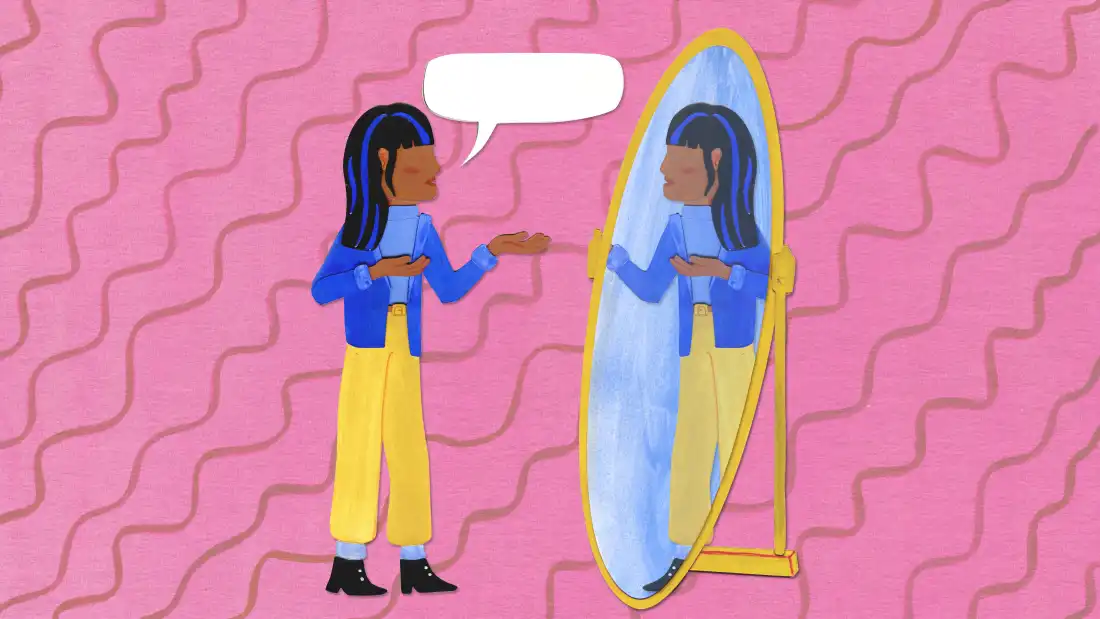
Before you open your mouth, reflect on your own motivations. Are you sharing your opinion to be kind — or just avoiding your own discomfort?
Abi Inman/NPR
hide caption
Abi Inman/NPR
Just because you don’t want to share the truth doesn’t mean the person on the receiving end shouldn’t or wouldn’t want to hear what you have to say.
A 2022 survey, for example, found that people consistently underestimate others’ desire for feedback. In the study, researchers put visible smudges of lipstick, chocolate or marker on their faces. Then, without acknowledging those smudges, they went out on the street asking random people to participate in a survey on a different topic.

Less than 3% of the survey participants spoke up, even though the smudges were something the researchers “clearly could have done something about and would have wanted to know,” says Bohns.
So, if you choose to stay silent when your new co-worker keeps mispronouncing the name of the company CEO, for example, reflect on your own motivations. “Are you being kind, or are you avoiding your own discomfort?” writes Bohns in her book. Speaking up may help your colleague in this instance.
Do they want your feedback?
Has anyone ever given you advice about a topic you knew more about than they did? Or misjudged how much you knew based on how you looked?
When in doubt, don’t assume you know what information the other person wants or needs from you. Pre-assessing how valuable the truth is to someone else, or their ability to handle it, can quickly make well-meaning feedback sound patronizing, writes Bohns in her book.
So just ask the other person if they want the feedback you have to share. “Give them the autonomy, then respect their decision, whatever it might be,” she says.
More communication skills from Life Kit
4 habits of highly effective communicators. Called ‘supercommunicators,’ these people have the exceptional ability of creating authentic connections with others — just by listening and talking.
Good conversations take time and attention. Here’s how to have better ones. Having good conversations is an art form. Former NPR host Sam Sanders tapped longtime radio host and podcaster Celeste Headlee for her tips for really listening and connecting.
4 negotiation tactics to try in everyday life. People often use negotiation tactics in business environments. But you can also use them to get your roommate to clean up, figure out where to eat for dinner or decide on which car to buy.
How to receive critical feedback. Receiving feedback doesn’t necessarily have to be terrifying, according to Shanita Williams, a feedback coach, professor and author of Feedback Mentality. In this episode, Williams and Stacy-Marie Ishmael, a writer and editor, provide five tips to make receiving feedback a little less scary.
This story was edited by Malaka Gharib. The visual editor is CJ Riculan. We’d love to hear from you. Leave us a voicemail at 202-216-9823, or email us at LifeKit@npr.org.
Listen to Life Kit on Apple Podcasts and Spotify, and sign up for our newsletter. Follow us on Instagram: @nprlifekit.
{For more tech updates, stay tuned to our blog.|Keep following us for the latest insights.|Check back often for more exciting news!}