
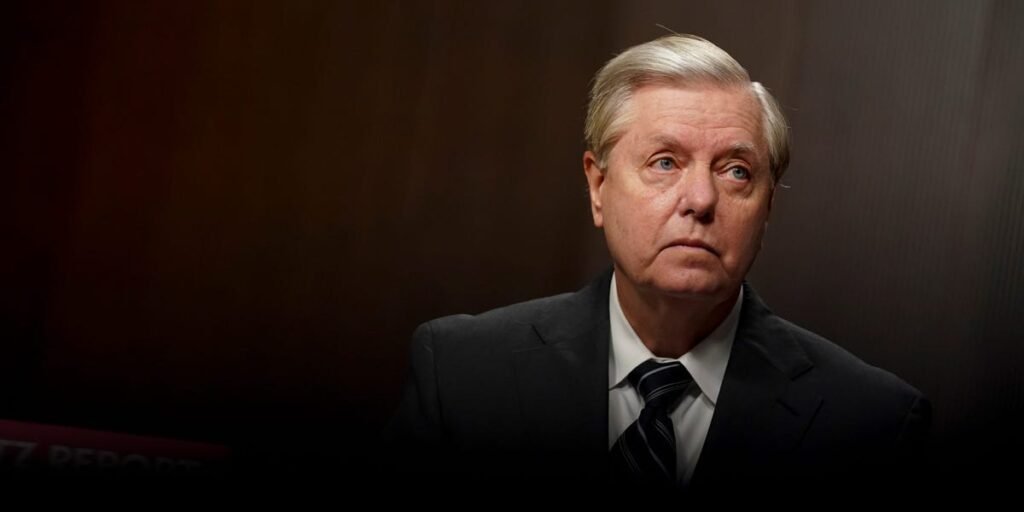
Republican lawmaker Lindsey Graham, who died Saturday at the age of 71, had a major influence on corporate tax rates, tariff policies and defense spending. Graham’s office said in a statement Sunday that the four-term senator died after a “brief and sudden” illness. Graham, an ally of President Donald Trump, had just returned from a
Republican lawmaker Lindsey Graham, who died Saturday at the age of 71, had a major influence on corporate tax rates, tariff policies and defense spending.
Graham’s office said in a statement Sunday that the four-term senator died after a “brief and sudden” illness. Graham, an ally of President Donald Trump, had just returned from a trip to kyiv, where he met with Ukrainian President Volodymyr Zelenskyy.
In his 23 years in the Senate, Graham helped shape a protectionist, national security-driven approach to trade and pro-business policies that lowered corporate tax rates. His interventionist foreign policy views also translated into support for increased defense spending. Billions of dollars in military spending ultimately flowed to his home state of South Carolina.
Here’s how the late legislator impacted American businesses and the economy.
Corporate taxes
Graham was instrumental in pushing corporate tax cuts through Congress over the past decade. He was a leading supporter of the Tax Cuts and Jobs Act of 2017, which reduced the corporate tax rate from 35% to 21%.
During Graham’s failed presidential bid in 2016, he made cutting corporate taxes a central part of his campaign. During a Republican primary debate in 2015, Graham argued that the corporate tax rate should be lowered to prevent companies from moving overseas and help create jobs for middle-class Americans.
“The best way to grow the middle class is to make it a good place to create jobs,” he said during a debate at the time.
During Trump’s second term, Graham, who chaired the Senate Budget Committee, helped clear the way in Congress for the president’s 2025 tax and spending package, known as the One Big Beautiful Bill, which made permanent many of the corporate tax cuts the two leaders spearheaded in 2017 and restored or expanded other business-friendly policies.
Nine days before his death, the senator released a statement celebrating the one-year anniversary of the permanent nature of those tax cuts.
“A year ago, President Trump signed the One Big Beautiful Bill into law, delivering the largest tax cut for working and middle-class families in American history,” Graham wrote. “As Senate Budget Chairman, I was proud to lead this effort alongside my Republican colleagues in the Senate and House of Representatives. We also eliminated taxes on tips and overtime and waived taxes on Social Security benefits for more than 35 million seniors.”
fair trade
While a broad supporter of free trade policies, Graham broke with other Republicans in his calls to use tariffs to punish countries he felt were operating unfairly.
In 2005, during his first term in the Senate, Graham called for aggressive tariffs against China for currency manipulation and intellectual property theft. Their views helped influence Trump’s own tariff policies, which became a pillar of his administration’s strategy in his second term.
Graham, like Trump, argued that tariffs should be used as leverage over other governments. Graham supported using tariffs to force countries like Mexico and Canada to increase border security, as a way to manage illegal immigration and stem the flow of fentanyl into the country.
Trump’s sweeping tariffs ultimately caused some headaches for American businesses, which struggled with supply chain uncertainties and rising prices. And the Supreme Court ruled in February that Trump’s use of the International Emergency Economic Powers Act to unilaterally impose sweeping tariffs on U.S. imports was illegal.
In response to that ruling, Graham said it was “undeniable” that the tariffs were having their intended effect.
“One of the main reasons our border is so secure is that President Trump threatened to impose tariffs on countries that allowed illegal immigrants across our southern border and held them responsible for the problem,” Graham wrote in a statement. “When it comes to finding fentanyl and other dangerous products coming into the country, President Trump has used tariffs extremely effectively.”
defense spending
Graham was one of the Senate’s staunchest advocates for increased defense spending.
After the Trump administration outlined its initial 2027 budget plans, which included a total request of $1.5 trillion for the U.S. military, the largest single-year military funding in modern U.S. history and a nearly 45% increase over the previous year, Graham called Trump “second to none” on national security.
“President Trump’s budget is truly historic when it comes to defense spending. It is the strongest increase in defense spending in many years, and it is more than justified by the threats we face around the world,” he wrote in a statement in April.
Graham’s support for robust defense spending grew out of his interventionist views on national security. He supported the Iraq war and opposed the withdrawal from Afghanistan. He supported Ukraine and called for broad sanctions and tariffs on Russia, as well as any country that buys Russian oil. He also supported military support for Israel and the continuation of the war against Iran.
His support of military spending also benefited his home state of South Carolina, which had a large military presence during Graham’s time in the Senate. In 2024, South Carolina received nearly $7 billion in military spending through items such as payroll, contracts and construction, according to the Department of Defense.
A 2022 state-commissioned study found that the military supported more than 250,000 jobs in the states and generated an annual economic impact of about $35 billion.
Federal defense dollars have supported major bases, nuclear weapons work and aviation manufacturing in South Carolina. As a member of the Senate Appropriations Committee, Graham pushed money for military and construction programs that helped secure and expand bases like Fort Jackson and Marine Corps Air Station Beaufort.
In 2023, Graham said his work to bring military spending to South Carolina “will pay dividends to our state for years to come.”