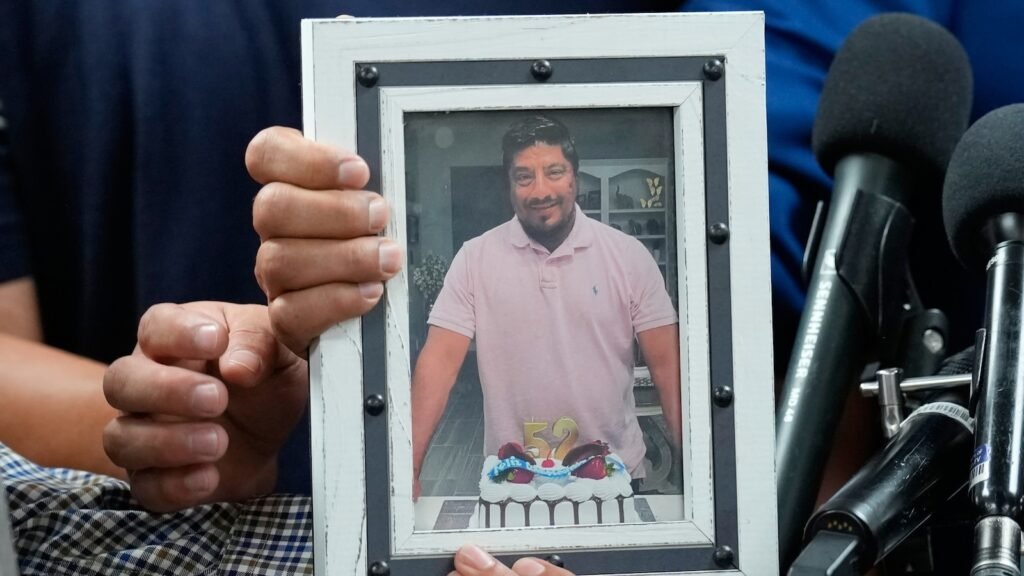
The builder would get up each morning well before dawn, leave the house to pick up his construction crew, and then head to work on another house somewhere in Houston. Fourteen hours later, Lorenzo Salgado Araujo would return to the wife he had met as a teenager in Mexico and the modest home he had
The builder would get up each morning well before dawn, leave the house to pick up his construction crew, and then head to work on another house somewhere in Houston.
Fourteen hours later, Lorenzo Salgado Araujo would return to the wife he had met as a teenager in Mexico and the modest home he had built for his family on the east side of the city.
It’s what he had done for decades, according to Ronaldo Salgado, his eldest son. He said his father built hundreds of homes over 35 years, creating a life for his family and watching his three children head to college.
On Tuesday, a U.S. Immigration and Customs Enforcement officer shot and killed Salgado Araujo, 52, after he was chased by federal agents driving unmarked vehicles while taking his team to their last duty station. The shooting has outraged Houston leaders and renewed public scrutiny of ICE and Trump’s immigration crackdown.
“This family needs answers. America needs answers,” Democratic Rep. Sylvia Garcia, whose district includes the area where the shooting occurred, said Friday. “This should not be happening on our streets or any street in this country.”
Federal agents were searching for another person when they tried to stop Salgado Araujo’s white van, Garcia said, citing a report he received from the acting director of ICE. The Department of Homeland Security has said that an ICE officer shot at the van in self-defense after Salgado Araujo, whom officials described as an “illegal alien,” rammed an ICE vehicle. They have not provided evidence.
The three men Salgado Araujo was driving said he was shot through the passenger window and that the ICE officer who shot him was not in front of the van or even in danger, said an attorney who spoke with them Friday.
His family has also questioned ICE’s version. They said lawyers who were helping him apply for a work permit had explained to him how he should behave if immigration agents stopped him. Salgado Araujo was close to obtaining legal status when he was killed, they said.
“He knew what to do,” Ronaldo Salgado told reporters this week. “He knew not to sign anything. He knew the first phone call he should make should be to me or my mom. That way we can start the process to get him out.”
He believes his father may have been afraid that unmarked vehicles were following him, worried that someone was planning to steal his truck or his tools.
The shooting in the predominantly Hispanic neighborhood is at least the eighth death during the Trump administration’s immigration enforcement campaign.
Salgado Araujo entered the United States more than 30 years ago, settling in Houston with his wife where they raised their three children.
Education was a constant focus in the house, said Ronaldo Salgado, who is now a teacher. One of his brothers is an engineer. The other is in college studying engineering.
Several of Salgado’s childhood friends recalled that his father was kind and soft-spoken, always asking about his wife’s day and how his children’s friends were doing after a long day of work.
“We didn’t really see him until the end of the day when he came home for dinner, but that shows how hard of a worker he was,” said neighbor Jessica Alanis Magdaleno. “Everything they have now is thanks to the dedication to that.”
Josué Flores, a friend of Ronaldo Salgado since his first year of high school, said he first saw Lorenzo Salgado Araujo at his son’s soccer game.
“I think it says a lot about the type of person he was,” Flores said, recalling how Salgado Araujo showed up for his son even after a hard day of work.
Salgado Araujo’s wife, a relative said, is “inconsolable.”
“She is very upset… angry, sad, disoriented,” José Torres Ramón, a nephew who lives in Mexico, told The Associated Press in a Facebook message.
After returning home at night, Salgado Araujo liked to listen to music on the porch and pet the family dog. His family has described him as a simple and routine man.
“He didn’t deserve to die,” Ronaldo Salgado said. “He dedicated his life in the United States to giving his family the American dream.”
___
Associated Press reporters Jack Brook in New Orleans and Valerie Gonzalez in McAllen, Texas, contributed.
Keep following us for the latest insights.