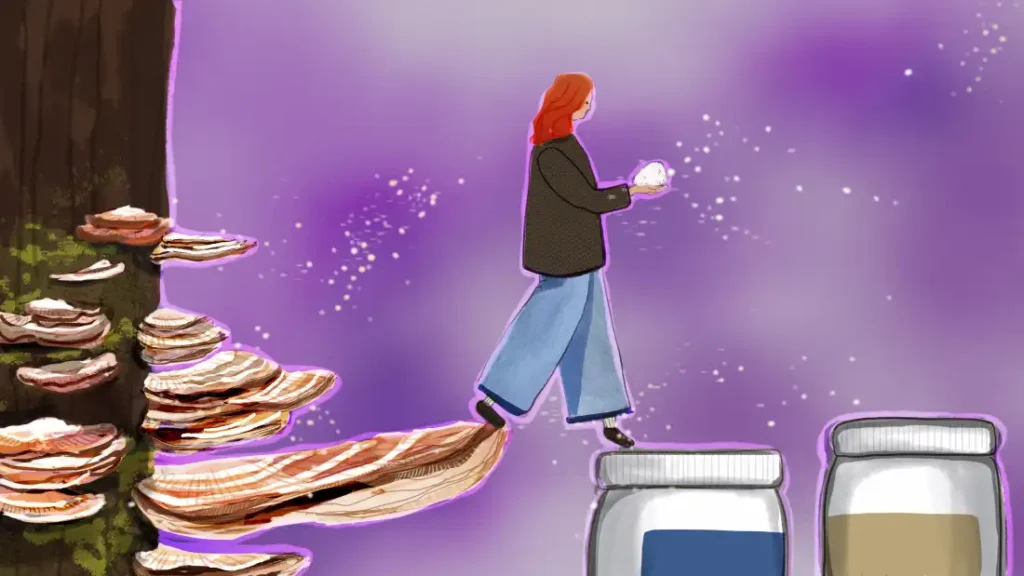
Growing up in the French Alps, Julie Daoust fell for mushrooms early in life. “So as a kid, we’d go out and forage,” she recalls. “We’d come across species like lion’s mane or reishi. And I became more and more interested in those species.” Daoust went on to get a Ph.D. in chemistry, searching nature
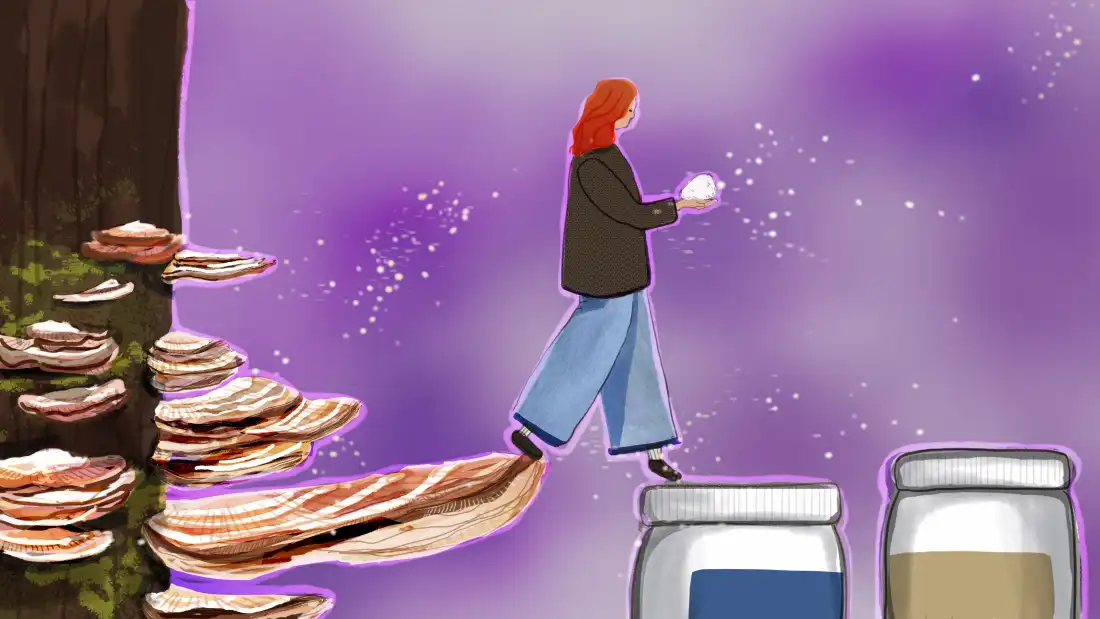
Growing up in the French Alps, Julie Daoust fell for mushrooms early in life.
“So as a kid, we’d go out and forage,” she recalls. “We’d come across species like lion’s mane or reishi. And I became more and more interested in those species.”
Daoust went on to get a Ph.D. in chemistry, searching nature for novel pharmaceuticals. Her work ultimately led her back to mushrooms, a group of organisms to which humans are more closely related than plants. And yet, many of our modern medicines and therapeutics come from plants.
“Mushrooms share a lot more in terms of their biochemistry with us than plants do,” says Daoust, which means “you have more chances of finding something that’s going to have bioactivity in a human than you would with other source organisms.”
Daoust is now vice president of science and innovation at Monterey Nutra, a company that specializes in the genetics and cultivation of mushrooms and sells fungal extracts and powders. Her team focuses not on the poisonous varieties, nor the psychedelic ones that contain psilocybin. Rather, they are interested in the functional or medicinal mushrooms that Daoust likens to tiny cauldrons of potentially useful molecules.
“We love to look for soft things that can’t run away very fast,” says Daoust, “because they typically produce really interesting chemistry to defend themselves or to communicate with others in their environment to survive.”
The claim
Daoust says that certain types of fungi may have specific uses.
For instance, lion’s mane — a soft chandelier of a fungus — may aid cognition. Reishi and turkey tail, which are mushrooms that grow as hard brown scales on decomposing trees, could bolster immune health.
And on social media, influencers and advertisers promise that medicinal mushrooms, taken as supplements, can slow aging and improve energy levels, focus and immune health.
The evidence
Robust clinical trials proving such connections — and their safety — are largely lacking, according to Abby Langer, a registered dietitian based in Toronto. “In my opinion, I don’t think that there’s much evidence for functional mushrooms as of now,” she says.
Langer says mushrooms accumulate and concentrate the materials in the ground they’re grown in, both good and bad — so one has to be cautious.
Want the latest stories on the science of healthy living? Subscribe to NPR’s Health newsletter.
She grants that in certain communities (in parts of Asia, for instance), mushrooms have been incorporated into their healing practices for generations. However, “just because something has been used for a long time doesn’t mean that it’s safe, that it’s effective, that the dosing has been established,” Langer says. “There are a lot of unknowns.”
Still, she acknowledges that empirical support for the potential positive impacts of mushrooms is growing. “The clinical research on specific functional mushroom products is young,” she says, “but it’s accumulating fast and already includes some impressive results.”

Mushrooms are a good source of vitamin D2 and antioxidants. Their cell walls contain beta-glucan, which has been linked to gut health, including a lower risk of Crohn’s Disease, and immune response. Research into the effects of mushrooms on cognition have been mixed.
In addition, there’s work out of Japan looking at how PSK, a purified extract from turkey tail, improved immune response in cancer patients. A meta-analysis considered 8,009 patients in eight randomized controlled trials who had undergone surgical removal of a gastric tumor and in almost all cases chemotherapy. Those who were also given PSK showed a 12% reduction in risk of death.
“This is not something that we brush off,” says Santhosshi Narayanan, an integrative oncologist based at the University of Texas MD Anderson Cancer Center who recognizes the potential of PSK.
Even so, she admits that this “does not mean that PSK or any mushrooms alone cures cancer. It just shows to us that we need to pay attention to these natural products.” Narayanan says there’s still a lot to figure out with this particular extract, especially for populations outside Japan with different genetics or treatment regimes who might experience unwanted side effects.
“We need to do more research and understand how we can use it,” she says. “Like which people, which type of patients benefit from which type of mushroom — because that itself is a whole science.”
Narayanan and her colleagues also surveyed 2,349 studies examining the relationship between medicinal mushrooms and cancer, but only 39 were robust enough to be included in their 2023 analysis. Of that subset, “31 studies showed beneficial effects of the mushrooms, resulting in improved quality of life, reduced [side effect] profiles of different chemotherapeutic drugs, improved anti-inflammatory and anti-metastatic effects, and improved [disease-free survival] as well as [overall survival] in a few trials,” according to the report.
Six studies didn’t reveal any advantage and two highlighted worse outcomes. Overall, the analysis was unable to make clear conclusions about “the complex biological effects of mushrooms on the immune system in cancer.”
The bottom line
In Narayanan’s estimation, there’s not yet enough evidence to support routine clinical use in cancer treatment.
And Langer recommends considering a few nutrition basics before introducing a supplement for gut health or cognition. “Take a closer look at what you’re eating, how you’re eating, when you’re eating,” she advises, “and see if there’s any tweaks that you need to make.”

Maybe it’s possible to eat more fiber or protein, reduce consumption of alcohol or sugar-sweetened beverages, skip fewer meals, or eat out less often, she says.
“There’s so many things that people can potentially improve on,” Langer says, “before adding something else that’s promised to be this panacea for everything that ails you.”
{For more tech updates, stay tuned to our blog.|Keep following us for the latest insights.|Check back often for more exciting news!}