
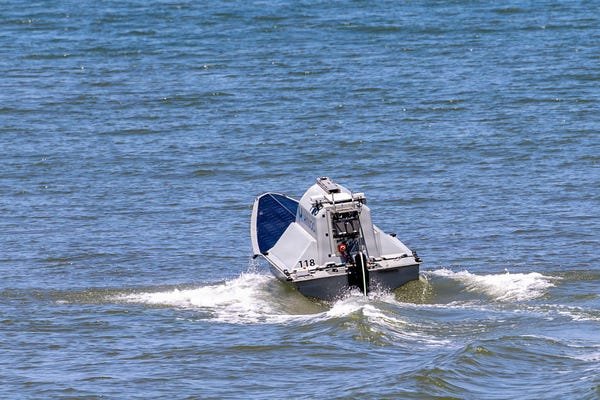
Nearly all of the Pentagon’s drone programs will now exist under a single office, giving its officials greater power over the future of unmanned systems in the U.S. military. Consolidation will accelerate the acquisition and deployment of drones, US Defense Secretary Pete Hegseth said in a memo, a top priority of the second Trump administration
Nearly all of the Pentagon’s drone programs will now exist under a single office, giving its officials greater power over the future of unmanned systems in the U.S. military.
Consolidation will accelerate the acquisition and deployment of drones, US Defense Secretary Pete Hegseth said in a memo, a top priority of the second Trump administration as it seeks to prepare forces for drone warfare.
According to a memo from earlier this week, the new office, called Direct Report Portfolio Manager for Unmanned Systems, will be “the sole joint integrator for all unmanned and autonomous systems programs” across the U.S. Department of Defense. The director of DRPM-UxS has not yet been named, but will report to Stephen Feinberg, U.S. deputy secretary of defense.
In addition to Feinberg and Hegseth, the office will have control over a wide range of unmanned systems, including small, surface vessels or drones, underwater vessels in coordination with the Department of Defense’s submarine office, ground robots, autonomous and artificial intelligence systems, drone swarm technology and counter-drone systems. DRPM-UxS will also oversee the drone markets that some Department of Defense offices have recently established.
With its oversight of so many programs, DRPM-UxS can decide which drones to advance, prioritize certain capabilities or contracts over others, and stop working on specific systems.

Only a few programs are exceptions to the authority of the DRPM-UxS. US Army photo by Pfc. Jose Nunez
While the organizational change gives DRPM-UxS greater authority over the future of unmanned systems in the U.S. military, there are some gaps. Major weapons programs that are already following a separate acquisition process, such as the US Air Force’s Collaborative Fighter Aircraft program, will remain in the services.
DRPM-UxS will also be in charge of the U.S. Interagency Joint Task Force 401, a military and federal government effort to counter small drones, as well as the Defense Autonomous Warfare Group, the Defense Department’s office for mass production of autonomous drones across the military.
The new office is the latest milestone in the United States’ broader push to integrate drone technologies into its military forces. It includes what Pentagon officials have called an unprecedented $74 billion budget request for drones and counter-drone systems, as well as massive investments to acquire, test and deploy small, cheap one-way attack drones.
“Adversaries collectively produce millions of unmanned systems each year across all domains,” Hegseth said in the memo. “While global production of unmanned military systems has skyrocketed over the past three years, the United States has been slow to deploy these capabilities at scale. Drones and autonomous systems are the most important battlefield innovation of this generation.”